NYT
France, the Crucible of  Europe

January 10, 2015

By:   Ross Douthat


THE France that endured a vicious terrorist attack last week is a France
that has suffered, for decades and centuries, from anxieties about its own
decline. And for good reason: Since the 18th century, when it bestrode Europe
 and seemed poised to dominate the globe, France has seen its relative
power  diminish, suffering defeats and humiliations at the hands of rival
forces, from  Britain’s navies to Germany’s jackboots to the invading might of
American  popular culture.

Now these  longstanding anxieties have been thrown into relief by the
murderous attack on  the satirical magazine Charlie Hebdo, an attack linked to
all the various  specters haunting contemporary France: fears of creeping
Islamification and  rising anti-Semitism, fears of the far right’s growing
power
and anti-Muslim  backlash — and all of it bound up in a larger sense, amid
economic stagnation,  of betrayal at the hands of the Continent’s  elite
But  notwithstanding these declinist fears, France isn’t actually
irrelevant or  spent. Instead, it’s arguably becoming more important, more
central to
the fate  of Europe and the West.
No, the age  of the Sun King isn’t about to return. But politically,
culturally, even  intellectually, events in France over the next half-century
could matter more  than at any point since before the two world wars. Indeed,
more than Germany or  Greece or Britain or any other actor, it’s in France
that the fate of  21st-century Europe could ultimately be decided.
Consider  the specific issue at the heart of the Hebdo nightmare: the
question of whether  European nation-states can successfully integrate Muslim
immigrants, and what  will happen if they don’t.
Here France looks like the crucial test case. It has the  largest Muslim
population of any major European country, and parts of that  population are
more assimilated and others far more radicalized (16 percent of  French
citizens expressed _support  for the Islamic State_
(http://www.newsweek.com/16-french-citizens-support-isis-poll-finds-266795)  in
a poll last summer) than
elsewhere on the  Continent.
Not  surprisingly, the response to Islam is divided as well: Muslims are
regarded _more  favorably in France_
(http://www.pewglobal.org/2014/05/12/chapter-4-views-of-roma-muslims-jews/)
than elsewhere in Western Europe, and
yet French  politics features an increasingly potent far-right party, Marine
Le Pen’s  National Front, whose electoral clout is now likely to increase.
Meanwhile,  France’s foreign policy has distinctive (often military)
entanglements across  Northern Africa and the Levant, which means the ripples
from
French domestic  politics have more room to spread and then return.

So if there’s a path to greater Muslim assimilation and  inclusion, it’s
more likely to be pioneered in France. If Islamic radicalism is  going to
gain ground or mutate into something more pervasive and dangerous, it’s  also
more likely to happen in France’s sphere of influence than elsewhere. And  if
Europe’s much-feared far right is going to complete its journey from the
fringe to the mainstream, it will probably happen first in Paris.

French politics is likewise central to the fate of the  wider European
Union project, which is in crisis at the moment because of the  gulf between
Germany’s interests and the interests of the E.U. periphery, Greece  and Italy
and Spain. But that gulf (and the weight of 20th-century history)  means
that the Germans, however economically dominant, cannot hold the union
together on their own. Instead it’s France, for reasons of _history and
culture_
(http://foreignpolicy.com/2012/03/05/the-return-of-the-king/)  as well as
geography, that has to bridge the divide between Europe’s  north and south and
make the E.U. work politically. Unless, of course, the  French gradually and
fatefully choose not to, in which case the entire project  will fall apart
or be completely reconceived.


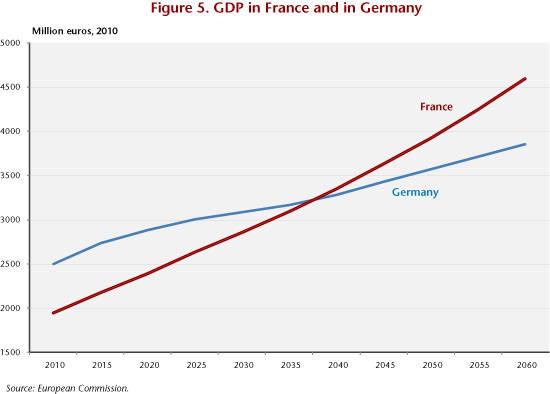
Either way, France’s star may rise as Germany’s descends. Demography, the
source of so much Gallic anxiety in the past, suddenly has turned in
France’s favor: The Germans are rich but aging, whereas even amid economic
drift
 the French birthrate has risen sharply (suggesting a certain optimism amid
the  ennui). By the 2050s, under some scenarios, France could once again
have the _larger  economy_
(http://www.ofce.sciences-po.fr/blog/wp-content/uploads/2012/10/G5anglais_Blog27-09.jpg)
  and _population_
(http://www.telegraph.co.uk/news/worldnews/europe/france/1489945/France-will-have-biggest-EU-popu
lation-by-2050.html)   — making it either dominant in a more integrated
Europe, or the most important  power on a continent more divided than today.

Then amid these political and economic patterns there’s  an important
intellectual possibility — namely, that if there’s something beyond  the West’s
current end-of-history torpor, some new ideological conflict or  synthesis,
it might emerge first in the place where so many revolutions had  their
birth.
France has  always been a country of extremes — absolutist and republican,
Catholic and anticlerical, Communist and fascist. Now it’s once again the
place  where strong forces are colliding, and where the culture’s
uncertainties — about  Islam, secularism, nationalism, Europe; about _modernity

itself_
(http://www.theparisreview.org/blog/2015/01/02/scare-tactics-michel-houellebecq-on-his-new-book/)
  — suggest that new ones might soon be born.
The decline  has been real, but the future is unwritten. If there is real
history yet to be  made in Europe, for good or ill, it might be made first in
la belle  France.

--
--
Centroids: The Center of the Radical Centrist Community
<[email protected]>
Google Group: http://groups.google.com/group/RadicalCentrism
Radical Centrism website and blog: http://RadicalCentrism.org

---
You received this message because you are subscribed to the Google Groups
"Centroids: The Center of the Radical Centrist Community" group.
To unsubscribe from this group and stop receiving emails from it, send an email
to [email protected].
For more options, visit https://groups.google.com/d/optout.