Kids as Young as 4 Find Safe Space at Transgender Day Camp
by ASSOCIATED  PRESS
EL CERRITO, Calif. — In some ways, Rainbow Day Camp is  very ordinary. Kids
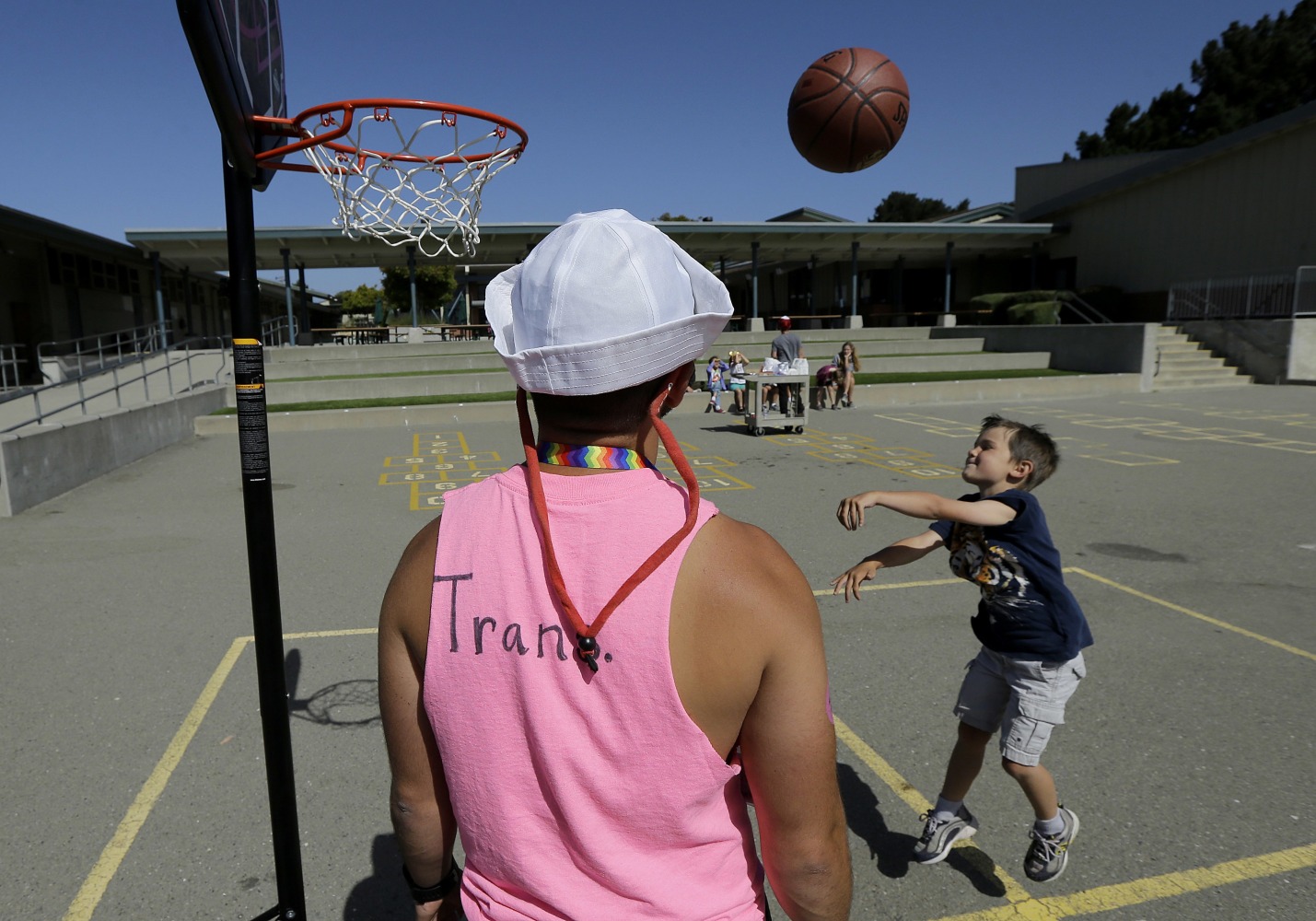
arrive with a packed lunch, make friendship bracelets, play  basketball,
sing songs and get silly. But it is also extraordinarily unique,  from the
moment campers arrive each morning.
At check-in each day, campers make a nametag with their  pronoun of choice.
Some opt for "she" or "he." Or a combination of "she/he." Or  "they," or no
pronoun at all. Some change their name or pronouns daily, to see  what
feels right.

The camp in the San Francisco Bay Area city of El  Cerrito caters to
transgender and "gender fluid" children, ages 4 to 12, making  it one of the
only
camps of its kind in the world open to preschoolers, experts  say.
Enrollment has tripled to about 60 young campers since it opened three  summers
ago,
with kids coming from as far as Los Angeles, Washington, D.C. --  even
Africa. Plans are underway to open a branch next summer in Colorado, and  the
camp has been contacted by parents and organizations in Atlanta, Seattle,
Louisiana and elsewhere interested in setting up similar programs.
On a sunny July morning at camp, the theme was "Crazy  Hair Day," and
6-year-old Gracie Maxwell was dancing in the sunshine as a Miley  Cyrus song
blasted from outdoor speakers. The freckled, blue-eyed blonde wore  her hair in
a braid on one side, a pigtail on the other and snacked on cereal as  she
twirled and skipped.

"Once she could talk, I don't remember a time when she  didn't say, 'I'm a
girl,'" said her mother, Molly Maxwell, who still trips over  pronouns but
tries to stick to "she."
"Then it grew in intensity: 'I'm a sister. I'm a  daughter. I'm a
princess,'" Maxwell said. "We would argue with her. She was  confused. We were
confused."

Living in the liberal-minded Bay Area made it easier.  The Maxwells found a
transgender play group, sought specialists, and at 4 years  old, let Gracie
grow her hair, dress as a girl and eventually change her  name.

"I see her now, compared to before. I watch her strut  around and dance and
sing and the way she talks about herself. If she was forced  to be someone
else," the mother trails off. "I don't even want to think about  that."

Gender specialists say the camp's growth reflects what  they are seeing in
gender clinics nationwide: increasing numbers of children  coming out as
transgender at young ages. They credit the rise to greater  openness and
awareness of LGBTQ issues and parents tuning in earlier when a  child shows
signs
of gender dysphoria, or distress about their gender.
"A decade ago, this camp wouldn't have existed.  Eventually, I do believe,
it won't be so innovative," camp founder Sandra  Collins said. "I didn't
know you could be transgender at a very young age. But  my daughter knew for
sure at 2."

Collins' experience as the mother of a transgender girl,  now 9, inspired
her to start the camp, and another for 13- to 17-year-olds  called Camp
Kickin' It.

"A lot of these kids have been bullied and had trauma at  school. This is a
world where none of that exists, and they're in the majority,"  Collins
said. "That's a new experience for kids who are used to hiding and  feeling
small."

Fourth grader Scarlett Reinhold, Collins' daughter who  was assigned male
at birth, says at camp she can be herself. "I feel comfortable  for being who
I am and who I want to be," says Scarlett, a confident 9-year-old  in a
frilly skirt who wears her dark hair long and wavy.

There is little comprehensive data on young children who  identify as
transgender, but experts say as the number of young people coming to  their
clinics increases, the prevailing medical guidance has shifted.

The favored protocol today is known as the "gender  affirmative" approach,
which focuses on identifying and helping transgender  children to "socially
transition" -- to live as the gender they identify with  rather than the one
they were born with until they're old enough to decide on  medical options
like puberty blockers and later, hormone treatments.

The Center for Transyouth Health and Development at  Children's Hospital in
Los Angeles, started a decade ago with about 40 patients,  now has over 900
people, ages 3 to 25, enrolled in its program, with 150 on its  waiting
list, said Johanna Olson-Kennedy, the clinic's medical director.

"I just think there's a lot more openness to the  understanding that trans
adults start as trans kids," Olson-Kennedy said. "When  people say, 'Isn't
this too young?' my question back to them is, 'Too young for  what? How young
do people know their gender?' The answer to that is some people  know it at
3, and some people know it at 30."
Diane Ehrensaft, director of mental health at the  University of
California, San Francisco's Child and Adolescent Gender Center,  says
enrollment there
has tripled over the past few years with a "sea change -  maybe we can even
call it a tsunami - in the number of little kids showing up  with their
families."

She fields a growing number of calls from families  overseas, including
South Africa, Ethiopia, Hong Kong, Belgium, England and  other countries that
lack resources.
Studies show transgender adults have higher rates of  suicide and
depression than the general population. A 2016 study by the  University of
Washington's TransYouth Project, published in the journal  Pediatrics, found
trans
children who live as their preferred gender and are  supported by their parents
have the same mental health outcomes as other kids  their age.

At Rainbow Day Camp, a therapist is on hand to talk if  kids want. Therapy
sessions are extended to parents at a support group after  morning drop-off.
Many counselors are transgender, which offers campers upbeat  role models.


(https://media4.s-nbcnews.com/j/newscms/2017_32/2097321/trans_day_camp_5_5e488cfd663ee488aa80c8aeed9af340.nbcnews-ux-2880-1000.jpg)

"I want to show these kids what a confident, happy,  successful trans
person looks like," said camp director Andrew Kramer, 30, who  goes by AK and
came out as a transgender man at 26. "We teach them they are  normal, deserving
of love, and not alone."

One family traveled from Africa to enroll their son in  the camp for its
full three-week summer session. The 9-year-old goes by the name  Nao at
Rainbow but has not publicly come out as a transgender girl. The family  asked
that their last name and the country where they live be kept confidential,
fearing repercussions there.
Nao's mother, Miriam, said she watched her child blossom  at camp. Nao was
happier and less prone to outbursts, made friends, opened up  about school
bullying, and wants to return next summer.
"I think for the first time, (Nao) feels like just a  normal kid," Miriam
said.
Before flying home, she said, Nao wrote a note to the  camp's counselors.
It read: "Thank you, for making me feel so  happy."


Paul Cameron, Ph.D.
Chairman, Family Research Institute
POB  62640
Colorado Springs, CO 80962
303 681 3113
www.familyresearchinst.org


--
--
Centroids: The Center of the Radical Centrist Community
<[email protected]>
Google Group: http://groups.google.com/group/RadicalCentrism
Radical Centrism website and blog: http://RadicalCentrism.org

---
You received this message because you are subscribed to the Google Groups
"Centroids: The Center of the Radical Centrist Community" group.
To unsubscribe from this group and stop receiving emails from it, send an email
to [email protected].
For more options, visit https://groups.google.com/d/optout.