Barlaam and Josaphat
>From Wikipedia, the free encyclopedia
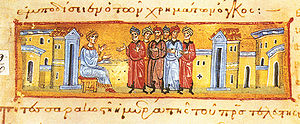
[https://upload.wikimedia.org/wikipedia/commons/thumb/3/3a/Josaphat.jpg/300px-Josaphat.jpg]<https://en.wikipedia.org/wiki/File:Josaphat.jpg>
A Christian depiction of Josaphat, 12th Century manuscript
Barlaam and Josaphat (Latin<https://en.wikipedia.org/wiki/Latin_language>:
Barlamus et Iosaphatus) are legendary Christian martyrs and saints. Their life
story may have been based on the life of the Gautama
Buddha<https://en.wikipedia.org/wiki/Gautama_Buddha>.[1]<https://en.wikipedia.org/wiki/Barlaam_and_Josaphat#cite_note-1>
 It tells how an Indian king persecuted the Christian Church in his realm. When
astrologers predicted that his own son would some day become a Christian, the
king imprisoned the young prince Josaphat, who nevertheless met the hermit
Saint Barlaam and converted to Christianity. After much tribulation the young
prince's father accepted the Christian faith, turned over his throne to
Josaphat, and retired to the desert to become a hermit. Josaphat himself later
abdicated and went into seclusion with his old teacher
Barlaam.[2]<https://en.wikipedia.org/wiki/Barlaam_and_Josaphat#cite_note-catholic-forum.com-2>
 The tale derives from a second to fourth century
Sanskrit<https://en.wikipedia.org/wiki/Sanskrit>
Mahayana<https://en.wikipedia.org/wiki/Mahayana>
Buddhist<https://en.wikipedia.org/wiki/Buddhist> text, via a
Manichaean<https://en.wikipedia.org/wiki/Manichaean> version, then the
Arabic<https://en.wikipedia.org/wiki/Arabic_language> Kitab Bilawhar wa-Yudasaf
(Book of Bilawhar and Yudasaf), current in
Baghdad<https://en.wikipedia.org/wiki/Baghdad> in the eighth century, from
where it entered into Middle Eastern Christian circles before appearing in
European versions. The two were entered in the Eastern
Orthodox<https://en.wikipedia.org/wiki/Eastern_Orthodox> calendar with a
feast-day on 26
August<https://en.wikipedia.org/wiki/August_26_(Eastern_Orthodox_liturgics)>,[3]<https://en.wikipedia.org/wiki/Barlaam_and_Josaphat#cite_note-SYNAXARISTES-3>
 and in the Roman Martyrology<https://en.wikipedia.org/wiki/Roman_Martyrology>
in the Western Church as "Barlaam and Josaphat" on the date of 27
November.[4]<https://en.wikipedia.org/wiki/Barlaam_and_Josaphat#cite_note-Macdonell1900-4>

Background: the Buddha
[https://upload.wikimedia.org/wikipedia/commons/thumb/c/c5/Battistero_di_parma%2C_portale_sud_03_leggenda_di_barlaam.JPG/220px-Battistero_di_parma%2C_portale_sud_03_leggenda_di_barlaam.JPG]<https://en.wikipedia.org/wiki/File:Battistero_di_parma,_portale_sud_03_leggenda_di_barlaam.JPG>
Depiction of Barlaam and Josaphat at the Baptistery of
Parma<https://en.wikipedia.org/wiki/Baptistery_of_Parma>, Italy


The story of Barlaam and Josaphat or Joasaph is a
Christianized<https://en.wikipedia.org/wiki/Christianity> and later version of
the story of Siddhartha
Gautama<https://en.wikipedia.org/wiki/Siddhartha_Gautama>, who became the
Buddha<https://en.wikipedia.org/wiki/Buddhahood>.[5]<https://en.wikipedia.org/wiki/Barlaam_and_Josaphat#cite_note-CatholicEncyclopedia-5>
 In the Middle Ages the two were treated as Christian saints, being entered in
the Greek Orthodox<https://en.wikipedia.org/wiki/Greek_Orthodox> calendar on 26
August<https://en.wikipedia.org/wiki/August_26_(Eastern_Orthodox_liturgics)>,[3]<https://en.wikipedia.org/wiki/Barlaam_and_Josaphat#cite_note-SYNAXARISTES-3>
 and in the Roman Martyrology<https://en.wikipedia.org/wiki/Roman_Martyrology>
in the Western Church as "Barlaam and Josaphat" on the date of 27
November.[4]<https://en.wikipedia.org/wiki/Barlaam_and_Josaphat#cite_note-Macdonell1900-4>
 In the Slavic tradition of the Eastern Orthodox Church, these two are
commemorated on 19
November<https://en.wikipedia.org/wiki/November_19_(Eastern_Orthodox_liturgics)>
 (corresponding to 2 December on the Gregorian
calendar).[6]<https://en.wikipedia.org/wiki/Barlaam_and_Josaphat#cite_note-PRAVOSLAVIE-6>[7]<https://en.wikipedia.org/wiki/Barlaam_and_Josaphat#cite_note-OCA-7>


<https://en.wikipedia.org/wiki/Barlaam_and_Josaphat#cite_note-OCA-7>

The first Christianized adaptation was the
Georgian<https://en.wikipedia.org/wiki/Georgian_language> epic Balavariani
dating back to the 10th century. A Georgian monk, Euthymius of
Athos<https://en.wikipedia.org/wiki/Euthymius_of_Athos>, translated the story
into Greek<https://en.wikipedia.org/wiki/Greek_language>, some time before he
was killed while visiting
Constantinople<https://en.wikipedia.org/wiki/Constantinople> in 1028[citation
needed<https://en.wikipedia.org/wiki/Wikipedia:Citation_needed>]. There the
Greek adaptation was translated into
Latin<https://en.wikipedia.org/wiki/Latin_language> in 1048 and soon became
well known in Western Europe as Barlaam and
Josaphat.[8]<https://en.wikipedia.org/wiki/Barlaam_and_Josaphat#cite_note-8>
The Greek legend of "Barlaam and Ioasaph" is sometimes attributed to the 7th
century John of Damascus<https://en.wikipedia.org/wiki/John_of_Damascus>, but
Conybeare argued it was transcribed by the
Georgian<https://en.wikipedia.org/wiki/Georgia_(country)> monk
Euthymius<https://en.wikipedia.org/wiki/Euthymius_of_Athos> in the 11th
century.[9]<https://en.wikipedia.org/wiki/Barlaam_and_Josaphat#cite_note-9>


<https://en.wikipedia.org/wiki/Barlaam_and_Josaphat#cite_note-9>

The story of Barlaam and Josaphat was popular in the Middle
Ages<https://en.wikipedia.org/wiki/Middle_Ages>, appearing in such works as the
Golden Legend<https://en.wikipedia.org/wiki/Golden_Legend>, and a scene there
involving three caskets eventually appeared, via
Caxton<https://en.wikipedia.org/wiki/William_Caxton>'s English translation of a
Latin version, in Shakespeare<https://en.wikipedia.org/wiki/Shakespeare>'s "The
Merchant of
Venice<https://en.wikipedia.org/wiki/The_Merchant_of_Venice>".[10]<https://en.wikipedia.org/wiki/Barlaam_and_Josaphat#cite_note-10>


<https://en.wikipedia.org/wiki/Barlaam_and_Josaphat#cite_note-10>

Two Middle High German<https://en.wikipedia.org/wiki/Middle_High_German>
versions were produced: one, the "Laubacher Barlaam", by Bishop Otto II of
Freising<https://en.wikipedia.org/wiki/Otto_II_of_Freising> and another,
Barlaam und Josaphat, a
romance<https://en.wikipedia.org/wiki/Chivalric_romance> in verse, by Rudolf
von Ems<https://en.wikipedia.org/wiki/Rudolf_von_Ems>. The latter was described
as "perhaps the flower of religious literary creativity in the German Middle
Ages" by Heinrich
Heine<https://en.wikipedia.org/wiki/Heinrich_Heine>.[11]<https://en.wikipedia.org/wiki/Barlaam_and_Josaphat#cite_note-11>


<https://en.wikipedia.org/wiki/Barlaam_and_Josaphat#cite_note-11>

The story of Josaphat was re-told as an exploration of free
will<https://en.wikipedia.org/wiki/Free_will> and the seeking of inner peace
through meditation<https://en.wikipedia.org/wiki/Meditation> in the 17th
century.
<https://en.wikipedia.org/wiki/Wikipedia:Citation_needed>


The legend

According to the legend, King Abenner or Avenier in India persecuted the
Christian Church in his realm, founded
by<https://en.wikipedia.org/wiki/St._Thomas_Christians> the Apostle
Thomas<https://en.wikipedia.org/wiki/Apostle_Thomas>. When astrologers
predicted that his own son would some day become a Christian, Abenner had the
young prince Josaphat isolated from external contact. Despite the imprisonment,
Josaphat met the hermit Saint Barlaam and converted to Christianity. Josaphat
kept his faith even in the face of his father's anger and persuasion.
Eventually Abenner converted, turned over his throne to Josaphat, and retired
to the desert to become a hermit. Josaphat himself later abdicated and went
into seclusion with his old teacher
Barlaam.[2]<https://en.wikipedia.org/wiki/Barlaam_and_Josaphat#cite_note-catholic-forum.com-2>

Name

Ioasaph (Georgian Iodasaph, Arabic Yūdhasaf or Būdhasaf) is derived from the
Sanskrit
Bodhisattva<https://en.wikipedia.org/wiki/Bodhisattva>.[4]<https://en.wikipedia.org/wiki/Barlaam_and_Josaphat#cite_note-Macdonell1900-4>[5]<https://en.wikipedia.org/wiki/Barlaam_and_Josaphat#cite_note-CatholicEncyclopedia-5>[12]<https://en.wikipedia.org/wiki/Barlaam_and_Josaphat#cite_note-12>
 The Sanskrit word was changed to Bodisav in Persian texts in the 6th or 7th
century, then to Budhasaf or Yudasaf in an 8th-century Arabic document
(possibly Arabic initial "b" ﺑ changed to "y" ﻳ by duplication of a
dot<https://en.wikipedia.org/wiki/Arabic_alphabet> in
handwriting).[13]<https://en.wikipedia.org/wiki/Barlaam_and_Josaphat#cite_note-13>
 This became Iodasaph in
Georgia<https://en.wikipedia.org/wiki/Georgia_(country)> in the 10th century,
and that name was adapted as Ioasaph in Greece in the 11th century, and then
was assimilated to Iosaphat/Josaphat<https://en.wikipedia.org/wiki/Jehoshaphat>
in
Latin.[14]<https://en.wikipedia.org/wiki/Barlaam_and_Josaphat#cite_note-D.M._Lang_1957-14>

Feast day

Although Barlaam and Josaphat were never formally
canonized<https://en.wikipedia.org/wiki/Canonized>, they were included in
earlier editions of the Roman Martyrology (feast day 27
November)[15]<https://en.wikipedia.org/wiki/Barlaam_and_Josaphat#cite_note-15>
— though not in the Roman Missal<https://en.wikipedia.org/wiki/Roman_Missal> —
and in the Eastern Orthodox
Church<https://en.wikipedia.org/wiki/Eastern_Orthodox_Church> liturgical
calendar (26 August in Greek tradition
etc.[3]<https://en.wikipedia.org/wiki/Barlaam_and_Josaphat#cite_note-SYNAXARISTES-3>
 / 19 November in Russian
tradition).[6]<https://en.wikipedia.org/wiki/Barlaam_and_Josaphat#cite_note-PRAVOSLAVIE-6>[7]<https://en.wikipedia.org/wiki/Barlaam_and_Josaphat#cite_note-OCA-7>

Texts
[https://upload.wikimedia.org/wikipedia/commons/thumb/6/61/Barlaam_and_Josaphat._English_lives_of_Buddha.djvu/page9-180px-Barlaam_and_Josaphat._English_lives_of_Buddha.djvu.jpg]<https://en.wikipedia.org/w/index.php?title=File:Barlaam_and_Josaphat._English_lives_of_Buddha.djvu&page=9>
A page from the 1896 edition by Joseph Jacobs at the University of Toronto


There are a large number of different books in various languages, all dealing
with the lives of Saints Barlaam and Josaphat in
India<https://en.wikipedia.org/wiki/India>. In this hagiographic tradition, the
life and teachings of Josaphat have many parallels with those of the
Buddha<https://en.wikipedia.org/wiki/Gautama_Buddha>. "But not till the
mid-nineteenth century was it recognised that, in Josaphat, the Buddha had been
venerated as a Christian saint for about a thousand
years."[16]<https://en.wikipedia.org/wiki/Barlaam_and_Josaphat#cite_note-16>
The authorship of the work is disputed. The origins of the story seem to be a
Central Asian manuscript written in the
Manichaean<https://en.wikipedia.org/wiki/Manichaean> tradition. This book was
translated into Georgian<https://en.wikipedia.org/wiki/Georgian_language> and
Arabic<https://en.wikipedia.org/wiki/Arabic>.

Greek manuscripts

The best-known version in Europe comes from a separate, but not wholly
independent, source, written in
Greek<https://en.wikipedia.org/wiki/Greek_language>, and, although anonymous,
attributed to a monk named John. It was only considerably later that the
tradition arose that this was John of
Damascus<https://en.wikipedia.org/wiki/John_of_Damascus>, but most scholars no
longer accept this attribution. Instead much evidence points to Euthymius of
Athos<https://en.wikipedia.org/wiki/Euthymius_of_Athos>, a Georgian who died in
1028.[17]<https://en.wikipedia.org/wiki/Barlaam_and_Josaphat#cite_note-loeb-17>


<https://en.wikipedia.org/wiki/Barlaam_and_Josaphat#cite_note-loeb-17>

The modern edition of the Greek text, from the 160 surviving variant
manuscripts (2006), with introduction (German, 2009) is published as Volume 6
of the works of John the Damascene by the monks of the Abbey of
Scheyern<https://en.wikipedia.org/wiki/Abbey_of_Scheyern>, edited by Robert
Volk. It was included in the edition due to the traditional ascription, but
marked "spuria" as the translator is the Georgian monk Euthymius the
Hagiorite<https://en.wikipedia.org/wiki/Euthymius_the_Hagiorite> (ca. 955–1028)
at Mount Athos<https://en.wikipedia.org/wiki/Mount_Athos> and not John the
Damascene of the monastery of Saint
Sabas<https://en.wikipedia.org/wiki/Monastery_of_Saint_Sabas> in the Judaean
Desert<https://en.wikipedia.org/wiki/Judaean_Desert>. The 2009 introduction
includes an
overview[18]<https://en.wikipedia.org/wiki/Barlaam_and_Josaphat#cite_note-18>


etc.......
<https://en.wikipedia.org/wiki/Barlaam_and_Josaphat#cite_note-18>

--
--
Centroids: The Center of the Radical Centrist Community
<[email protected]>
Google Group: http://groups.google.com/group/RadicalCentrism
Radical Centrism website and blog: http://RadicalCentrism.org

---
You received this message because you are subscribed to the Google Groups
"Centroids: The Center of the Radical Centrist Community" group.
To unsubscribe from this group and stop receiving emails from it, send an email
to [email protected].
For more options, visit https://groups.google.com/d/optout.