Errors in the Bible
One assertion that I have  made on various occasions is that the Bible contains

several hundred errors of different kinds.  Some of these mistakes are
essentially

inconsequential, like misidentification of historical King A when an author
should have

said that it was King B and the issue in question isn't momentous anyway.


Other mistakes mean more but do not effect questions of faith in major ways.

For example, the Book of Daniel garbles the historical record Re: the rulers of

Persia at a time when  -if the book was written at the time it claims-

should have been second nature to the writer.  This calls into question

much more than this, of course, it casts a shadow on the whole book

since it purports to be prophecy written from the perspective of the
ca 500 BC era when, it seems all-too-clear, the "forecasts" were actually

retrospectives composed in the Hasmonean era about 300 years later.


Still, there are all kinds of contributions to religion that are made in Daniel

not least as forerunner of the Book of Revelation, and the entire apocalyptic
tradition,

and the Gospels quote Daniel in several places.


But other mistakes are even more important, like the reconstructed empirical
history

of the Exodus vs. the inflated account in the OT.   This may not mean terribly
much

to most Protestant Christians but this has great significance for Jews.
However,

when you think deeply about this matter it also has serious implications for
Christians.

However, rather than explain this myself let me recommend a major part of

a review-essay which follows.


The point being that if someone is going to assert that there are errors

in the Bible then he should be prepared to explain what these mistakes

mean for the life of faith.  These are not simple spelling flubs

or  grammar boo-boos.


This subject goes in a number of different directions and can get very
complicated

but to give you an idea to get you started on the theme if you have an
interest........


Billy


----------------------------


Reference is to Richard Elliott Friedman's 1987 best seller "Who Wrote the
Bible?"


Jewish Review of Books

Spring 2018


Exodus and Consciousness

By: Benjamin D, Sommer


Friedman poses a straightforward historical question: Did the exodus from Egypt
really happen? He notes that many scholars regard scripture’s narrative
concerning Moses, Pharaoh, and the Israelites as a fiction concocted by authors
who lived in the first millennium B.C.E., long after the events were supposed
to have happened. After all, no archaeological evidence of the presence of
Israelite slaves in Egypt has ever been found, much less evidence of their
sudden liberation one early spring night in the Late Bronze Age. This line of
reasoning doesn’t impress Friedman. To be sure, some details of the exodus
story cannot be historically accurate. For instance, the book of Numbers tells
us that the liberated slaves included 603,550 adult males. If we extrapolate
conservatively from this number, we would conclude that at least two million
Israelites left Egypt, which would be a lot of missing slaves to go unnoticed
by ancient Egyptian historians. But ancient historians did not use numbers the
way we do, so getting bogged down over what were probably intended as
typological figures is hardly necessary. (Furthermore, some parts of the Bible
suggest that the number of escaped slaves was far smaller.) The absence of
specific references to Israelite slaves in Egypt is hardly surprising, since
Egyptian texts do not indicate the precise ethnicity of slaves. Israelites
would simply have been considered “Asiatic,” and references to Asiatic slaves
abound in the relevant time period.

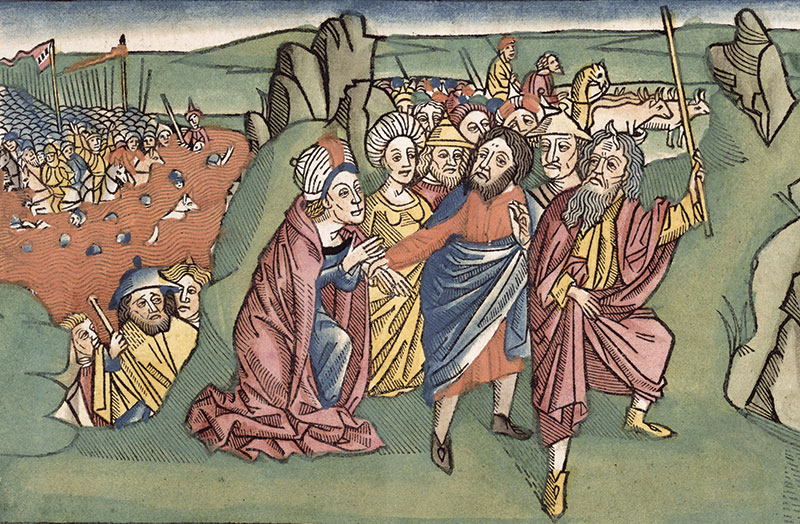
[Illustration of Moses and the Israelites crossing the Red
Sea]<https://jewishreviewofbooks.com/wp-content/uploads/2018/03/Sommer1.jpg>


Moses and the Israelites crossing the Red Sea, from the Nuremberg Bible.
(Biblia Sacra Germanaica, The Stapleton Collection/Bridgeman Images.)

But Friedman goes beyond doubting the doubters. He brings together several
converging lines of evidence that point toward a smaller exodus in the latter
part of the second millennium. He focuses especially on an odd pattern: Though
the Bible tells us that all 12 tribes of Israel were enslaved in Egypt, every
named character in the story comes from the tribe of Levi. Further, the Bible
mentions Levites who have Egyptian names (for example, Moses, Phinehas, and
Pashhur), but members of other tribes never bear them. It might be suggested
that some characters were given Egyptian names to provide an authentic flavor
to the narrative, but, if so, why isn’t the occasional man from Ephraim or
woman from Manasseh given an Egyptian name? There is, in short, a disconnect
between the way the Bible wants to portray the exodus and the data the Bible
uses to do so, and this suggests that the data was not made up. A pure fiction
would hold together better; historical reports based on real evidence tend to
have rougher edges.


Consequently, Friedman believes that there really was an exodus, but only of
the Levites. In fact, he proposes, it is possible that the Levites were not
originally part of the nation Israel; alternatively, they were separated from
their Israelite brethren precisely by the fact of their sojourn in Egypt, a
sojourn that the other tribes never experienced. Friedman notes that the oldest
parts of the Bible depicting Israelites in the Land of Canaan, such as the Song
of Deborah in Judges 5, don’t include Levites in their list of Israelite
tribes. Conversely, another very old poem, the Song of the Sea in Exodus 15,
talks about the exodus but doesn’t specify that Israelites left Egypt. That
poem’s closing verses identify arrival at a temple (“the sanctuary, O Lord,
which Your hands established”) as the ultimate goal of the exodus; thus, this
poem reflects specifically priestly, Levitical concerns. All this leads
Friedman to conclude that the Levites united—or perhaps reunited—with the
Israelites only after they had left Egypt. When these Levites merged with the
Israelites they brought memories of bondage in Egypt, liberation, and the
creation of a covenant with the desert deity whom they credited as their
savior. Those historical memories were eventually adopted by all the
Israelites, and the Levites then came to serve as Israel’s priestly caste.


In support of this theory, Friedman notes similarities between the priestly
Tabernacle described in the book of Exodus and second-millennium Egyptian
ritual and military structures. He agrees with the scholarly consensus that the
biblical story as we have it was composed in the first millennium, but he
argues persuasively that this story contains historical memories that go back
much further.

[Photo of Richard Elliott
Friedman.]<https://jewishreviewofbooks.com/wp-content/uploads/2018/03/Sommer2.jpg>


Richard Elliott Friedman. (Photo by Jade.)

To this Friedman adds what he sees as another clue. For close to two centuries,
many biblical critics have upheld what is known as Documentary Hypothesis, the
theory that the five books of the Torah combine four originally separate
documents, which biblical scholars famously named J, E, P, and D. Three of
these documents, in Friedman’s view, were composed by Levites: E, P, and D. The
authentic second-millennium Egyptian elements of the story, Friedman claims,
show up specifically and only in those three documents. Further, those three
documents, unlike the non-Levitical J document, use the exodus experience as
the underpinning of Israelite identity, law, and morality. For example, E, P,
and D—but not J—repeatedly tell us to treat aliens with compassion, because we
were once aliens in Egypt; all three of these sources—but not J—require Hebrew
slaves to be freed after a term of service rather than forcing them to remain
slaves forever.


In short, at some point after the Levites escaped from Egypt and joined the
Israelites who were already established in Canaan, what was originally a Levite
story came to be remembered as a story about all Israelites. And, most
crucially for Friedman, that ethnic merger was accompanied by a theological
merger. The desert deity of the Levites, known by the Tetragrammaton, was
identified with the high god of the Israelites, known as El. One might have
imagined, in the polytheistic world of the ancient Near East, that the newly
unified Israelite nation would simply have two main gods. After all, the
Egyptians managed perfectly well with a divine menagerie. But the newly merged
Israelites did not create a mythology that told the story of the relationship
between two distinct gods; instead, they came to believe that these were merely
two distinct names for one unique god.


For Friedman, then, the most important result of the exodus and the consequent
fusion of Levitical and Israelite identity was the creation of monotheism
itself. And that fusion involved not only a theology but an ethics, for at the
heart of Levitical religion was the view that aliens and even slaves had to be
treated with compassion and dignity. “[T]he birth of monotheism,” Friedman
writes, “was paralleled with the birth of love of neighbors, even alien
neighbors. The exodus led both to monotheism and to the exceptional attitude
toward others.”


Thus, a significant part of Friedman’s project in this book is a defense of
biblical religion. Not only is the Bible’s central historical narrative based
on a real event, but the essence of its teaching is the opposite of what some
cultured despisers of monotheism have claimed. Monotheism is not essentially
exclusivist or intolerant, for the event that led to Israel’s acceptance of a
single deity also demanded a compassionate attitude toward others. Friedman
does not deny the presence of ethically problematic texts in the Bible, such as
those calling for the wholesale slaughter of Amalekites. But he shows that
those laws sit alongside others that call for humane treatment of other
nations, and it is those verses that predominate and remain in force in the
postbiblical era.

--
--
Centroids: The Center of the Radical Centrist Community
<[email protected]>
Google Group: http://groups.google.com/group/RadicalCentrism
Radical Centrism website and blog: http://RadicalCentrism.org

---
You received this message because you are subscribed to the Google Groups
"Centroids: The Center of the Radical Centrist Community" group.
To unsubscribe from this group and stop receiving emails from it, send an email
to [email protected].
For more options, visit https://groups.google.com/d/optout.