Anxious Bench website
Alexander Hamilton’s “Christian Constitutional Society”
April 29, 2015 by
johnturner<https://www.patheos.com/blogs/anxiousbench/author/johnturner/>

<https://www.patheos.com/blogs/anxiousbench/2015/04/alexander-hamiltons-christian-constitutional-society/#twt-comments>

Today’s guest post comes from Jonathan Den Hartog, associate professor of
history at the University of Northwestern in St. Paul, Minnesota. The
University of Virginia Press recently released his Politics & Piety: Federalist
Politics and Religious Struggle in the New American Nation. Den Hartog’s book
illustrates that intense political conflicts over the relationship between
Christianity and the American government are nothing new. In his book, Den
Hartog argues that the religious dimension of Federalism (often lost in
discussions of banking and commerce and the scope of the national government)
is critical to understanding the way that a host of key players in early
American politics (such as John Jay, Caleb Strong, and Charles Pinckney)
understood their new nation.


Readers may have heard about the sensation in New York that is the musical
Alexander
Hamilton<http://www.nytimes.com/2015/02/18/theater/review-in-hamilton-lin-manuel-miranda-forges-democracy-through-rap.html>,
 currently playing off-Broadway but planning to move onto Broadway this summer.
If you want a sneak peak of the intro number, performed several years ago at
the White House, you can watch it here<https://youtu.be/WNFf7nMIGnE>.
Lin-Manuel Miranda has not only written the score, he stars as Hamilton.


If Hamilton is experiencing a comeback, I thought he deserved a moment in The
Anxious Bench.

Although most people wouldn’t connect Hamilton and religion in America, there
are several strands of his life that bear examining. In fact, in a famous
article from 1955, Douglass Adair provocatively asked, “Was Alexander Hamilton
a Christian Statesman<http://www.jstor.org/stable/1920511>?”


Without going as far as Adair, I think we can see elements of faith in
Hamilton’s life. They were most on display early and late. As a young man,
Hamilton interpreted events in a strongly providentialist vein, and his writing
about a Caribbean Hurricane brought him to the attention of American colonial
Presbyterians. In fact, Hamilton was scheduled to attend college at
Princeton–where he would have studied under John Witherspoon–until he realized
that he could finish a year sooner by attending King’s College in New York (now
Columbia). Near the end of his life, Hamilton also expressed increasingly pious
sentiments. The knocks of a contentious public life and the death of a son–in a
duel, no less–led him to a stronger participation in Trinity Episcopal Church
in Manhattan. In between those periods, during Hamilton’s ambitious public
career, there is much less expression of either practice or belief.


Still, in his last decade, Hamilton also called for a greater connection of
public faith and organized political activity. In 1802, Hamilton wrote to James
Bayard to propose a “Christian Constitutional
Society.<http://founders.archives.gov/documents/Hamilton/01-25-02-0321>” This
letter is interesting in its own right and for what it suggests about attitudes
of the Federalist Party after Thomas Jefferson had become President.


Hamilton was advocating for greater organization to rally potential supporters
to the Federalist side. He believed some emotional appeals would be necessary,
since “Men are rather reasoning than reasonable animals, for the most part
governed by the impulse of passion.” Federalists had been relying “so much on
the rectitude and utility of their measures as to have neglected the
cultivation of popular favor, by fair and justifiable expedients.” In other
words, they had argued the logic and rightness of their cause without
convincing people’s hearts. But, Hamilton insisted, the Federalists needed to
“carry along with us some strong feelings of the mind.” Otherwise, he didn’t
believe the Federalists would produce “any substantial or durable results.”


To rally popular support, then, Hamilton hoped to link Americans’ defense of
the Constitution with their sense of defending Christianity. Not surprisingly,
Hamilton was most interested in defending the Constitution:

In my opinion, the present Constitution is the standard to which we are to
cling. Under its banners, bona fide, must we combat our political foes,
rejecting all changes but through the channel itself provides for amendments.
By these general views of the subject have my reflections been guided.


Let an association be formed to be denominated “The Christian Constitutional
Society.” Its objects to be:

1st. The support of the Christian religion.

2d. The support of the Constitution of the United States.


To carry this plan out, Hamilton proposed a national organization to channel
Federalist endeavors, the use of newspapers for partisan communication, and the
formation of local societies that would be simultaneously charitable and
recognized as Federalist.

What should we make of these suggestions?

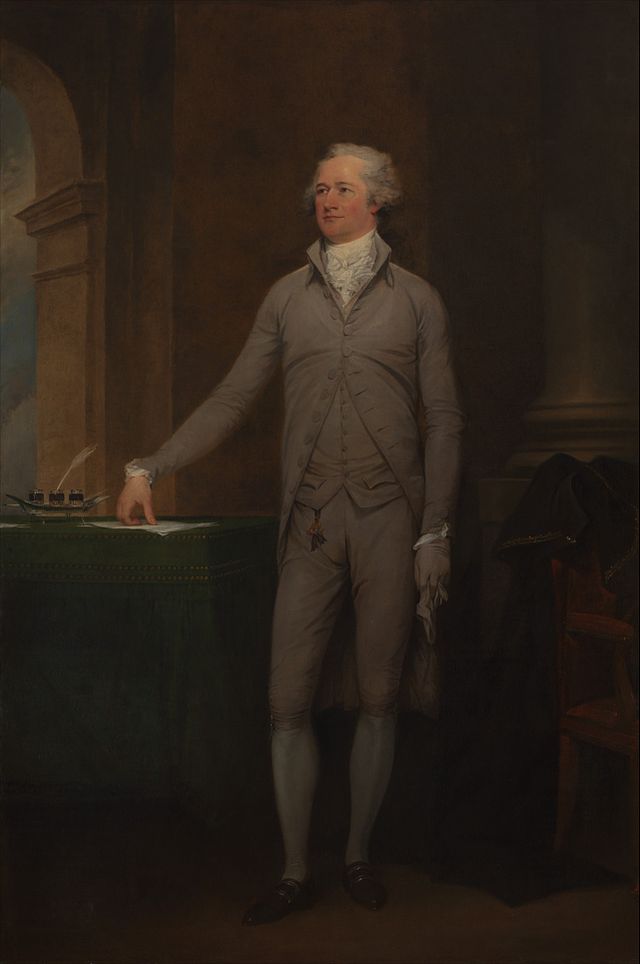
[Hamilton_Trumbull_1792]<http://wp.production.patheos.com/blogs/anxiousbench/files/2015/04/Hamilton_Trumbull_1792.jpg>John
 Trumbull, Alexander Hamilton, 1792

It’s worth noting that this topic doesn’t come up again in Hamilton’s remaining
years. In other words, this was an idea that Hamilton had, but not one that he
would actively pursue or that would bear significant fruit. Moreover, most
Hamilton biographers have seen this more as a political ploy than an idea
arising out of deep faith. I am largely content with that reading.


Still, there are several intriguing things about Hamilton’s writing this letter
at this time. One useful question might be to ask why Hamilton believed–or
others at the time believed–that in America both the Constitution and
Christianity were threatened. The 1790s and first decade of the 1800s were a
time of great political and religious tumult in the country. Although the
Constitution had set up a frame of government, much remained to work out,
including the role that Christianity would or would not play in the republic.
Because Americans didn’t know where the country would be going, they pursued
religious campaigns and partisan politics with intense zeal. For all they knew,
the country’s future development was hanging in the balance.


These debates about religion and politics received even more fuel as the news
of the French Revolution arrived in America. The French had turned decidedly
against their received Catholicism through the Jacobin process of
de-christianization. Further, the initially hopeful Revolution had turned much
darker, producing a Terror in 1793-94. Americans were apt to import political
categories from abroad to speak about their opponents. So, to the Federalists,
their Democratic-Republican rivals became Jacobins, with the term suggesting
that they wanted to enact in America everything that had happened in France,
including the use of the guillotine. These fears only grew across the decade,
as America faced the possibility of war with France in 1798 (ultimately
avoided) and then the prospect of a Democratic-Republic in the presidency, in
the person of Thomas Jefferson.


So, although Hamilton’s proposal did not go anywhere, I would suggest that he
reveals a common concern among many Federalists in the period. Apart from
Hamilton, there really were many Federalists who wanted to defend both
Christianity and the Constitution. These included men like president of Yale
College Timothy Dwight, the minister Jedidiah Morse, and politicians like Elias
Boudinot of New Jersey, Caleb Strong of Massachusetts, and Henry William
DeSaussure of South Carolina. For them, the idea of linking a defense of the
Constitution with the defense of Christianity was already clearly established.
They would pursue those ideas through sermons, orations, publications,
political activity, and cultural endeavors.

Thus, Hamilton was not so much an outlier as one who had picked up,
second-hand, a very prominent approach to politics that linked religious and
political concerns.

--
--
Centroids: The Center of the Radical Centrist Community
<[email protected]>
Google Group: http://groups.google.com/group/RadicalCentrism
Radical Centrism website and blog: http://RadicalCentrism.org

---
You received this message because you are subscribed to the Google Groups
"Centroids: The Center of the Radical Centrist Community" group.
To unsubscribe from this group and stop receiving emails from it, send an email
to [email protected].
For more options, visit https://groups.google.com/d/optout.