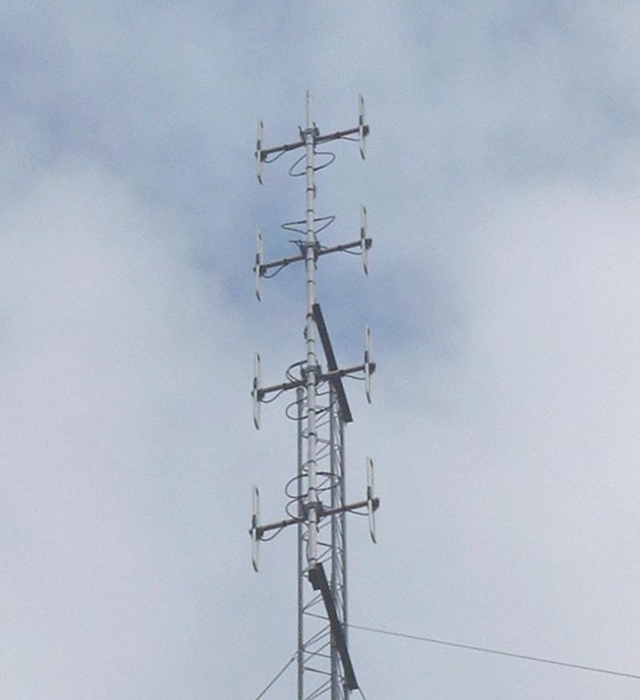
All,

I have been somewhat following the discussion and think I have the correct
antenna geometry
and have created a NEC model in free space.   See the attached power point.
Bill, WA8WG


----- Original Message -----
From: "Paul Kelley N1BUG" <[email protected]>
To: <[email protected]>
Sent: Wednesday, June 24, 2009 3:49 PM
Subject: Re: [Repeater-Builder] SRL235-2 Bi-Directional Antenna, which
direction has gain?


> Yup. I completely agree with the theory of operation as you stated
> it for free space in-phase dipoles and dipoles 1/4 wave from a mast
> but not fed in pairs on opposite sides of a mast. It would certainly
> be interesting if someone were to model this thing.
> My take on it is that having two side by side dipoles fed in phase
> (which they are) changes the situation. The fed in phase dipoles
> largely overcome the tendency for the mast to act as a reflector.
> There may be some pattern disruption from the presence of the mast.
> That may be why there don't seem to be any deep nulls in the
> SRL235-2 pattern, where with a free space array I would expect to
> see fairly deep nulls in-line with the dipole pairs.
>
> But who knows... it has to be a rather complex situation.
>
> 73,
> Paul N1BUG
>
>
> Jeff DePolo wrote:
>> Now you have me second-guessing myself.
>>
>> Over-simplying greatly:
>>
>> If the dipoles are spaced roughly 1/2 wave apart or less, it's going to
>> be
>> broadside to the axis of the elements (assuming the elements are fed in
>> phase, which I presume they are).  That's in free-space; but here we have
>> a
>> mast right in the middle of the two elements.
>>
>> If the elements are spaced somewhere in the vicinity of 1/2 wave apart,
>> that
>> means the mast is roughly 1/4 wave from each bay.  A mast 1/4 wave behind
>> a
>> dipole would normally yield a cardiod pattern, with maximum gain away
>> from
>> the mast.  So, two such cardiods back-to-back would yield an end-fire
>> "figure 8" pattern.  That contradicts the first analysis (broadside).
>>
>> Maybe time to model it...
>>
>> I checked a Sinclair catalog (circa 1990) and, although it showed the
>> elliptical pattern, it didn't say how the antenna was oriented for the
>> plot.
>> I don't have Comprod docs other than what's on their web site.
>>
>> --- Jeff
>>
>>> -----Original Message-----
>>> From: [email protected]
>>> [mailto:[email protected]] On Behalf Of Paul
>>> Kelley N1BUG
>>> Sent: Wednesday, June 24, 2009 5:36 AM
>>> To: [email protected]
>>> Subject: Re: [Repeater-Builder] SRL235-2 Bi-Directional
>>> Antenna, which direction has gain?
>>>
>>>
>>>
>>> If the Comprod is really the equivalent of the Sinclair SRL235-2, I
>>> must respectfully disagree with this. The instruction sheet for the
>>> SRL235-2 says the opposite, that maximum radiation would be
>>> perpendicular to a line drawn as described. I can scan a page from
>>> the Sinclair instruction sheet to back up this statement.
>>>
>>> Paul N1BUG
>>>
>>> Jeff DePolo wrote:
>>>> If all of the elements are parallel as in your photo, then it's
>>>> bi-directional. If you drew a line through one element,
>>> through the mast,
>>>> and through the other element, maximum radiation would be
>>> along that axis.
>>>> If the elements are staggered such that each bay pair is
>>> rotated 90 degrees
>>>> from the bay above/below it, then it's basically omnidirectional.
>>>>
>>>> --- Jeff
>>>>
>>>>> -----Original Message-----
>>>>> From: [email protected]
>>> <mailto:Repeater-Builder%40yahoogroups.com>
>>>>> [mailto:[email protected]
>>> <mailto:Repeater-Builder%40yahoogroups.com> ] On Behalf Of Jesse Lloyd
>>>>> Sent: Tuesday, June 23, 2009 8:28 PM
>>>>> To: [email protected]
>>> <mailto:Repeater-Builder%40yahoogroups.com>
>>>>> Subject: [Repeater-Builder] SRL235-2 Bi-Directional Antenna,
>>>>> which direction has gain?
>>>>>
>>>>>
>>>>>
>>>>> Hi all,
>>>>>
>>>>>
>>>>> I acquired a Comprod equivalent to the SRL235-2. Basically
>>>>> the same, just heavier duty and the cabling harness is in the
>>>>> boom. Anyway, which way is it directional? In the case of
>>>>> this picture of one
>>>>> http://www.repeater.n1bug.com/sinclairant.jpg
>>> <http://www.repeater.n1bug.com/sinclairant.jpg>
>>>>> <http://www.repeater.n1bug.com/sinclairant.jpg
>>> <http://www.repeater.n1bug.com/sinclairant.jpg> > is it
>>>>> diectional through the dipoles, or 90 degrees from them, ie
>>>>> in the diection of the tower (and opposite to) in that case.
>>>>>
>>>>>
>>>>> Thanks,
>>>>>
>>>>> Jesse
>
>
> ------------------------------------
>
>
>
> Yahoo! Groups Links
>
>
>