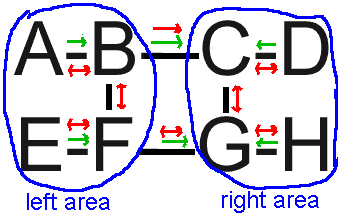
I still do not understand what you try to teach me.
At first, this has nothing to do with geographical data. It would be the
same task inside some OSPF-network.

The way I described how to use Dijkstra enables a Dijkstra shortest path
tree which respects constraints like uni-directional forwarding. E.g. from node

N1 to N2 but not from N2 to N1. And even conditioned: .. but not from N2 to N1
 unless N1 is the destination node.


I didn't ask for adding red arrows but for expressing the task differently,
by telling me which black line may be passed in which direction(s). If every
node not only sees the topology of black lines but also the attributes per
line (allowed forwarding direction(s)  ), then I don't see why my
Dijkstra-based computation should produce incorrect paths.

Heiner

In einer eMail vom 13.07.2008 22:53:42 Westeuropäische Normalzeit schreibt
[EMAIL PROTECTED]:
On Sat,  Jul 12, 2008 at 3:40 PM,  <[EMAIL PROTECTED]>  wrote:
>>>  http://bill.herrin.us/network/geoag-h1.gif.
>
> Well, it requires  a red arrow not only from B to C but also from C to B.
> But then all  black lines are replaced by pairs of oppositely directed
>  arrows.
> So we have no restricted situation anymore.
>
>  Heiner, shruging my shoulders

Precisely. There is no configuration of  red arrows you can draw that
correctly respects the permission constraint  described by the green
arrows. Nor can we simply do away with the green  arrows; they describe
the technical portion of the Internet's core economic  model.

Hence we have found a contradiction: a valid network  configuration for
which your algorithm can't meet the constraints. If this  was math,
we'd say it was disproven. Since it's engineering, we say  something
along the lines of: disqualified for technical error.

It  turns out that -all- geographic aggregation strategies suffer from
a  variant of this problem. That's why none of the rest of us are
interested  in talking about geographic aggregation.

Your insights into other  approaches, however, continue to be welcome.


> [the described  approach] has always been useful for QoS/SLA/available
bandwidth
>  sensitive/etc  routing inside any OSPF network.
> Can either  OSPF-experts or edu-folks comment on my question?

I used OSPF for my  interior routing back in my ISP days. I have the
following two answers to  that question:

1. OSPF is intradomain. Because all links are owned by  the same
organization, permission is not a hard constraint the way it is  in
interdomain routing.

2. I never got more than a trivial amount of  aggregation with OSPF.
I'm not sure if the fault was OSPF or my  configuration, but it didn't
offer up aggregation  easily.

Regards,
Bill Herrin


--
William D. Herrin  ................ [EMAIL PROTECTED] [EMAIL PROTECTED]
3005 Crane Dr.  ...................... Web: <http://bill.herrin.us/>
Falls Church, VA  22042-3004