On Sun, Jul 20, 2008 at 9:06 AM, Iljitsch van Beijnum
<[EMAIL PROTECTED]> wrote:
> I don't see that.
>
> If I want to shrink my routing tables I can filter out any Canadian more
> specifics all over the world except in Canada, and instead put in an
> aggregate that covers the address space used in Canada.
Iljitsch,

As you recall, I refuted a geoaggregation approach you described on
ARIN PPML last year using arguments similar to the recent discussion
with Heiner. I understand your current proposal is different: it takes
those arguments into account. To wit:

1. Assignment of addresses to organizations by some geographical basis
is mandatory. When assigning addresses, registries should choose from
a block reserved for the closest geographical match for that
organization.

2. Aggregation of routes by geography is strictly opportunistic.
Routes are distributed via BGP as now. If a particular router finds
that most or RIB entries for a given geography take the same exit from
the router, it may aggregate the routes that take that exit before
passing them on. Any routes which don't take that exit are passed on
as more-specific cutouts within the aggregated prefix.

Is that correct?


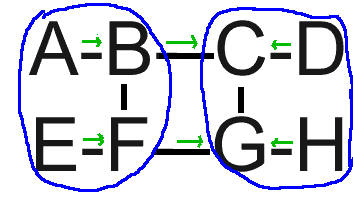
Take a look at http://bill.herrin.us/network/geoag.gif . Let's sever
the link between F and G. A backhoe took it out. This should sever
nodes E and F from nodes G and H. Until the link is repaired, those
two node sets should be unable to communicate with each other.

>From your plan, the RIBs look something like this:

Node B:
B local, propagate to F, A. C
A via A, propagate to F, C
F via F, propagate to A
E via F, propagate to A
C via C, aggregate in {right area}
D via C, aggregate in {right area}
G via C, aggregate in {right area}
H via C, aggregate in {right area}
{right area} via C propagate to A

Node C:
C local, propagate to B, D, G
A via B, aggregate in {left area}
B via B, aggregate in {left area}
D via D, propagate to B, G
G via G, propagate to D, B
H via G, propagate to D, B
{left area} via B, propagate to D, G

Node G:
G local, propagate to C, H (F link is down)
{left area} via C, propagate to H
C via C, propagate to H (F link is down)
D via C, propagate to H (F link is down)
H via H, propagate to C (F link is down)


Okay, so the first thing we notice is that we get no meaningful
benefit in nodes B and C. The RIBs there are as large or larger than
they are with plain old BGP.

The next thing we notice is that there is still a path from H to E:

H->G (left area known via G)
G->C (left area known via C)
C->B (left area was aggregated via B)
B->F (E known via F)
F->E (E known via E)

This is a permission violation!

There does not appear to be a reverse path. Packets can not travel
from E to H because neither F nor E have a route to {right area}.
However, F may be able to cheat by placing a static route to {right
area} via B,

If we restore the link between F and G, F *can* cheat by receiving
routes from G but not sending any routes. If F's traffic is
predominantly inbound, this will save him some money at B and C's
expense.

In today's networks, this would be prevented by installing traffic
filters at the peering points so that F may only send packets to B
that are destined to B or A. But because of the aggregation, that
filter is no longer effective. I suppose you could filter packets from
B to F that don't originate from A or B but that adds complexity and
consumes the same kind of router resources that the FIB does.

Anyway, my concern is this: if it's that close to a full breach of the
permission constraint in an 8-node system, what does it look like in a
50-node system?


There are some other weaknesses in the plan as well but lets look at
this one for now.

Regards,
Bill Herrin


--
William D. Herrin ................ [EMAIL PROTECTED] [EMAIL PROTECTED]
3005 Crane Dr. ...................... Web: <http://bill.herrin.us/>
Falls Church, VA 22042-3004

--
to unsubscribe send a message to [EMAIL PROTECTED] with the
word 'unsubscribe' in a single line as the message text body.
archive: <http://psg.com/lists/rrg/> & ftp://psg.com/pub/lists/rrg