buat baca-baca,semoga bermanfaat
http://peterlbrandt.com/lessons-from-a-difficult-year-of-trading/


   - Posted by *PeterLBrandt <http://peterlbrandt.com/author/peterlbrandt/>*
   - on May 24th, 2011

*This correspondence details lessons I have learned about myself, my trading
and the markets as a result of a difficult year of trading.*

Perhaps these lessons can benefit you, especially if you are a discretionary
trader who uses chart patterns for trading.

I am not shy about hyping my good trades. I am also not hesitant to point
out my unprofitable trades as well. In fact, traders who know me best would
say that I am much more inclined to discuss my struggles than my victories
in trading.

Touting only profitable trades is a violation of full disclosure because
profitable trades are not representative of overall trading performance. On
the other hand, an analysis and discussion of the trials and tribulations of
trading can produce trading insight. In fact, I believe that the best
thinking by traders occur during periods of adversity. It is during these
periods that traders think most deeply about their trading and risk
management protocols and practices, about market behavior and about the
human dimension of market speculation.

I am presently experiencing a quite unpleasant 12-month period in the
markets. It has been Chinese water torture. I have been forced to go back to
the drawing board to re-examine every aspect of my trading.

Background

First, some perspective is in order.

Coming into 2010, I had three pretty good years of trading. In 2007, my
trading account gained 95 percent (due mostly to Gold). I was up 59 percent
in 2008 (EURUSD and GBPUSD). Then, 2009 was an okay year with a 24-percent
gain (due almost exclusively to a mid-year Sugar move). I had a fair first
four months in 2009, up about 7 percent, but trading has been a struggle
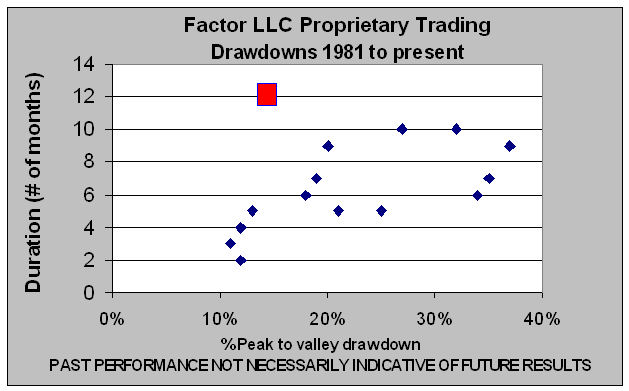
since then. I am in a 12-month drawdown of around 13 percent. The
peak-to-valley magnitude of this drawdown (marked by red box) has been mild
by historical standards, but the duration has been a 30-year record. The
scatter graph below displays all my drawdowns in excess of 10 percent.

<http://peterlbrandt.com/wp-content/uploads/2011/05/Drawdowns-1981-to-present.jpg>


I have had some excellent trades in the past 12 months, but they have been
too few and far between. As I stated earlier in this correspondence, this
past year has been like Chinese water torture…drip…drip…drip! Of all the
drawdowns I have encountered over the years, this one has without a doubt
been the emotionally toughest to endure.

Since 1981 I have experienced more drawdowns than I can remember – at least
two in excess of 5 percent every year I have traded. I have survived every
drawdown. I have no doubt I will survive this drawdown – and that I will
emerge as a better trader.

As has always been the case with drawdown periods, I attempt to ask (and
hopefully answer) three questions.

1. Has my trading plan/guidelines/rules been out of synch with the markets?

   - If so, in what ways? Has the drawdown uncovered some basic flaws of the
   plan? [*Note: Basic flaws in trading plan are masked during profitable
   periods – they show their hand during drawdown periods*.]
   - What modifications could I make to address foundational flaws of the
   trading plan, *not* to optimize the plan against the recent time period,
   but to improve upon the plan. *[By the way, I am not a believer in the
   optimization of indicators.]*

2. Has the basic behavior of the markets changed?

   - If so, might the change in market behavior be permanent?
   - If permanent, what might be the reasons?
   - If permanent, what are the implications for the trading plan?

3. Has my trading execution been out of synch with the plan? (*Note: this
applies more to discretionary traders than to systematic traders*.)

   - If so, in what ways has my execution been out of synch with my trading
   plan?
   - Have there been any particular patterns in the breach of the trading
   plan?
   - What changes are needed to bring execution back into line with the
   plan?

As I analyzed the past year, the answers to the three questions are YES,
YES, and YES. My analysis attributes a percentage contribution to trading
results by each item. Perhaps in a future post I will address the
attribution analysis.

Over short periods of time nothing can really be done to address #1. All
trading plans are cyclical in terms of their alignment with market action.
Addressing foundational flaws of a trading plan is an ongoing effort for all
traders. This is a healthy and needed process.

But a “Yes” answer to item #2 is a more complicated matter. I believe the
basic behavior of markets has changed permanently. See my blog post here
<http://bit.ly/ecvicF>for my thinking on this matter. Yet, I also believe
that my solutions for items #1 and #3 will address the changing nature of
the markets.

Action plan

The bottom line issue for me is simple – What changes do I need to make to
my trading plan (and the execution of the same) and to my risk management
protocols to return my trading plan to consistent profitability? Without
going into depth on each item, the following represents my action plan. Some
of these items represent modifications, some new twists and some a
rededication to basic principles.

Focus on charts from an elevation of 40,000 foot

Daily chart patterns have become increasingly unreliable. In fact, the
changing nature of the markets (especially in forex and futures) has almost
made shorter-term patterns things to be faded. This means that I will not
look at an intraday chart and only look at a daily chart *if* the weekly or
monthly charts have given me a reason to do so. Fortunately, the weekly and
monthly charts have not been compromised by changes in shorter-term market
behavior.

Decrease risk per trading event

My historical maximum risk per trade has been 100 basis points, with the
entire position entered at once. I have readjusted this maximum risk to 60
basis points, with positions being established in halves or thirds.

Avoid range-bound markets

The past year has greatly reinforced the concept of “markets at rest remain
at rest and markets on the move remain on the move.” I have lost a
significant amount of capital in the past year anticipating breakouts that
did not occur.

Be much more aware of the underlying trend

Defining “trend” can be a difficult challenge, but I have begun monitoring
some moving averages – not in the sense of developing or using a
moving-average trading system, but as a proxy for trend. A majority of the
chart pattern trades that have cost me money in the past year have been
countertrend (as measured by the moving average proxy).

Transition away from high/low/close bar charts to closing price charts

“Noise” has increased in my primary markets (futures and forex). I have had
way too many orders executed at intraday price extremes, only to have the
markets close at prices favorable to my trades. The most important price of
the day is the closing price. The most important price of the week is
Friday’s close.

Modify my protective stop protocol to reflect increased intraday noise

I have always believed in having protective stop orders in place at all
times. I am no longer a strong advocate for this practice. I have been
stopped out of too many positions only to see better exit spots within hours
or days. Rather, I am now an advocate of the following protective stop
protocol.

   1. No stops in overnight markets, including forex
   2. Mental stops based on closing price charts – the use of mental stops
   requires disciple to follow through with intentions
   3. Very wide actual stops (daytime session) to protect against a “worst
   case scenario”

Actively trade a portion of a position

Historically, I have held onto my entire position until the target was
reached or until the initial protective stop was hit. This strategy has not
treated me well during the past year, and, in fact, has negatively impacted
my bottom line for the past two years. Rather, I have adopted a strategy to
hold half of a position while trading half of a position, selling only on
strength and buying only on weakness.

Avoiding ambiguous market situations

As a discretionary trader (as opposed to a systematic trader), there are
always market situations that fall into a grey zone – “is there a set-up or
isn’t there a set up?” I have historically erred on the side of giving a
set-up the benefit of doubt, believing that I would benefit if just one in
four questionable set-ups worked. My theory has been that making money is
more important than being right. I have reappraised this trading strategy in
favor of demanding more clarity from chart patterns. I still believe that
making money is far more important than being right — but with less reliable
chart patterns, erring on the side of caution is now part of this belief
system.

Limit my decision-making time window

I have long had a rule to determine and enter my orders each afternoon and
then avoid exposure to the markets during the trading session. At the same
time, I love the markets and, like so many other traders, get caught up in
the price-making process. The degree to which real-time decision making has
negatively impacted my bottom line really hit home in the past year. I am
NOT a good intraday trader – never have been, never will be. Paying
attention to the markets during the trading session is detrimental to my
financial (and emotional) health.

Another aspect of intraday decision making is worthy of note. There was a
time in the markets when the trend of the first several hours would continue
through the day. This is no longer the case. Directional price momentum
during one time slot seems to have no correlation to momentum in subsequent
time slots. Markets now routinely make new highs and lows frequently
throughout the day.

Let me close this post with one other thought. I am in a drawdown. Yet, I am
in no hurry for a new NAV peak. I have seen too many traders blow-up by
“doubling up to catch up.” I can only control what I can control – but
profitability during any given time period is not a controllable variable.

That’s it for now, folks.