Dharma and its Role in Business
<http://4.bp.blogspot.com/-mDJjyCzLxzg/U8--Qk1O_4I/AAAAAAAAEr8/I9jaxaLQJ7U/s1600/MANAGEMENT+-+FIG.+1+-+FOUR+TYPES+OF+DHARMA.jpg>


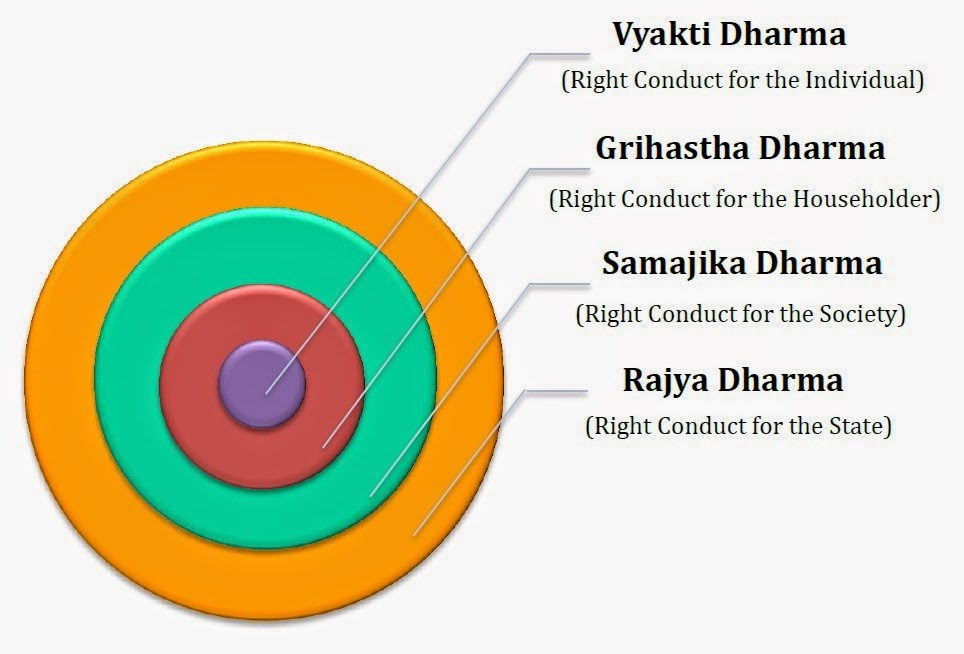
There is no virtue greater than Dharma. There are four types of Dharma [i]:
Vyakti Dharma (individual/personal ethics), Grihastha Dharma (householder
ethics), Samajika Dharma – (societal ethics), Rajya Dharma (national ethics).
Each of these is mutually interdependent and inextricably interlinked. So, if
individual / personal ethics are not proper, householder ethics decline;
societal ethics are adversely affected, and consequently, national ethics
deteriorate. So, Rashtriya Dharma (national character) and the welfare of the
nation are dependent on the proper observance of the Vyakti Dharma (individual
character). It does not make any sense if one country tries to copy the
management styles of another country in an unempirical way. Such replication
often leads to wastage of resources and many undesirable side-effects. This is
what is happening in many countries, including India. What is good or suitable
for one country need not necessarily be good for another. We should bear in
mind the circumstantial variables such as local conditions, individual
attainments and the specific needs of a country while evolving the policies and
procedures. The culture and values of India are different from those of others.
These different scenarios cannot be construed in the same manner. The
artificial integration of different sets of values of different countries may
result in the dilution of values of a less dominant country.


INDIA: THEN AND NOW


In the field of business too, a similar situation has come into existence in
India. By blindly following the business models of one country or other, India
would mess-up its economy by inappropriately using its valuable resources. In
bygone ages, India was a model to other countries. After visiting other
countries in Asia, a king from Greece came to India to study the conditions
here, especially concerning education and religion. He was impressed by the
Gurukula system of education and the kind of relations that existed between the
Guru and the Shishyas. Every Ashram (centre of learning) was a great learning
centre, despite the absence of any of the paraphernalia available in the modern
universities today. The students were prepared to undergo all kinds of
hardships to obtain knowledge from Gurus. He also noted the discipline and
elevated character of the students. He gathered texts like the Upanishads and
the Gita and recognised the value attached by Indians to truth and integrity.
He made a study of the Bible, the Quran, and Buddhist texts, and found that all
of them laid stress on Truth. He noted that the Bible declared: “Righteousness
exalteth a nation”. In the Quran, he found that only by adherence to Truth,
could one become a good human being. He noted the essential truth, which was
common to all faiths and recognised that in Bharat, there was religious
tolerance and harmony as part of the people’s code of ethics. He decided to
follow India’s systems and practices in Greece. Alexander, the Great, came to
India at the command of his Master. On his way back to Greece, he took along
with him a small amount of Indian soil, a vessel full of Ganges water, copies
of the Bhagavad Gita and Mahabharata and the blessings of an Indian sage.


Notwithstanding India’s priceless heritage, many people in this country conduct
themselves similar to those under the shade of a lamp, who, ignorant of its
light, are attracted to far-off things. It is the charm for glamour, which is
responsible for the sorry- state of affairs in our country. Hence, in the field
of Management Studies, we should give due place to Indian culture and values.
Communication is an important aspect of business management, but care should be
taken to use it within the judicious limits. Unrestrained use of communication
patterns and styles may cause considerable damage to the country in its own
way. For instance, if media gives unwarranted focus to undesirable matters and
affairs the news immediately spreads to other parts like wild fire, which may
do more harm than good.


Note: [i] Dharma here refers to ethics as applied to the individual, family,
society and the nation. Ethics is not an English equivalent for the Sanskrit
word Dharma. However, it is used here depending on the context.


Source: Art and Science of Management in India, Chapter 4, Man Management: A
Values-Based Management Perspective
<http://saipublications.com/b008_Man_Management.html>

--

---
You received this message because you are subscribed to the Google Groups
"saimsg" group.
To unsubscribe from this group and stop receiving emails from it, send an email
to [email protected].
For more options, visit https://groups.google.com/d/optout.