Lessons From The Krishna Avatar – Part 1


<http://1.bp.blogspot.com/-H9t809lQtUY/U-KI7oj8RvI/AAAAAAAAEuk/HG2iAMfYhRE/s1600/DISCOURSE+1.jpg>

http://1.bp.blogspot.com/-H9t809lQtUY/U-KI7oj8RvI/AAAAAAAAEuk/HG2iAMfYhRE/s1600/DISCOURSE+1.jpg


Krishna was able to give a lead and set an ideal example in all spheres of
activity. Krishna was a rare individual. He could be regarded as an ideal for
the entire world. But to be able to understand these aspects of Krishna, we
have to make some attempts and effort. Truly, if we want to comprehend these
ideal aspects of Krishna, we have to push aside, to some extent, the Divinity
present in Him and concentrate on the human aspects of His life and work.


If we want to understand and comprehend the human aspects of Krishna, we will
have to make a journey into the times in which He lived. Many may not have
understood this; but if we look at the legends around Sri Krishna, then it will
become perfectly obvious to us that humility and obedience were two
characteristic features of Him. People of these times are likely to get some
doubt whether humility and obedience are qualities which were, at all, really
present in Him. The reason for this doubt is that the kind of Krishna which we
see depicted in the cinemas today, and the description of Krishna that we read
in the texts of today, differ very much from facts, and hence we get this doubt.


When we see these things, we get the picture that Krishna was always fighting
with kings and removing them from their thrones. We also think that He was
blindly worshipped by His devotees. These are the only two features that we
notice. But if we carefully look at the contents of the Mahabharata, written by
Vyasa, we get the unmistakable feeling that humility and obedience were present
in Krishna in a large measure.


“Two Great Human Qualities of Humility and Obedience Characterized the Krishna
Avatar”, Summer Roses on the Blue Mountains, 1976, Ooty


Everything in the Universe is governed by certain laws. The five elements that
constitute the Earth are also controlled by certain laws. Even the infinite
ocean moves under certain laws and regulations. In the context of the whole
world, man’s life is only a part. Therefore, man’s life has to be regulated.
Whether it is for Prema, for hatred, or for anger, some regulation is
necessary. Such regulation has been shown to us, as an example, by Sri Krishna
in His lifetime.


“Mahabharata contains many Valuable Lessons for Us”, Summer Roses on the Blue
Mountains, 1976, Ooty


Young people should have purity of mind. They should take great care to protect
truth and honesty. This was the ideal taught and demonstrated by Krishna. He is
one who has eternal youth. We should understand the significance of saying that
He is eternally young. By saying that He is eternally young, we should not
imply that He has a young and youthful body forever. This should convey to us
the meaning that He has no anxiety and that He has a smiling disposition
always. This kind of bliss and happiness also gives happiness to one’s body and
bodily health.


“The Human Body is like a Water Bubble on the Surface of Water”, Summer Roses
on the Blue Mountains, 1976, Ooty


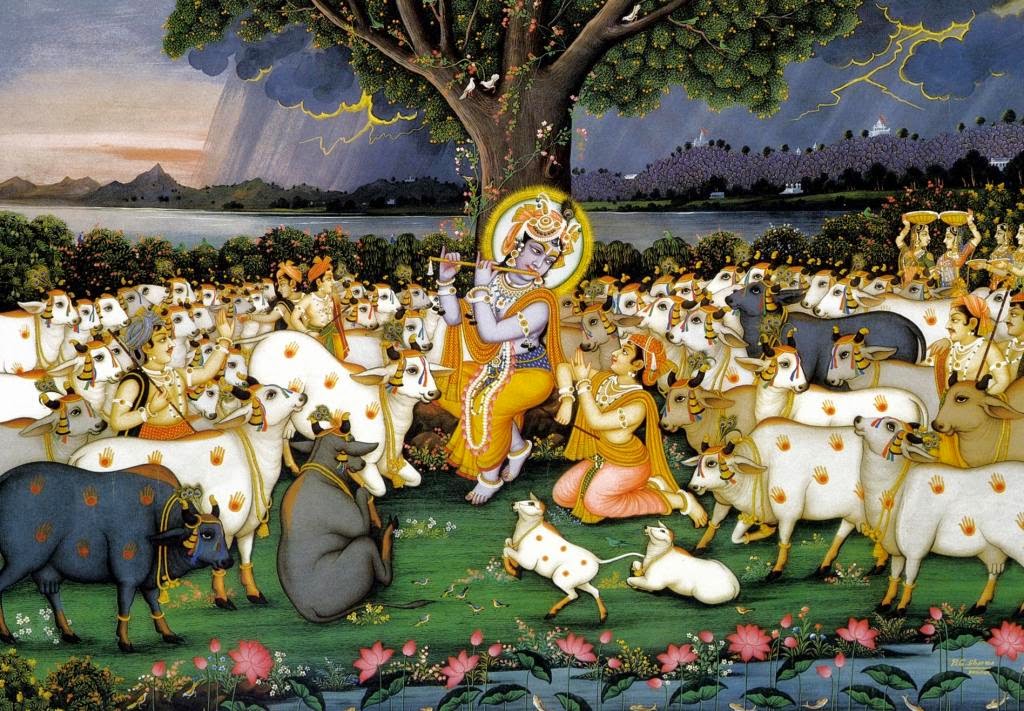
The cow transforms grass and gruel into sweet strength-giving milk and gives it
away in plenty to its master. Develop that quality, that power to transform the
food you consume into sweet thoughts, words and deeds of sympathy for all. The
child Krishna wept for permission to go along with the cows to the fields of
pasture. Yashoda said, “Dear child! Your tiny silken soles cannot walk along
those thorny, pebble-filled tracks. I shall get nice little sandals for You.
You can go, after the sandals are ready”. But Krishna prattled back. “The cows
whom we serve are not shod. Why should we, who are their servants, avoid the
thorns and stones which they cannot avoid?” No wonder the cows and calves of
Gokul were immobilized and wept, when Krishna left for Mathura!


“Ask the Right Question”, Sathya Sai Speaks, Volume 08, January 11, 1968,
Prasanthi Nilayam


Not recognizing His Divinity many people reviled Krishna calling Him a
philanderer and a thief. These accusations do not detract from His greatness.
They are born of delusion. Men make the same mistake about themselves,
forgetting their inherent Divinity and identifying themselves with their
bodies. Krishna appeared in human form to teach mankind to transcend their body
consciousness.


“The Glory of Krishna Avatar”, Sathya Sai Speaks, Volume 27, August 28, 1994,
Brindavan


Seva taken up as Sadhana teaches Sahana (fortitude). Even Avatars demonstrate,
in their lives, the supreme importance of Seva. When Dharmaraja performed the
great Rajasuya sacrifice, on the advice of the sage Narada, in order to
propitiate his deceased father, Lord Krishna attended the sacrifice and asked
to be allotted some service; He preferred the service of removing the leaves on
which food was served for the thousands who were fed every day! Since service
was so dear to Him, He was revered as the King-maker of the Age, the Law-giver
for all.


“Ask the Right Question”, Sathya Sai speaks, Volume 08, January 11, 1968,
Prasanthi Nilayam


Krishna was always immersed in bliss. Whether it was a burial ground, or a
battlefield or a haven of peace, He remained the same. Krishna was standing
between two immense opposing armies and He sang a song. That is the Gita, which
means song. Would it be possible for anyone to sing in such a situation? One
sings only when one is happy. Krishna, because He was the embodiment of joy
could sing even on the battlefield.


“Role of the Avatars”, Sathya Sai Speaks, Volume 23, August 14, 1990, Prasanthi
Nilayam


To be continued…

--

---
You received this message because you are subscribed to the Google Groups
"saimsg" group.
To unsubscribe from this group and stop receiving emails from it, send an email
to [email protected].
For more options, visit https://groups.google.com/d/optout.