Ancient Indian Wisdom for the Modern Manager – Part 1


What is the meaning of Naraha? It means Atman. The two syllables of Naraha: Na
- not, Raha – perishable, means that which is not perishable. The one that is
imperishable is the Atman. Out of this Atman, space and other elements
originated. In everything (meaning several aspects of human life), there is
relevance of water. How would you comprehend it? Each could apply his own plane
of reference to assess the relative criticality of events, issues and objects.
How do human beings grieve over minor and major issues of life? It is not in
the inherent nature of human beings to grieve over everything. It could be
considered as a trait of incongruity - weak quality. Nara – water; Ayana – eye
which suggests that tears should appear in the eyes of a person only for the
sake of Narayana (God) and not for anything else.


The word Upanayana comprises two syllables Upa - near, Nayana - vision. What is
the connotation of ‘near vision’? It implies that it is the kind of vision
which takes people closer to Divinity. Another word in Sanskrit is Upanishad:
Upa – near, Nishad – sit down, which means sitting very close and reflecting on
the Divine principle. The question may arise as to why should we sit down near?
The implication of this is: According to ancient Indian tradition, the one who
imparts knowledge and skills (Guru) should be placed at a higher pedestal and
the disciple who receives knowledge and skills from the Guru should be placed
at a lower pedestal. For example, Uddalaka sent his son, Shwetaketu, to another
preceptor. In reality, Uddalaka himself possessed more credentials than the
person whom Shwetaketu approached for learning. However, he thought that the
true sense of Guru and Shishya (teacher and disciple) relationship that ought
to exist between a mentor and learner might not possibly be present between a
father and son. Father and son will have love and affection towards each other
and such bias would prevent objective reflection. The student should have the
feeling of a disciple and the Guru the feeling of a teacher. Thus, Guru should
be seated at a higher level (height) and disciple should be seated at a lower
height (in a physical sense). The effects of education are so subtle. Upanishad
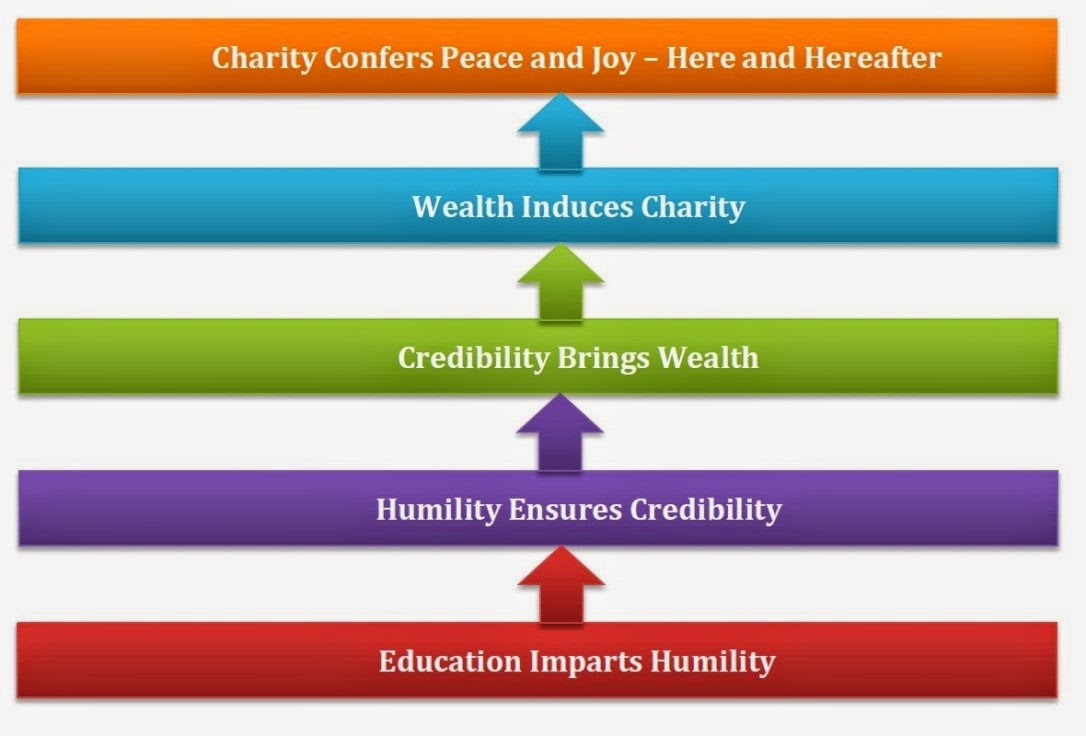
means sitting down and listening. That is the true sign of humility. If there
is no humility, there is no education.


All the actions of the sages and saints in the bygone times always aimed at
transforming their disciples.


Therefore, in the parlance of spirituality, everything implies marketing in a
certain sense. Commercial market may have a different connotation. The
combination of all the multiple forms or the entirety would mean market in a
certain sense. Therefore, we should have connection (links) with the
wholesalers, retailers, consumers, customers, advertisers, brokers,
transporters, local community and other stakeholders.


<http://3.bp.blogspot.com/-lcJtr0iR5Ik/VCKK-GnQQ1I/AAAAAAAAFDE/w0Qar6n_IBM/s1600/MANAGEMENT.jpg>


Qualities of a Truly Educated Person


Total understanding is necessary. To have this, we must develop awareness. It
is also called ‘Chit’ - meaning that which is effulgent throughout. In Vedantic
parlance, it is called Asti, Bhaati and Priyam. Here lies the flower. It means
‘existence’ or ‘being’. How do you know that it exists? Because of the light,
you are able to witness the same with your eyes and you recognise the existence
of the flower. Light enables visibility. Even if there is no light, it (flower)
may still exist. So, that which always exists is Asti; that which shows the
object which is already in existence, is Bhaati. After it is noticed because of
light, you collect it with your hand and smell its fragrance, which is Priyam
or Ananda. All the three are same. When the awareness is there, you come to
know of the being. When both are there, you get Priyam. Therefore, that which
happens first is ‘being’ and that which follows is ‘becoming’. The communicator
should have a perfect understanding so that the listener can understand him.
But sometimes it may happen that the person communicating (sender) does not
understand his own message, but the receiver understands the same in the
correct manner. When both the sender as well as receiver, happen to understand
a given message in the same sense, it can be described as proper communication.


To be Continued…


Note:

[i] Baba illustrated the meaning of Asti, Bhaati, and Priyam with the help of a
flower that was placed on his table.


Source: Values-oriented Marketing: Insights from Ancient Indian Wisdom, Chapter
8, Man Management: A Values-Based Management Perspective
<http://www.saipublications.com/b008_Man_Management.html>


Ancient Indian Wisdom for the Modern Manager – Part 2


<http://4.bp.blogspot.com/-sLrj_Mdo9ho/VC0a8GLVsvI/AAAAAAAAFGo/vHNt3KE8cTw/s1600/MANAGEMENT%2B1.jpg>

http://4.bp.blogspot.com/-sLrj_Mdo9ho/VC0a8GLVsvI/AAAAAAAAFGo/vHNt3KE8cTw/s1600/MANAGEMENT%2B1.jpg


… Continued from Part 1
<http://sathyasaiwithstudents.blogspot.in/2014/09/ancient-indian-wisdom-for-modern.html#.VC1Wj_mSw7I>


Puranas and Vedas: Essential Differences


If the message sent by the sender is ambiguous, the receiver also gets
confused. This is what happens in majority of the philosophical discourses
given in the present times. People who do not comprehend philosophical concepts
properly attempt to discourse and the audience is confused. This gives scope to
many misunderstandings and misgivings. The preachers may not be able to
comprehend the correct inner meaning of the words or the sentences they use in
their public speeches. Another issue is regarding the stories / anecdotes used
by speakers to illustrate a point. These stories are borrowed from the Puranas.
The Puranas were written by human beings and as they were written by Manishi
meaning person (human being), they would be in accordance with Manas (frame of
mind) of the author at the time of writing a particular incident. When the
scholars used to write, they used to keep a lamp on a stand. During the course
of their writing, the wives of the scholars were supposed to adjust the wicks
in order to maintain the brightness of the lamp. Apart from this, the wives
used to prepare some drinks to quench the thirst of their husbands. Therefore,
on any day, when the poet was happy with the services rendered by his wife, he
would extol women in his writings. On some other day when the poet was doing
his work, if the wife was not very helpful, women would be grossly criticized
and condemned in the scholars’ writings. Thus, the nature of Puranas underwent
change in accordance with the conditions and circumstances prevailing at the
time of their writing. But the Vedas are not like that. They are Apaurusheya
(that which is not created by man).


Sanskrit: The Mother of all Languages


In Treta Yuga, there was no language other than Sanskrit. Gradually, all other
languages were derived from Sanskrit. For instance, the English word ‘Mother’
comes from the Sanskrit word ‘Matru’, ‘Father’ from ‘Pitru’; ‘Brother’ from
‘Bhratru’. Today we discover that many words have their origin in Sanskrit
which is an Antarvahini (inner current) for all languages. In the olden days
prior to Jesus, even Divinity did not have a specific name. The king was
treated as God. They used to offer worship to the king. Because of the efforts
made by Jesus Christ, Christianity took its roots in Rome. In the Roman
language, there is a word - ‘Persona’ which means ‘highly sacred’. This
sacredness is present in every one. The derivative of this word (persona) is
‘person’ and the root word is ‘Purusha’. Thus, the root of each word can be
traced to Sanskrit, which could be described as the mother of all languages.
That is why even Gayatri (chanted by Indians as a sacred incantation) is in
Sanskrit. Perhaps on account of this it is said, “Gayatri Chhandasaam Maata”,
which means - Gayatri is the Mother of the Vedas. The true connotation 0f the
verses mentioned in the Sanskrit language is not comprehended in the right way
but is interpreted according to the whims and fancies of each individual. No
one is enquiring whether it is right or not.


Ephemeral Human Existence


In Purusha Suktam, there is a sentence: ‘Sahasra Sheersha Purusha’. It actually
means that every man is God. In those days, the population was only in
thousands; hence the word ‘Sahasra’ (thousands) is used. ‘Purusha’ does not
mean a man who puts on a pant and shirt. ‘Pura’ means body. The one who is
present in the body from the head to toe is ‘Purusha’. ‘Ramyate Iti Ramaha’,
which means ‘the one who attracts is Rama’. Mother loves her child, wife loves
her husband. Rama is present in the form of this love everywhere. Rama means
attraction. From where do you get this attraction? It comes out of the Atman.
Therefore, Rama does not merely imply Dasharatha’s son alone. It is the name of
the spirit ‘Atmaram’ (the One who resides in all beings as the Atman). So, as
long as it (Atman) is there, there continues to be attraction. Once it ceases
its existence in the human body, the attraction also ends.


Example 1: A wife and husband might have been together for 50 years. Even in
pitch darkness, they draw courage and confidence from their company and are
fearless. The reason is that as long as Atman or spirit is there, there is no
possibility to fear each other. If suddenly the husband dies, the wife who was
near him for a long time is suddenly fear-stricken. There is no longer any
attraction, but on the contrary there is fear. As long as there is life, there
is attraction, and also there is no fear.


Example 2: There was a boy aged 20 years and his mother was aged 60 years. The
mother died due to some reason. The son kept his mother’s dead body in front
and cried, “Oh mother!  You have left me.” If the body was his mother, then it
was still there. Then who left him? The life-force had departed the body.
Therefore, body with life is the real mother and not the body without life.
After death, who knows what would happen to mother, father, son or daughter?
When she was living, he would have felt bad even if she had sustained a bruise,
but after death, the same son mercilessly consigns the body of the mother to
flames (As per the Hindu tradition, a dead body is consigned to the flames,
symbolic of offering the body made of the five elements, back to the elements).


Many people speak of worldly things and relationships. All these worldly
relations are temporary. When there is Atman in the body, all the material
things in the phenomenal world possess value. The body devoid of Atman would
have no value. We struggle and earn money and wealth. A dying person does not
take even a fistful of sand with him. Thus, we should always bear in mind that
we cannot carry anything with us after death.


Note:

[i] It is a verse of hymns from Rig Veda in praise of the ‘One’ who is believed
to be behind the entire creation of cosmos in Sanatana Dharma (ancient Indian
culture and way of life).


Source: Source: Values-oriented Marketing: Insights from Ancient Indian Wisdom,
Chapter 8, Man Management: A Values-Based Management Perspective
<http://www.saipublications.com/b008_Man_Management.html>

--

---
You received this message because you are subscribed to the Google Groups
"saimsg" group.
To unsubscribe from this group and stop receiving emails from it, send an email
to [email protected].
For more options, visit https://groups.google.com/d/optout.