Sri Sathya Sai on Yoga and Meditation – Part 1


<http://3.bp.blogspot.com/-Meb_RcKJfkk/VIFpvqYl5iI/AAAAAAAAFeU/tNTI0nX3GFY/s1600/DISCOURSE%2B1.jpg>


Practice of Yoga helps for the slow and regulated respiration. To achieve this,
the sages of earlier years lived in the forests. They went to forests for no
other reason than to achieve purity of speech and control of senses. How was
their practice of meditation? The first component is Dharana (keeping the mind
steady, concentrating the mind on a particular object). Twelve Dharanas
constitute a Dhyana (contemplation). Twelve such Dhyanas constitute Samadhi
(meditation). What is Dharana? Looking at an object continuously with
concentration for 12 seconds with the mind focused on it is called Dharana.
Practice looking at a photo or an object or an idol for 12 seconds. Without a
wavering mind, concentrate only on that object. This is only for 12 seconds,
not a very long duration. Such practice (Dharana) forms the basis for Dhyana.
Holding the vision on an object for 12 seconds is called Dharana.


After Dharana comes Dhyana. Twelve such Dharanas make a Dhyana. This is 12 x 12
= 144 seconds. That means 2 minutes and 24 seconds. When Dharana is practiced
properly, you can reach the state of Dhyana within the duration of 2 minutes
and 24 seconds. Twelve such Dhyanas make a Samadhi. This is 12 x 144 = 28
minutes and 48 seconds. This is not one hour or one day or months together.
This period of 28 minutes and 48 seconds is Samadhi. Such discipline was
followed by the sages of those days. This discipline was not mentioned either
in the scriptures or by any scholar. To attain this, you have to first start
with Dharana. Practice this Dharana for 12 seconds daily. This is essential for
the students. Godly men like Aurobindo and Ramana Maharshi practiced this kind
of meditation. Ramana Maharshi used to concentrate on a dot. He used to look at
it steadily for 12 seconds. If you practice the Dharana 12 times, it becomes
one Dhyana. That is for 2 minutes and 24 seconds. You put the thermometer
inside the mouth for 2 minutes to measure the temperature. Can’t you
concentrate on an object for 2 minutes? If you keep on practicing this for more
and more time, you attain the state of Samadhi. What is the meaning of Samadhi?
People think that the Samadhi is something like a state of unconsciousness or
super-consciousness. This is not consciousness of any kind. What people have is
hysteria. What does true Samadhi mean? That state where there is equanimity
between dualities is called Samadhi. To accept with equal mindedness happiness
and pain, gain and loss, praise and abuse, heat and cold is true Samadhi. This
is the result of true Dhyana.


Students! Today being an auspicious day, start practicing this right away. With
this you develop sharpness in what you study and what you think. I too did not
disclose this to any one earlier. There are various other procedures in this
practice. There are procedures for concentrating the mind and the posture in
which one has to sit to concentrate for 12 seconds. I shall tell those
separately to all those who are interested in all that. Meditation is simple.
To attain the state of Samadhi is still simpler. But because of lack of
knowledge about the procedure, people are facing troubles in following that
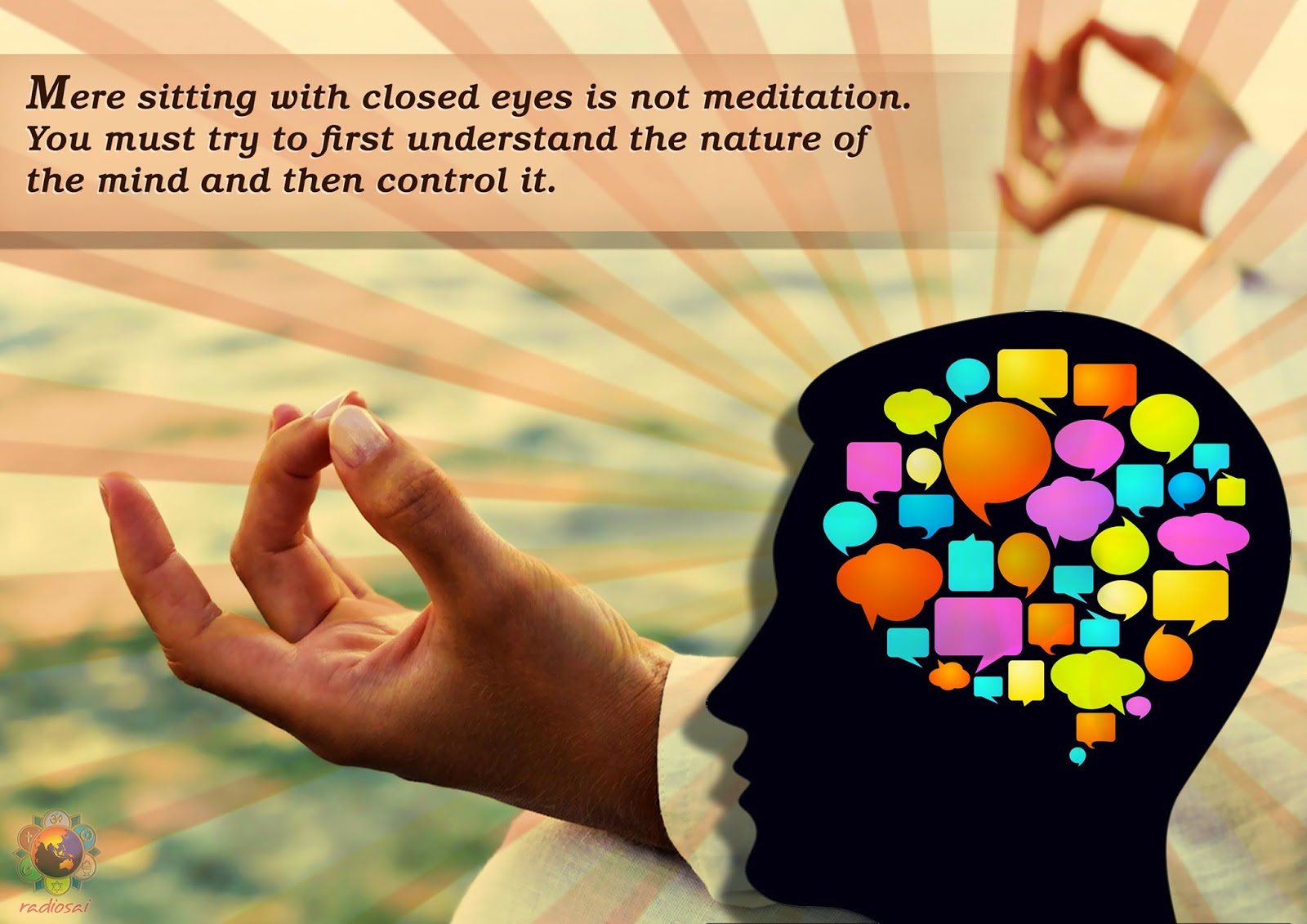
path. You are under the impression that meditation is all about sitting in the
lotus posture. That is not true meditation. You sit steady. But mind wanders
all around. People get diverted when a mosquito flies in front of the nose.
Meditation gets disturbed. When the man sits steady these mosquitoes also
become sharp. Even if you drive them away, they come back and keep disturbing
you. You drive them away once again, with much force the second time, third
time you get angry, fourth time you try killing them! This happens often in
Dhyana of these days. All this is not Dhyana.


<http://4.bp.blogspot.com/-GvtHlX1jxi4/VIFsF26M-UI/AAAAAAAAFeg/yikeSaH_44I/s1600/DISCOURSE%2B2.jpg>


There is a subtle principle in meditation. That is the power. That is Yoga. As
said by the earlier student speaker, it is that state of mind where you are not
excited; you are at peace and calmness. You have to achieve peace only through
patience and forbearance. You can attain peace only through Dharana. You gain
control over the senses. You develop pure thoughts and feelings. With pure
thoughts you attain Godliness. Hence it is said in Bhagavad Gita:


Shreyohi Jnanamabhyasaat, Jnanaat Dhyanam Vishishyate

Dhyanaat Karma Phala Tyagaha, Tyagaat Shanti Nirantaram


Better indeed is knowledge than practice.

Better than knowledge is meditation on God.

But better than meditation is renunciation of the desire for the fruits of
action.

For thereafter follows peace unendingly.


What we want is peace. Today our meditation is confined to our room of worship.
The moment we step out of that room, we start abusing and arguing with people.
‘Satatam Yoginaha’, you have to be in the state of Yoga all the time. This does
not mean abstaining from worldly activities. You should study well. You should
discharge your responsibilities. Spirituality is no obstacle to all this. In
all your worldly pursuits, concentration (Dharana) is essential. Only then,
such practice transforms into true meditation. Contemplating on something is
meditation. We see often in day-to-day activities, when something is being
said, a few people pay no attention to it. We ask them as to what they are
contemplating on. What is meant by meditation? Contemplating on something is
meditation. We have to think only of the same thing or person. That is what is
called Saalokya (being in the world of something else), living in one’s own
world of thoughts.


Saalokyam means thinking about one’s own aspirations, thinking about whatever
you want, thinking about the person whom you want. That is Saalokyam. In the
word Saalokyam, ‘Saa’ means true nature. That is Brahman. That is God. This
pertains to omnipotence of God. But out of ignorance, you believe that this is
yours and that is his. But in reality, nothing is yours in the universe.
Nothing on this earth is yours. Only one that exists is yours and that is the
Atma. That alone is you. You can’t say that the Atma is yours. In fact, the
Atma is you yourself. This authority and experience comes to you only through
Dhyana. But today, there are various practices observed in the name of Dhyana.
All these are to achieve mean ends. Divinity can’t be attained through these
practices. First of all, the turbulence of the mind has to be subdued. Sitting
in the lotus posture and closing the eyes is being considered as Dhyana these
days. This is not Dhyana. This is a disease.


Students! First of all you have to develop the grasping power, concentration
(Dharana). Select an object of your choice or a form of your interest or take a
material object of your liking. Look at that object without wavering mind for
12 seconds continuously. As I told you earlier, there is another method of
meditation by turning your vision inside. As you close your eyes, you can
observe a black dot which is stable between your eyebrows. As you try to
concentrate on it, you feel it wanders away from you. Only when the dot is
contained to that place between your eyebrows, meditation is possible for you.
That is true meditation. That very dot is the knowledge embedded in ignorance,
pure knowledge in the knowledge, the Divine spark present in the purest of
knowledge. If you ask Me, where exactly it is present, I will say, from turmoil
comes peace, from peace glittering light and from that light emanates the spark
of Divinity. Then you understand that this attribute of Divinity, the Divine
spark shows itself only through turmoil.


To be Continued…


Source: Dharana-Dhyana-Samadhi, Discourse 25, My Dear Students Volume 5, Divine
Discourse at the Sri Sathya Sai Hostel, Prasanthi Nilayam on June 29, 1989
<http://www.saipublications.com/b004_my_dear_students_vol_5.html>

--

---
You received this message because you are subscribed to the Google Groups
"saimsg" group.
To unsubscribe from this group and stop receiving emails from it, send an email
to [email protected].
For more options, visit https://groups.google.com/d/optout.