Significance of the Term ‘Manager’ – Part 2


<http://2.bp.blogspot.com/-qAPRe-0Ph70/VHa7R0MigZI/AAAAAAAAFc4/XeLCkCZTIuI/s1600/MANAGEMENT.jpg>
 Image removed by sender.


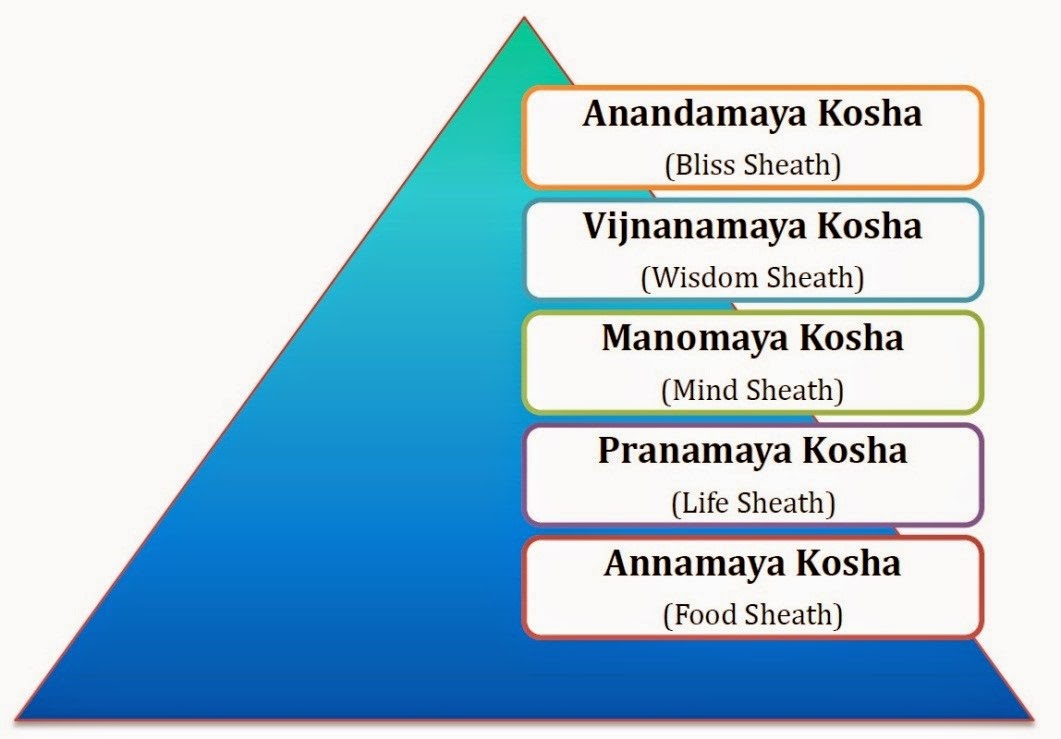
The Pancha Koshas - The Five Human Sheaths


Man is a manifestation of Panch-Koshas (five sheaths). First, there is the
Annamaya Kosha, i.e. our physical body. We have a lot of interest in this Kosha
(sheath). The amount of attention and care we show towards this, the attire we
put on, the ornamentations used for decoration and the amount of the cleansing
done to this, we do not perhaps do the same to any other constituent of the
human system. This may be construed as quite necessary, but it should be borne
in mind that man must not get stuck here only, but must journey to the
Pranamaya Kosha. Without life, what is the worth of the physical frame (body)?
As such, the individual develops great deal of concern about life, which is
unquestionably essential for individual survival. To safeguard this life, an
individual would not hesitate even to spare a lion’s share of his income. Some
people move ahead from the Annamaya to the Pranamaya and from there to the
Manomaya Kosha (mind sheath). But it should be enquired as to what is meant by
the mind and how should we use the mind? Nobody is making efforts to progress
towards the Vijnanamaya Kosha (knowledge sheath) and the Anandamaya Kosha
(Bliss sheath). Therefore, no one is able to get permanent bliss. We have to
continue on our journey till we reach the sheath of knowledge (Vijnanamaya
Kosha). Knowledge in this context does not connote mere possessing of
information. The blossoming of the Atman is knowledge (Vijnana). The
recognition of the Atman as the true basis of oneself is knowledge.
Self-realisation (identification with the Atman which is the reflection of the
same Divine principle that is present in all beings) is knowledge. The joy
experienced by merging oneself with Atman is knowledge.


The fusion of self-respect, knowledge and bliss is true knowledge. Nobody is
bothered about this type of enquiry. So, if we wish to do MBA, we should
understand the meaning of each of the seven letters of the term ‘Manager’. Take
any object, for instance, a mic (microphone used in public address system).
What is the meaning of the word ‘mic’? The form itself suggests the meaning of
the object. As is the case with the mic, similar is the case with the tumbler,
kerchief or any other item. Padaartha refers to material. Similarly, the inner
significance of ‘mind’ and ‘man’ lies in the words themselves. The equivalent
word for ‘man’ in Sanskrit is ‘Manuja’, which means the one who is the
descendent of Manu. As per the Indian culture and history, Manu [i] is
considered as the codifier of all types of Dharma and is said to be the
foremost among all human beings. Manu’s principles of moral codes [as
enunciated in his Dharma Shastra (treatise of moral codes)] have been guiding
the progress of Bharat right from the times of yore. All our activities are
guided and governed by Manu’s Dharma Shastra. ‘Manu’ means the foremost person
and ‘Ja’ means being born. Therefore, Manuja means ‘one who is the descendant
of Manu. Thus every word conveys to us how it has originated and what is its
meaning. Everyone should thoroughly assimilate the meaning of each of the seven
letters of the word ‘Manager’ in spirit and be able to put it into practice
through sincere effort. One should realise that since we are human beings, we
should have a mind that humans ought to possess. One must also make all efforts
to master this mind. If one internalises the meaning of the seven letters and
demonstrates the same in one’s conduct, one would gain the eligibility to
achieve the status of being a master; else, we would slide to sub-human levels.


One has to acquire self-mastery for the sake of self-development. Education is
not for acquiring affluence per se, but for acquiring good qualities. Without
good qualities, any amount of learning is futile. What is the use of learning,
if after studying so much, one is not able to realise one’s true identity
(meaning that one should be able to understand who the real Self is: whether it
is the body or the spirit)? People acquire several degrees such as M.A., M.Sc.,
M.Com, M.B.A and Ph.D., but they are ignorant of their true nature. We have to
be familiar with the basic principles and should not get swayed by the
vicissitudes of life.


Today, learning is similar to the following analogy. From the worldly
perspective, humanity is undoubtedly making rapid strides, but on the moral
front it is deteriorating swiftly. Here is a small example. To drive away the
birds causing damage to the fields and crops, farmers in the bygone times used
to employ some traditional methods. A catapult was used to drive away the
birds. If the stone hit the bird, it would be killed. Our pseudo-modern people
condemned such killing, alleging that the modus-operandi was crude and savage.
Slowly, the modern methods such as bow and arrow arrived, followed by rifles,
smaller version ‘pistol’ and still later, bombs. Some pseudo-animal
sympathizers who objected to the killing of birds with stones are now silent
when millions of innocent people and creatures are perishing with weapons of
mass-scale destruction. This has become so common in the present-day world. The
modern people, who charge people of olden times as primitive, do not even
possess a fraction of the concern, which those people had towards living
beings. Which of the two is crueller: killing a bird with a stone or killing
millions of innocent people with weapons? Is this not a demonic quality?


Note:

[i] In Hinduism, Manu is a title accorded to the progenitor of humankind, the
first king to rule this earth, who saves humankind from the Pralaya (universal
flood). Mahabharata says, “And Manu was endued with great wisdom and devoted to
virtue. And he became the progenitor of a line. And in Manu’s race have been
born all human beings, who have, therefore, been called Manavas. And it is of
Manu that all men including Brahmanas, Kshatriyas and others have been
descended, and are, therefore, all called Manavas”.


Source: Source: The Manager and Values-Based Management: Significance and
Salient Features, Chapter 9, Man Management: A Values-Based Management
Perspective <http://www.saipublications.com/b008_Man_Management.html>

--

---
You received this message because you are subscribed to the Google Groups
"saimsg" group.
To unsubscribe from this group and stop receiving emails from it, send an email
to [email protected].
For more options, visit https://groups.google.com/d/optout.