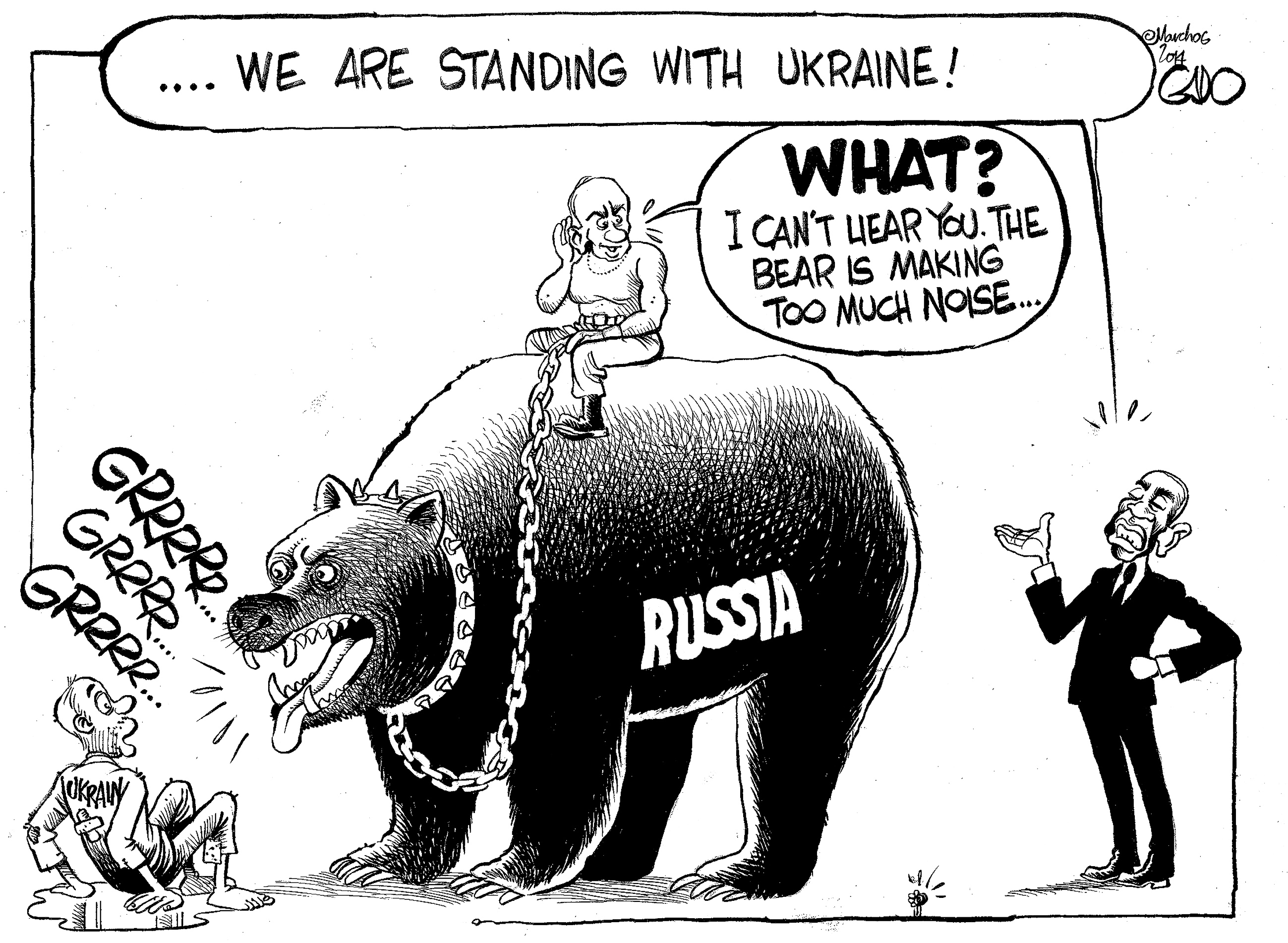
A Ukraine-Russia peace deal: Crimea must have a cost
<https://inmoscowsshadows.files.wordpress.com/2015/01/march-06-14-russia-ukraine-and-obama2.jpg>
 Efforts to secure some kind of peace deal between Moscow and Kiev—and not just
a temporary ceasefire that preserves a frozen conflict—continue. The latest
suggestions are that Washington is coming up with proposals to this effect, as
explored in this story from Bloomberg
<http://www.bloombergview.com/articles/2014-12-31/inside-obamas-secret-outreach-to-russia>
  by Josh Rogin. While not officially confirmed, its details chime with what I
have been hearing from people in and close to the policy circles. The essence
is that in return “for a partial release of some of the most onerous economic
sanctions” Russia would have to adhere to September’s Minsk agreement and cease
direct military support for the rebels, while the “issue of Crimea would be set
aside for the time being, and some of the initial sanctions that were put in
place after Crimea’s annexation would be kept in place.”

In other words, Russia’s seizure of Crimea would be considered a done deal and
taken out of the equation, in return for only minor and personal (ie, not
systemic) sanctions, while Russia and Ukraine would in effect be considered to
have positions of equal moral weight in the negotiations over eastern Ukraine.
Although it is essential to end this war—and both Moscow and Kiev want and
would gain from a resolution—this basis is, in my option, immoral,
muddle-headed and downright dangerous.

1. Yes, alas for the moment it is not worth trying to get Moscow to surrender
Crimea. It may not be right, but this is the only viable position. For Putin to
abandon the peninsula would not be totally against his own instincts, it would
also be politically lethal, critically undermining his credibility and
legitimacy. He simply will not do this.

2. But there must be a real and serious cost to Russia as a result. The US
terms would essentially give Moscow a pass on this act of aggression, reverting
to only the most minor and entirely bearable level of sanctions. The lesson
this would teach to both Moscow and other powers observing this debacle (not
least China) is that there are acts of aggression which are mortal sins and
others which are merely venial ones, peccadillos which deserve only a slap on
the wrist and the lightest mortifications. Rather, if Moscow is (for the
moment) to be granted Crimea—de facto if, and this is important, never de
jure—then it must be made to realize that this is a major concession from Kiev
right from the start and one for which Ukraine must be compensated.

3. The claims of Kiev and Moscow cannot be considered comparable. Both because
this is a conflict triggered by illegitimate and unjustified Russian
interference into Ukrainian domestic affairs and also because of the Crimean
compromise, Kiev is the injured party. The Kremlin may not like that, but
Washington must never lose sight of this, or allow itself to forget it in the
name of a deal. The reported Kerry proposals essentially make this false
comparison.

4. The Minsk Agreement was just a start point: Moscow must renounce all
interference in Ukraine. It is not enough that Russia “cease direct military
support” for the rebels, as that leaves open political support, economic
pressure and indirect support (eg, encouraging third parties such as
Transdnestria to provide weapons and offering transport routes into Ukraine).
Moscow will also have to cooperate in active measures to end the fighting, such
as by offering asylum to those rebel leaders for whom there is no scope for
reconciliation with Kiev. Obviously the ideal thing would be that they face
justice for their crimes and I would imagine a lot of Interpol Red Notices
(international arrest warrants) being issued, ensuring that they would not be
doing any global jaunts for the foreseeable future, but again a pragmatic
desire to end the war as quickly and as neatly as possible means amnesties for
some fighters and quiet evacuation for others.

5. Moscow owes Kiev. This is a war of aggression, and when it ends Kiev will be
left picking up the pieces in a region that has been ravaged by vicious
fighting. Just before Christmas, Ukraine paid the remaining $1.65 billion to
cover its gas debt, but paying for Russian energy remains a long-term challenge
that also opens up future grounds for conflict (and Russian pressure). So the
answer may be that instead of expecting a Kremlin already dealing with an
economic crisis to hand over any cash, that suitable reparations be offset
against Ukraine’s future energy bills, allowing Kiev to focus its efforts on
reconstruction.

6. NATO and EU membership are neither imminently likely, nor anything over
which Moscow has a veto. I can fully understand why Kiev would want to join
both NATO and the EU, but we must face facts: neither is going to happen for
years and years to come, and not until Ukraine has managed to develop its
institutional, economic and security structures. To this end, while demanding
that Kiev formally repudiate any such aims might seem a painless enough
move—after all, is it really any sacrifice to give up something you won’t
anyway have?—it would also implicitly acknowledge that Ukrainian sovereignty is
conditional upon Moscow’s comfort. Would Washington ever accept that Canada or
Mexico get to veto the USA’s international affiliations? I think not. By all
means let NATO and the EU affirm that they do not see any prospect of Ukrainian
membership for years, if this will help ease Moscow’s concerns, but don’t treat
Kiev like some unwanted pariah.

Besides, the very effort to reach the criteria for membership, whether or not
ultimately successful, would create a great basis for Ukraine’s future
development after twenty-plus years of failed state-building (and feel free to
read that as a failure to build a working state, or the active construction of
a failing one…). Without the hope of membership, the spur to build proper
institutions may well be much less powerful, and it will take a powerful and
above all sustained effort to challenge the toxic legacies of institutional
corruption, localized clientelism, economic drift and political cynicism that
beset Ukraine.

7. The optics are important: Moscow cannot be allowed to claim victory, but nor
can it be humiliated. In return for a grudging and de facto acknowledgement of
its claim to Crimea (perhaps including lifting some of the economic sanctions
on companies operating there: there is no reason why ordinary Crimeans should
suffer disproportionately), Moscow must in effect abandon its interference in
Ukraine. This represents a defeat, but for practical reasons it would be
essential that the West and Kiev alike not crow over that. Putin needs some
face-saving assistance if any deal is to be palatable, and if the intent is to
bring peace to Ukraine—rather than to use this as an excuse to punish or even
destabilize the Kremlin—then this needs to be on the table.

Kiev can offer protections for the rights of Russian-speakers (already on the
table), a degree of autonomy or guarantees for the political elites of the east
(already on the table), reconciliation programs and amnesties for those
fighters not involved in atrocities (already on the table). Given that the
ostensible reason for Russian involvement—insofar as the Kremlin admits it at
all—has been the claimed threat to the Russophone population, this would give
Putin the opportunity to claim “mission accomplished” to his domestic audience,
and the pliant Russian broadcast media would duly follow this line.

Of course, this would be a thin fiction, and in the eyes of the world, Moscow
would have been forced to retreat and to pay a price for its seizure of Crimea.
And so it should, not least to warn others that even a nuclear power cannot
breach international law without consequences. But in the delicate balance
between punishment and humiliation, the best chance of peace can be found.

The bottom line is simple. Russia is the aggressor, not just one party in a
dispute. Forcing the return of Crimea may for now be impossible (and would
actually be something of a headache for Kiev), but Moscow must not get a pass
as a result. Any peace must recognize the damage done to Ukraine and the cost
of reconstruction and penalize Russia as a result. And if Moscow is unwilling
to accept these terms? Then the economic warfare that is the sanctions regime
must continue and if anything be ratcheted up. Yes, US Secretary of State Kerry
may be uncomfortable with this state of affairs. Yes, there is an inevitable
collateral impact on Europe (and, for separate reasons, Central Asia). Yes, it
means Moscow will seek to stir up trouble in Europe and elsewhere. But to
buckle would be to reward Putin for his aggressions and strengthen his regime,
while weakening the whole fabric of international law.

http://inmoscowsshadows.wordpress.com/2015/01/01/a-ukraine-russia-peace-deal-crimea-must-have-a-cost/#ixzz3NoHzKfRAFirst

--
Ову поруку сте добили зато што сте пријављени на Google групу „SERBIAN NEWS
NETWORK“.
Да бисте отказали пријаву у ову групу и престали да примате имејлове од ње,
пошаљите имејл на [email protected].
Да бисте постављали у овој групи, пошаљите е-поруку на [email protected].
Посетите ову групу на http://groups.google.com/group/senet.
За више опција посетите https://groups.google.com/d/optout.