blogs.lse.ac.uk
<https://blogs.lse.ac.uk/europpblog/2020/04/09/the-covid-19-outbreak-has-exposed-deep-rooted-weaknesses-in-the-eus-institutions/>
The Covid-19 outbreak has exposed deep-rooted weaknesses in the EU’s
institutions


6-8 minutes

  _____


<about:reader?url=https%3A%2F%2Fblogs.lse.ac.uk%2Feuroppblog%2F2020%2F04%2F09%2Fthe-covid-19-outbreak-has-exposed-deep-rooted-weaknesses-in-the-eus-institutions%2F#Author>

<about:reader?url=https%3A%2F%2Fblogs.lse.ac.uk%2Feuroppblog%2F2020%2F04%2F09%2Fthe-covid-19-outbreak-has-exposed-deep-rooted-weaknesses-in-the-eus-institutions%2F#Author>
 The Covid-19 outbreak could push the EU to the brink again, write
<about:reader?url=https%3A%2F%2Fblogs.lse.ac.uk%2Feuroppblog%2F2020%2F04%2F09%2Fthe-covid-19-outbreak-has-exposed-deep-rooted-weaknesses-in-the-eus-institutions%2F#Author>
 Piergiuseppe Fortunato and
<about:reader?url=https%3A%2F%2Fblogs.lse.ac.uk%2Feuroppblog%2F2020%2F04%2F09%2Fthe-covid-19-outbreak-has-exposed-deep-rooted-weaknesses-in-the-eus-institutions%2F#Author>
 Marco Pecoraro. But the EU’s inability to stage a united response to the
pandemic is simply a symptom of a much deeper problem that began with the
erosion of public trust following the financial crisis.

A pivotal element in dealing with pandemics is trust
<https://www.politico.com/news/magazine/2020/03/07/coronavirus-epidemic-prediction-policy-advice-121172>
  in public institutions and compliance with lockdowns, emergency protocols,
and any other containment measure adopted by the competent authorities. But
Covid-19 is not only a health emergency, it is also posing economic challenges
<https://unctad.org/en/pages/PressRelease.aspx?OriginalVersionID=548>  of a
tall order. Without solidarity from other members, the more fragile EU
economies will not be able to respond adequately to the crisis and run the risk
of experiencing a prolonged economic depression on top of a humanitarian
catastrophe. Unfortunately, this pandemic is hitting Europe at a time when
mutual suspicion seems rife in the union and public trust in its institutions
is as weak as ever.

Trust in communitarian institutions has been progressively deflated since the
global financial crisis. Real wages
<https://blogs.lse.ac.uk/europpblog/2018/06/23/the-gap-between-wages-and-productivity/>
 , especially those of low educated individuals, stagnated, unemployment soared
and inequality
<http://www.bu.edu/gdp/files/2019/05/Updated-New-Graphics-New-Multilateralism-May-8-2019.pdf>
  continued on its long-run upward trajectory. This generated a diffuse sense
of anxiety, especially among the most vulnerable sectors of the population, and
increased the space
<https://voxeu.org/article/european-trust-crisis-and-rise-populism>  for
Eurosceptic and populist political proposals designed to match the demand
<https://www.ft.com/content/9198533e-6521-11e9-a79d-04f350474d62>  for social
justice. The combined vote share of parties not belonging to the traditional
political families – be they on the far right or on the far left – has more
than doubled
<https://www.theguardian.com/world/ng-interactive/2018/nov/20/revealed-one-in-four-europeans-vote-populist>
  since 2007, reaching a figure above twenty-five per cent. The last time we
saw a comparable diffusion of anti-establishment parties in the continent was
in the mid-1930s, right before the collapse of the Weimer Republic.

Such a boom has also been aided by important changes that took place in the
technology of political communication. Social media has changed
<https://www.nature.com/articles/s41599-018-0104-x>  how political actors and
citizens relate to each other. By increasing the frequency of interactions and
(allegedly) eliminating any filter, social media-driven communication has
favoured the diffusion of emotionally charged political platforms and simple
clear-cut messages, especially among the most vulnerable social categories.
During the 2016 EU referendum campaign in the UK, for example, the leave side
dominated the day-to-day volume of tweets. Overall, along the last three weeks
leading up to the vote, support for leaving
<https://blogs.lse.ac.uk/politicsandpolicy/how-leave-won-twitter/>  on the
platform outstripped support for remaining by a factor of four. Similarly, from
October 2018 to May 2019 before the EU elections, eighty five per cent of all
shared Facebook posts originating
<https://www.spiegel.de/international/germany/germany-afd-populists-dominate-on-facebook-a-1264933.html>
  from German political parties stemmed from the AfD.

In a recent paper <ftp://sitelftp.unine.ch/RePEc/irn/pdfs/WP20-01.pdf> , we
show that social media has been instrumental for the diffusion of Eurosceptic
ideas among those individuals that suffered the most from the 2007-08 meltdown.
More specifically, using both European-wide and national surveys, we
demonstrate that individuals with low educational attainment, or unsecure and
low-paying occupations, are more likely to manifest alienation towards European
institutions if they engage with politics using social media. This effect
disappears when considering the attitudes of individuals less exposed to the
waves of the financial crisis.

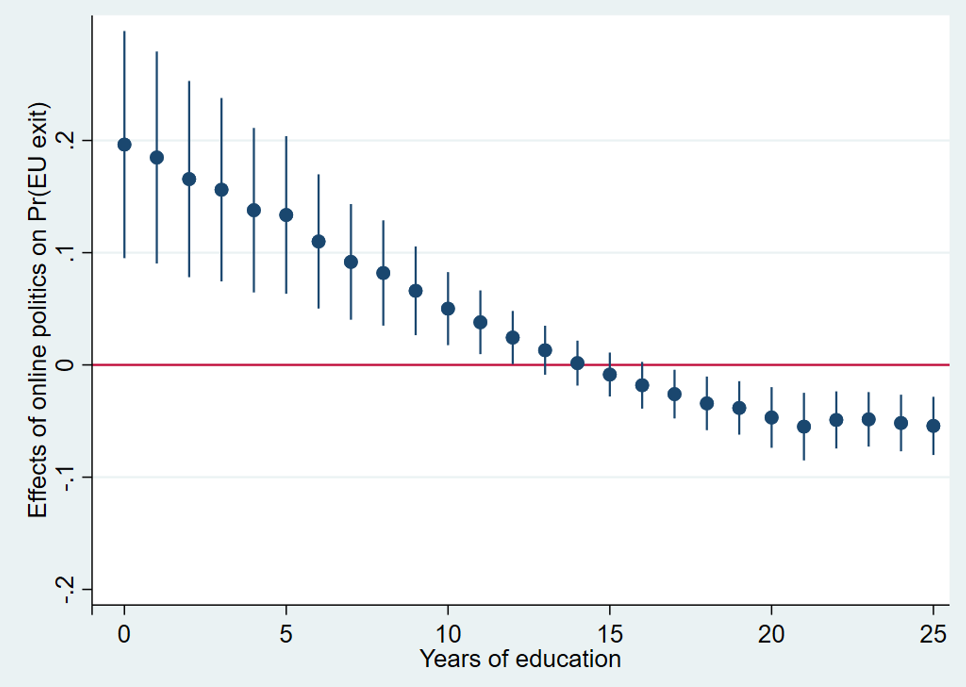
This is illustrated in the figure below that plots the estimated effect of
exposure to online political activity on Euroscepticism at different levels of
education. The data comes from the 8th round of the European Social Survey
<http://www.europeansocialsurvey.org/> , which monitors public attitudes and
values within several European countries and covers over 50,000 individuals.
Euroscepticism is assessed with a specific question on whether respondents
declare themselves in favour of their own country leaving the EU. Exposure to
politics online, in turn, is measured with a dummy variable that takes value 1
if the respondent declares to have posted or shared something about politics
online during the last 12 months, and 0 otherwise.

Figure: Estimated effect of exposure to online political activity on
Euroscepticism at different levels of education

 <https://blogsmedia.lse.ac.uk/blogs.dir/28/files/2020/04/pfmpfigure9april.png>


Note: For more information, see the authors’ accompanying paper
<ftp://sitelftp.unine.ch/RePEc/irn/pdfs/WP20-01.pdf> .


The estimated effect turns out to be positive and statistically significant
only for those individuals with less than 12 years of education (roughly
equivalent to the first two educational cycles in most European countries)
while it is negative (albeit more moderate) for individuals with higher
educational attainment (i.e. tertiary education and above). This means that the
impact of exposure to online political activity on attitudes towards the EU
critically depends on the level of education of the individual concerned.
Similar results hold when we look at individuals with different employment
histories (i.e. those who experienced long periods of unemployment versus
respondents with a more stable work experience).

This evidence clarifies the role played by the digitalisation of the public
sphere in the diffusion of Euroscepticism. Economic insecurity and heightened
anxiety among a growing number of European citizens has progressively hollowed
out trust in communitarian institutions and led to much more open questioning
of the official story on the shared benefits of European integration. Populist
movements have managed to turn this discontent into an electoral consensus
exploiting the disintermediation made possible by social media.

Trust in the EU has been lost right when the continent was approaching its
darkest hours, when trust would be needed the most. In such a fragile
situation, European leaders seem to be incapable
<https://www.theguardian.com/commentisfree/2020/mar/25/shock-coronavirus-split-europe-nations-share-burden>
  (or worse: unwilling) to stage a united response to the pandemic. Even in the
face of a symmetric shock, the EU is responding in random order. Unless this
inertia is changed soon, the integration project risks becoming yet another
fatality of Covid-19.

 <http://blogs.lse.ac.uk/europpblog/about/comments-policy/> Please read our
comments policy before commenting.

Note: This article gives the views of the authors, not the position of EUROPP –
European Politics and Policy or the London School of Economics. Featured image
credit: European Union <https://newsroom.consilium.europa.eu/permalink/p103148>

_________________________________

About the authors

Piergiuseppe Fortunato – UNCTAD
Piergiuseppe Fortunato is a Senior Economist at the United Nations Conference
on Trade and Development (UNCTAD).

–

Marco Pecoraro – FSO
Marco Pecoraro is a Scientific Collaborator at the Swiss Federal Statistical
Office (FSO).


<about:reader?url=https%3A%2F%2Fblogs.lse.ac.uk%2Feuroppblog%2F2020%2F04%2F09%2Fthe-covid-19-outbreak-has-exposed-deep-rooted-weaknesses-in-the-eus-institutions%2F>


--
You received this message because you are subscribed to the Google Groups
"SERBIAN NEWS NETWORK" group.
To unsubscribe from this group and stop receiving emails from it, send an email
to [email protected].
To view this discussion on the web visit
https://groups.google.com/d/msgid/senet/060e01d60e61%249f269210%24dd73b630%24%40gmail.com.