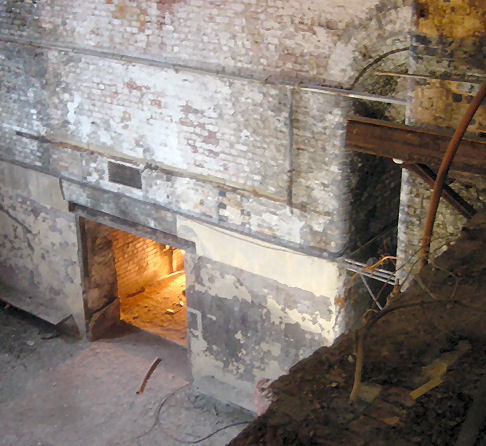
Kingsway Tunnels: See inside one of London's most unusual property
      What connects BT, an air-raid shelter, former Soviet leader Nikita
Khrushchev,
      MI6 and a budget hotel chain? Answer, the Kingsway Tunnels in London.
      By Graham Ruddick
      Last Updated: 5:41PM GMT 23 Jan 2009

      VIDEO:

      ;
http://link.brightcove.com/services/link/bcpid1529573275/bctid8689046001
      http://www.brightcove.com/channel.jsp?channel=1139053637
       The underground complex, 100ft below the City of London, has enjoyed a
      colourful 60-year history and is now for sale after its owner, BT,
      instructed agents to find a buyer.

      The telecoms giant is looking for about £5m for the tunnels and has
already
      received interest from art galleries, hotel companies and data storage
      groups.

      Late last year, Simon Woodroff, the man behind restaurant chain YO! Sushi
      and budget hotel group Yotel, emerged as a potential buyer with plans to
      turn the complex into a hotel with up to 200 rooms for City workers and
      weekend nightclubbers.

      However, the extraordinary property remains on the market.

      The Kingsway Tunnels, known as a 'city under a city' by BT staff, have
been
      shrouded in secrecy ever since they were constructed as an air-raid
shelter
      in 1942. The entrance to the complex is off High Holborn, right at the
heart
      of London's financial district, yet thousands of people walk past the
modest
      door every day with no idea of what is below.

      At its peak, 200 BT staff worked on the site before new technology made
its
      role as a transatlantic telephone exchange redundant in the 1980s. The
      tunnels housed a snooker hall, canteen, bar, offices and even a tropical
      fish tank, although most of the furniture has now been stripped out
leaving
      behind only old equipment, carpets and pictures.

      Street signs to mark out each tunnel are another relic of the complex's
      past, among them First Avenue, The Dog's Leg and Cafeteria Alley.

      "It's a unique property," says David Hay, BT's head of heritage, "and
we've
      received some significant interest in it."

      Kingsway was built by the old London Passenger Transport Board at the
      directive of the Government for use as a bomb shelter during World War
II.
      London Transport used non-English speakers to construct the facility in
an
      attempt to keep its location a secret.

      The complex was designed to provide accommodation for approximately 8,000
      people with full water, electricity and services. The shelter was similar
to
      sites at Stockwell, Clapham and Belsize Park, but unlike those locations,
      Kingsway was eventually used as a troop hostel rather than for civilians.

      As the war dragged on the Government began using the tunnels for other
      purposes. Its residents included the Special Operations Executive, an
      offshoot of MI6, which used Kingsway as a base for covert operations,
      initially focused on German-occupied countries.

      London Transport had constructed the tunnels so they could at some stage
be
      used as part of a new London Underground line but, once World War II
ended,
      it turned down the opportunity to acquire them. Instead they were adopted
by
      the Public Records Office to store 400 tons of documents.

      Finally they passed onto BT - then operating under the Post Office name -
      which expanded them into the mile-long Kingsway complex of today.

      A post-war report by the Government had determined the need for the UK's
      communications network to be protected in case of an attack, so the
tunnels
      became a 'trunk exchange' connecting long-distance calls, including the
      famous hotline connecting the US and Soviet leaders. It also housed the
      first ever transatlantic telephone cable.

      The equipment, spread over four large tunnels in the complex, required
      constant maintenance and a significant number of engineers and
      administrators to keep the service running. According to Mr Hay, the BT
      historian, the on-site staff locked themselves in the tunnels for two
weeks
      at the peak of the Cuban Missile Crisis in 1962 - fearing nuclear war -
and
      lived using the underground facilities.

      The tunnels' use as an exchange slowly diminished from the 1960's, thanks
to
      new technology, and the 1980's marked the beginning of the end. From
then,
      they housed closed circuit television and secure data back-up services,
but
      by the 1990's even this purpose was abandoned and the Kingsway Tunnels
      became merely a storage location.

      The hope for BT now is to find an occupier who can provide the
underground
      complex with a future as colourful as its 60-year past.

      Elaine Hewitt, group property director for BT, said: "We are looking for
a
      purchaser with the imagination and stature to return the tunnels to
      productive use. The site has the most fantastic history and, now that we
      have no requirement for it for telecommunications use, it is right that
we
      should offer it to the market. Here's hoping it has a fantastic future."

      The company, which also owns one of London's most prominent properties in
      the BT Tower, says fire and safety restrictions mean the chances of the
      complex becoming a hotel is unlikely. However, after decades behind
closed
      doors, one of London's most secretive properties could still open its
      history to the public if the right buyer and the right plan is found.


http://www.telegraph.co.uk/finance/4324339/Kingsway-Tunnels-See-inside-one-of-Londons-most-unusual-property.html


      http://www.camdenguide.co.uk/camdenimages/newspix/catacombs/cat4.jpg


http://www.welt.de/multimedia/archive/00686/eng_tunnel2_BM_Baye_686328g.jpg


      http://cache.daylife.com/imageserve/03Ti5z48FzfUs/610x.jpg


      http://newsimg.bbc.co.uk/media/images/45111000/jpg/_45111463_-15.jpg


http://newsimg.bbc.co.uk/media/images/45121000/jpg/_45121235_tunnels512.jpg

      http://news.bbc.co.uk/2/hi/uk_news/7677965.stm


      http://www.jaunted.com/files/17070/tunnels.jpg


      http://farm4.static.flickr.com/3052/2961186720_61034ca485_o.jpg


      http://cache.daylife.com/imageserve/02JNcdw1qNbpS/610x.jpg


      http://www.fictionalcities.co.uk/tunnel%20entrance.JPG


      http://www.disappearinglondon.com/CMS/upload/photos/london%20Tram.jpg

      Entrance to Kingsway underground cold-war telephone exchange (London)
(edit info)


      The Kingsway telephone exchange started life as one of eight deep tunnel
      shelters (built underneath Northern Line and Central Line tube stations
in
      London during WWII. Kingsway is located underneath Chancery Lane tube
      station.

      The wartime shelter consisted of the two long parallel tunnels which run
      underneath High Holborn. There was a plan that the tunnels could be used
      after the war as part of a new underground railway line, but this never
      happened.

      The site was taken over by the GPO in 1949. It was extended, by building
the
      four short, large-diameter tubes in the southern sector, to house the
secret
      defence and international telephone exchange. Construction started in
1951
      and the exchange entered service in October 1954.

      In 1956 it also became the London terminal for the first Transatlantic
      telephone cable, TAT1. This involved a complicated arrangement of
equipment
      at three sites, with several hundred copper `pairs' linking them:
Kingsway
      itself, the International exchange in Wood Street and the Continental
      exchange in the Faraday building.

      The exchange has been declining in importance over many years, and in
1996
      the site was offered for sale by BT. Only the Main Distribution Frame
(MDF)
      was still in service, linking a few circuits between other sites.

      The government built a bunker of some sort in the two easternmost of the
      four main tunnels in the southern sector, possibly in the early 1980s.
This
      too has now been decommissioned, and Sub Brit members were able to look
      around inside what's left of the facility during their visit on 13th July
      1996. The heart of the bunker appeared to be a briefing room, with
seating
      facing a screen at one end and a projection booth at the back. (At one
time
      we thought this was the bunker known as Pindar, but most sources say that
      Pindar is located underneath the MoD building in Whitehall. Maybe
Kingsway
      was a temporary home for Pindar during construction of the Whitehall
site.)

      British Telecom used another part of these tunnels for the Kingsway
Computer
      Centre (KYCC) between 1986 and 1990. This housed a secure backup for
Icarus,
      (International Circuit Allocation Record Update System) located in
central
      London.

      It has been reported by Stuart McDonald that the entrance in Tooks Court
is
      being demolished. He says "arriving there on Sunday 4th November 2001, I
      found it surrounded with fences and it was in the process of being
knocked
      down! Walking down Furnival Street off the main road, the ventilation
shaft
      on your right hand side (with the crane over the main door) is still
there.

      Walking further down to where I assumed the entrance to be, I found the
      demolition team had already started knocking it down. As you looked to
your
      right into Took's Court (to which access is still allowed), the immediate
      area around the street level structure was fenced off and there was
      scaffolding all around it, as well as a corrugated fence to stop unwanted
      visitors. A small digger was sitting on the roof. Demolition has started
      from the Furnival Street end. Looking through gateway there, you can see
      where the entrance has been collapsed to allow the digger access to the
      roof. Looking at the structure, you can see they have not had it easy
trying
      to knock it down. The top left hand corner as you look at it, must be at
      least a metre thick all round with a layer of bricks over it."

      There is also a goods entrance in Furnival Street, it is unclear if this
has
      also been demolished.


http://wikimapia.org/2412497/Entrance-to-Kingsway-underground-cold-war-telephone-exchange

      http://underground-history.co.uk/front.php


--~--~---------~--~----~------------~-------~--~----~
You received this message because you are subscribed to the Google Groups
"ShadowGovernment" group.
To post to this group, send email to [email protected]
To unsubscribe from this group, send email to
[email protected]
For more options, visit this group at
http://groups.google.com/group/shadowgovernment
-~----------~----~----~----~------~----~------~--~---