On 04/23/11 02:52, Heather Madrone wrote:

> I didn't realize how often prepositions modify the meanings of English
> verbs until I started learning Dutch, which does the exact same thing. I
> was grumbling to myself about this one day, when the verb “to take”
> grabbed my by the elbow and said, “That's nothing, baby! Take in, take
> out, take on, take off, take over, take down, take up....”
Heh! I've been amusing myself by learning Lojban, which is interesting.
It's designed to have no such silliness. There are separate words for
taking an object, removing a garment, etc ;-)

Other features include sixteen digit names (for hexadecimal numbers), a
powerful and expressive vocabulary of tiny words to add emotional
context to sentences or arbitrary parts thereof, a semantic definition
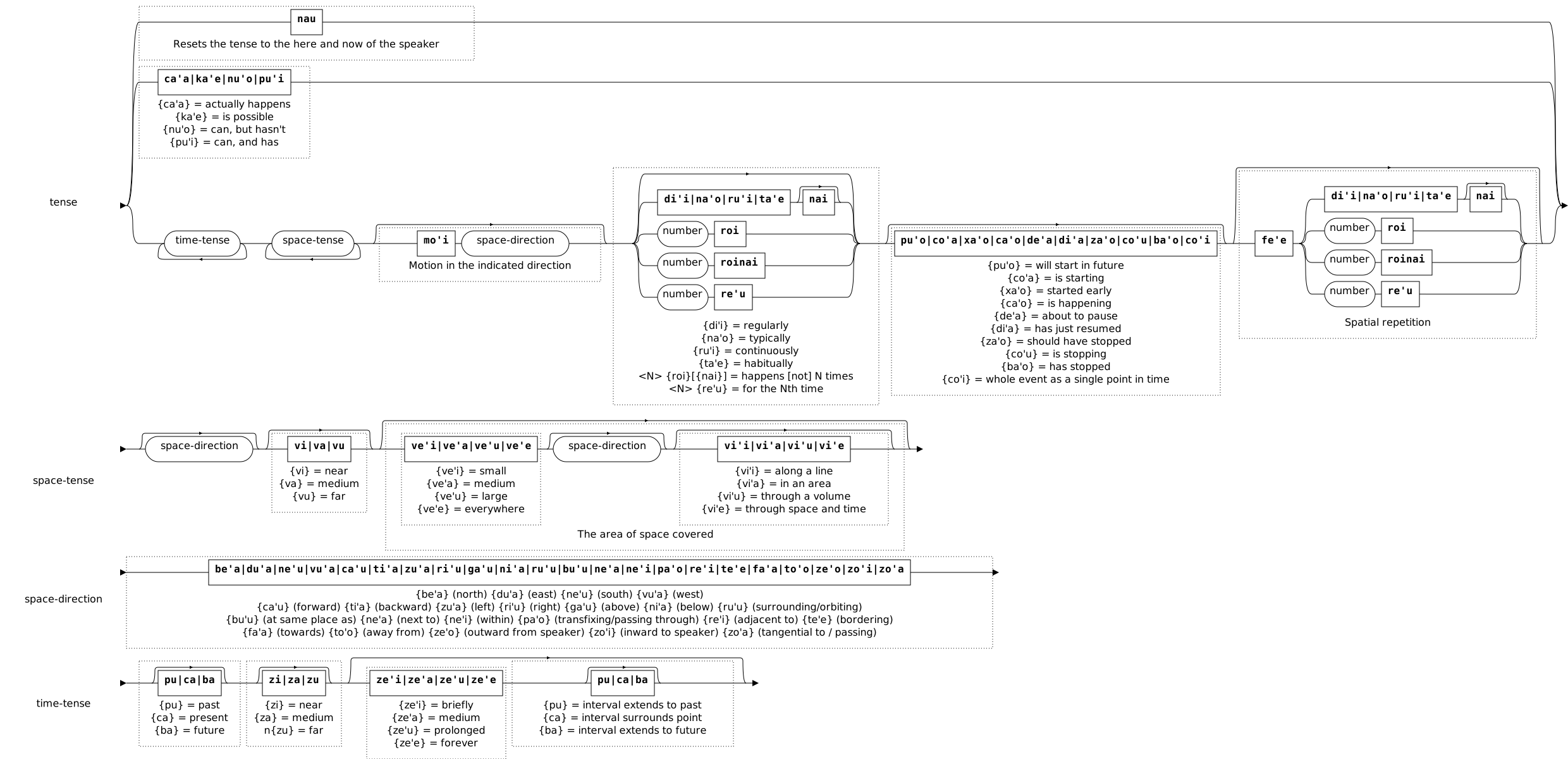
in terms of predicate calculus, and a system of tenses that lets you
construct compound tenses for (for example) "the start of an
interruption to an event that took a long time and occured over a large
area of space, which occurred in the medium future, inside something
northwest of here".

{ba za ze'u be'a vu'a ne'i ve'u vi'a de'a}, in fact. {mi ba za ze'u be'a
vu'a ne'i ve'u vi'a de'a citka} means "I will, in the medium future,
interrupt my prolonged wide-area-ranging eating inside something
northwest of here" ;-)

There's further tense tags for the direction of motion of an event, its
temporal or spatial repitition, and which direction the temporal
interval or spatial distance/area/volume covered by an event extends in,
etc.

Check out http://love.warhead.org.uk/~alaric/junk/lojban-tenses.svg for
a nice diagram I did of the tense system, as a learning aid.

There's deliberately no syntactic ambiguity in Lojban (no puns, alas!),
but then they've built mechanisms to very precisely express semantic
ambiguity (*something* happens, I don't say what; etc). Generally, the
shortest form is the most ambiguous, with further words narrowing
something down; this stands in contrast to English, where there's often
specific connotations in the common forms of things, and more general
phrasings tend to be longer.

English: "I'll have to ask my wife" vs. "I'll have to ask one or more of
the things to which I am married"

Lojban: {.ei mi te preti fo le pa fetsi speni be mi} / {.ei mi te preti
fo le speni be mi}: the {pa fetsi} is required to specify "one" and
"female" explicitly.

Lojbanic people can be polyamorous and pansexual with much less
awkwardness than others ;-)

ABS

--
Alaric Snell-Pym
http://www.snell-pym.org.uk/alaric/