On Wed, Feb 19, 2014 at 2:33 PM Thaths <[email protected]> wrote:

> On Wed, Feb 19, 2014 at 12:56 PM, Udhay Shankar N <[email protected]> wrote:
>
>>
>> http://www.newscientist.com/article/dn25068-wikipediasize-maths-proof-too-big-for-humans-to-check.html
>>
>> Wikipedia-size maths proof too big for humans to check
>>
>>     17:38 17 February 2014 by Jacob Aron
>>
>> If no human can check a proof of a theorem, does it really count as
>> mathematics? That's the intriguing question raised by the latest
>> computer-assisted proof. It is as large as the entire content of
>> Wikipedia, making it unlikely that will ever be checked by a human being.
>>
>
> Speaking of proofs that are unlikely to be checked by human beings:
>
>
> http://www.nytimes.com/2012/09/18/science/possible-breakthrough-in-maths-abc-conjecture.html
>
> On Aug. 30, with no fanfare, Shinichi Mochizuki, a mathematician at Kyoto
> University in Japan, dropped onto the Internet four papers.
>
> The papers, encompassing 500 pages and four years of effort, claim to
> solve an important problem in number theory known as the abc conjecture.
> (No, it does not involve the alphabet; it has to do with integers and prime
> numbers, and the letters represent mathematical variables used in
> equations.)
>
Two+ years later, here is a nice longform piece on the current state of
Mochizuki's proof and where Mathematicians are with respect to
understanding it :

https://www.quantamagazine.org/20151221-hope-rekindled-for-abc-proof/

Earlier this month the math world turned toward the University of Oxford,
looking for signs of progress on a mystery that has gripped the community
for three years.

Play: In new window
<http://media.blubrry.com/quanta/p/www.quantamagazine.org/wp-content/uploads/2016/01/QuantaPodcast_Week20-11216-8.46-AM.mp3>
 | Download
<http://media.blubrry.com/quanta/p/www.quantamagazine.org/wp-content/uploads/2016/01/QuantaPodcast_Week20-11216-8.46-AM.mp3>

Subscribe: iTunes
<https://itunes.apple.com/us/podcast/quanta-science-podcast/id1021340531?mt=2&ls=1>
 | Android
<https://subscribeonandroid.com/www.quantamagazine.org/feed/podcast/> | RSS
<https://www.quantamagazine.org/feed/podcast/>
Audio Player

The occasion was a conference on the work of Shinichi Mochizuki
<http://www.kurims.kyoto-u.ac.jp/~motizuki/top-english.html>, a brilliant
mathematician at Kyoto University who in August 2012 released four papers
<http://www.kurims.kyoto-u.ac.jp/~motizuki/papers-english.html> that were
both difficult to understand and impossible to ignore. He called the work
“inter-universal Teichmüller theory” (IUT theory) and explained that the
papers contained a proof of the *abc* conjecture, one of the most
spectacular unsolved problems in number theory
<https://www.quantamagazine.org/tag/number-theory/>.

Within days it was clear that Mochizuki’s potential proof presented a
virtually unprecedented challenge to the mathematical community. Mochizuki
had developed IUT theory over a period of nearly 20 years, working in
isolation. As a mathematician with a track record of solving hard problems
and a reputation for careful attention to detail, he had to be taken
seriously. Yet his papers were nearly impossible to read. The papers, which
ran to more than 500 pages, were written in a novel formalism and contained
many new terms and definitions. Compounding the difficulty, Mochizuki
turned down all invitations to lecture on his work outside of Japan. Most
mathematicians who attempted to read the papers got nowhere and soon
abandoned the effort.

For three years, the theory languished. Finally, this year, during the week
of December 7, some of the most prominent mathematicians in the world gathered
at the Clay Mathematical Institute at Oxford
<http://www.claymath.org/events/iut-theory-shinichi-mochizuki> in the most
significant attempt thus far to make sense of what Mochizuki had done. Minhyong
Kim
<https://www.quantamagazine.org/20151221-hope-rekindled-for-abc-proof/Minhyong%20Kim>,
a mathematician at Oxford and one of the three organizers of the
conference, explains that the attention was overdue.

“People are getting impatient, including me, including [Mochizuki], and it
feels like certain people in the mathematical community have a
responsibility to do something about this,” Kim said. “We do owe it to
ourselves and, personally as a friend, I feel like I owe it to Mochizuki as
well.”

The conference featured three days of preliminary lectures and two days of
talks on IUT theory, including a culminating lecture on the fourth paper,
where the proof of *abc*is said to arise. Few entered the week expecting to
leave with a complete understanding of Mochizuki’s work or a clear verdict
on the proof.  What they did hope to achieve was a sense of the strength of
Mochizuki’s work. They wanted to be convinced that the proof contains
powerful new ideas that would reward further exploration.
[image: Shinichi Mochizuki]
<https://www.quantamagazine.org/wp-content/uploads/2015/12/ABC_04.jpg>

*Philipp Ammon <http://www.photoammon.com/#!/index> for Quanta Magazine*

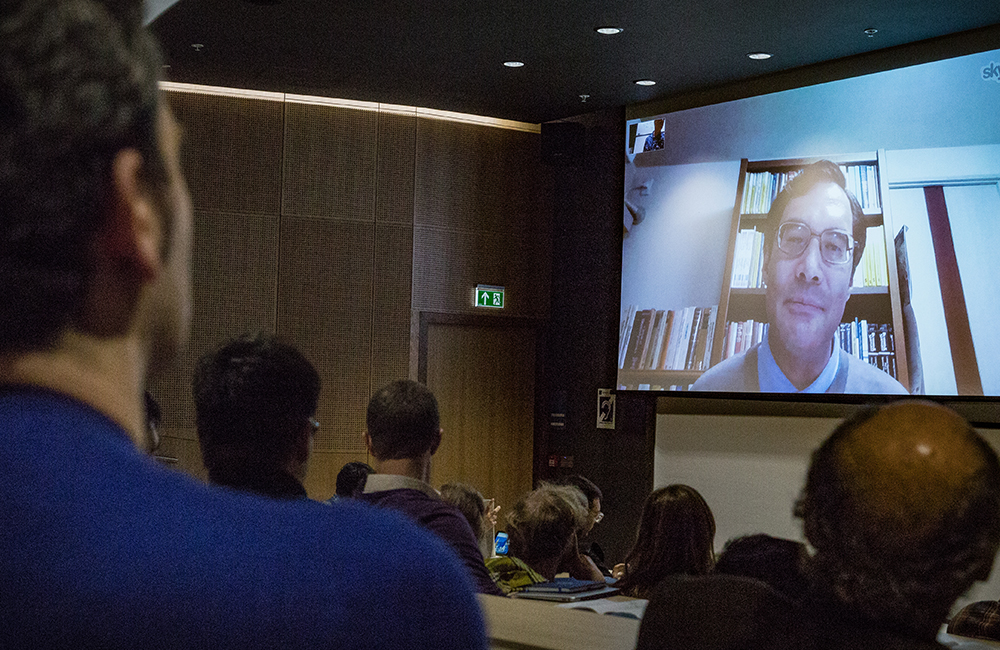
Shinichi Mochizuki appearing via videoconference to answer questions.

For the first three days, those hopes only grew.

*A New Strategy*

The *abc* conjecture <https://www.youtube.com/watch?v=RkBl7WKzzRw> describes
the relationship between the three numbers in perhaps the simplest possible
equation: *a *+ *b* = *c*, for positive integers *a*, *b* and *c*. If those
three numbers don’t have any factors in common apart from 1, then when the
product of their distinct prime factors is raised to any fixed exponent
larger than 1 (for example, exponent 1.001) the result is larger than *c*with
only finitely many exceptions. (The number of exceptional triples *a*, *b*,
*c* violating this condition depends on the chosen exponent.)

The conjecture cuts deep into number theory because it posits an unexpected
relationship between addition and multiplication. Given three numbers,
there’s no obvious reason why the prime factors of *a* and *b* would
constrain the prime factors of *c*.

Until Mochizuki released his work, little progress had been made towards
proving the*abc* conjecture since it was proposed in 1985. However,
mathematicians understood early on that the conjecture was intertwined with
other big problems in mathematics. For instance, a proof of the *abc*
conjecture
would improve on a landmark result in number theory. In 1983, Gerd Faltings
<https://www.hcm.uni-bonn.de/people/profile/gerd-faltings/>, now a director
of the Max Planck Institute for Mathematics in Bonn, Germany, proved the
Mordell conjecture, which asserts that there are only finitely many
rational solutions to certain types of algebraic equations, an advance for
which he won the Fields Medal in 1986. Several years later Noam Elkies
<http://www.math.harvard.edu/~elkies/>of Harvard University demonstrated
that a proof of *abc* would make it possible to actually find those
solutions.

“Faltings’ theorem was a great theorem, but it doesn’t give us any way to
find the finite solutions,” Kim said, “so *abc*, if it’s proved in the
right form, would give us a way to [improve] Faltings’ theorem.”

The *abc* conjecture is also equivalent to Szpiro’s conjecture, which was
proposed by the French mathematician Lucien Szpiro
<https://www.gc.cuny.edu/Page-Elements/Academics-Research-Centers-Initiatives/Doctoral-Programs/Mathematics/Faculty/Lucien-Szpiro/>
 in the 1980s. Whereas the *abc* conjecture describes an underlying
mathematical phenomenon in terms of relationships between integers,
Szpiro’s conjecture casts that same underlying relationship in terms of
elliptic curves, which give a geometric form to the set of all solutions to
a type of algebraic equation.
[image: Go Yamashita, Ariyan Javanpeyka and Yuichiro Hoshi]
<https://www.quantamagazine.org/wp-content/uploads/2015/12/ABC_01.jpg>

*Philipp Ammon <http://www.photoammon.com/#!/index> for Quanta Magazine*

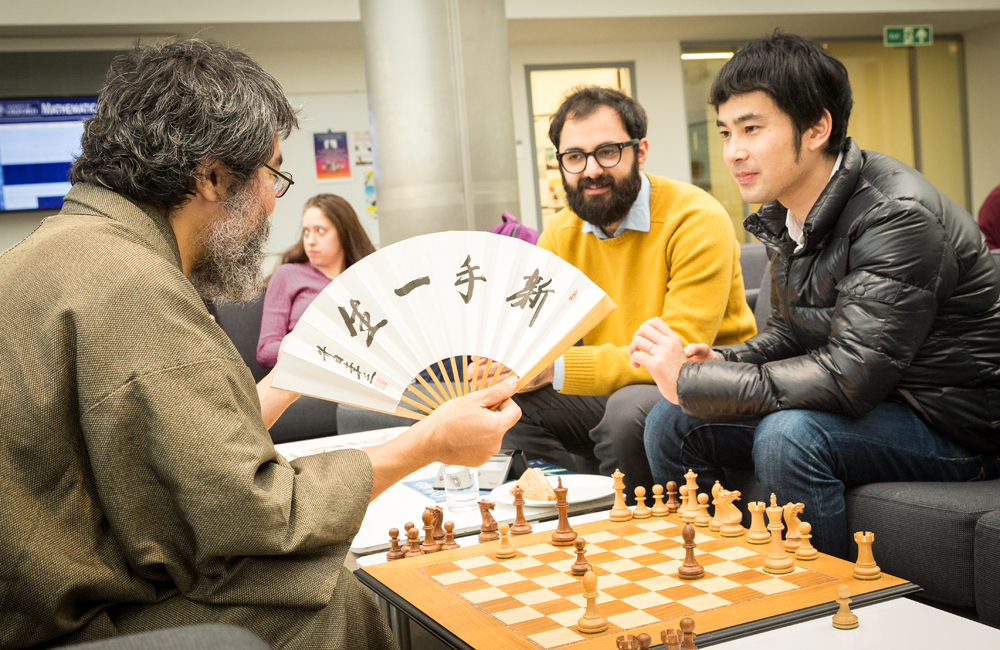
Go Yamashita, Ariyan Javanpeyka and Yuichiro Hoshi (left to right)
discussing the presentations during a break.

The translation from integers to elliptic curves is a common one in
mathematics. It makes a conjecture more abstract and more complicated to
state, but it also allows mathematicians to bring more techniques to bear
on the problem. The strategy worked for Andrew Wiles
<https://www.maths.ox.ac.uk/people/andrew.wiles> when he proved Fermat’s
Last Theorem in 1994. Rather than working with the famously simple but
constraining formulation of the problem (which states that there is no
solution in positive integers to the equation *an* +*bn* = *cn* for any
integer value of *n* greater than 2), he translated it twice over: once
into a statement about elliptic curves and then into a statement about
another type of mathematical object called “Galois representations” of
elliptic curves. In the land of Galois representations, he was able to
generate a proof that he could apply to the original statement of the
problem.

Mochizuki employed a similar strategy in his work on *abc*. Rather than
proving *abc*directly, he set out to prove Szpiro’s conjecture. And to do
so, he first encoded all the relevant information from Szpiro’s conjecture
in terms of a new class of mathematical objects of his own invention called
Frobenioids.

Before Mochizuki began working on IUT theory, he spent a long time
developing a different type of mathematics in pursuit of an *abc* proof. He
called that line of thought “Hodge-Arakelov theory of elliptic curves.” It
ultimately proved inadequate to the task. But in the process of creating
it, he developed the idea of the Frobenioid, which is an algebraic
structure extracted from a geometric object.

To understand how this works, consider a square with the corners labeled *A*
, *B*, *C* and*D*, with corner *A* in the lower right and corner *B* in the
upper right. The square can be manipulated in a number of ways that
preserve its physical location. For example, it can be rotated by 90
degrees counterclockwise, so that the arrangement of the labeled corners,
starting from the lower right, ends up as (*D*, *A*, *B*, *C*). Or it can
be rotated 180, 270 or 360 degrees, or flipped across either of its
diagonals.

Each manipulation that preserves its physical location is called a symmetry
of the square. All squares have eight such symmetries. To keep track of the
different symmetries, mathematicians might impose an algebraic structure on
the collection of all ways to label the corners. This structure is called a
“group.” But as the group becomes freed from the geometric constraints of a
square, it acquires new symmetries. No set of rigid motions will get you a
square that can be labeled (*A*, *C*, *B*, *D*), since in the geometric
square, *A* always has to be adjacent to *B*. Yet the labels in the group
can be rearranged any way you want — 24 different ways in all.
[image: Go Yamashita]
<https://www.quantamagazine.org/wp-content/uploads/2015/12/ABC_02.jpg>

*Philipp Ammon <http://www.photoammon.com/#!/index> for Quanta Magazine*

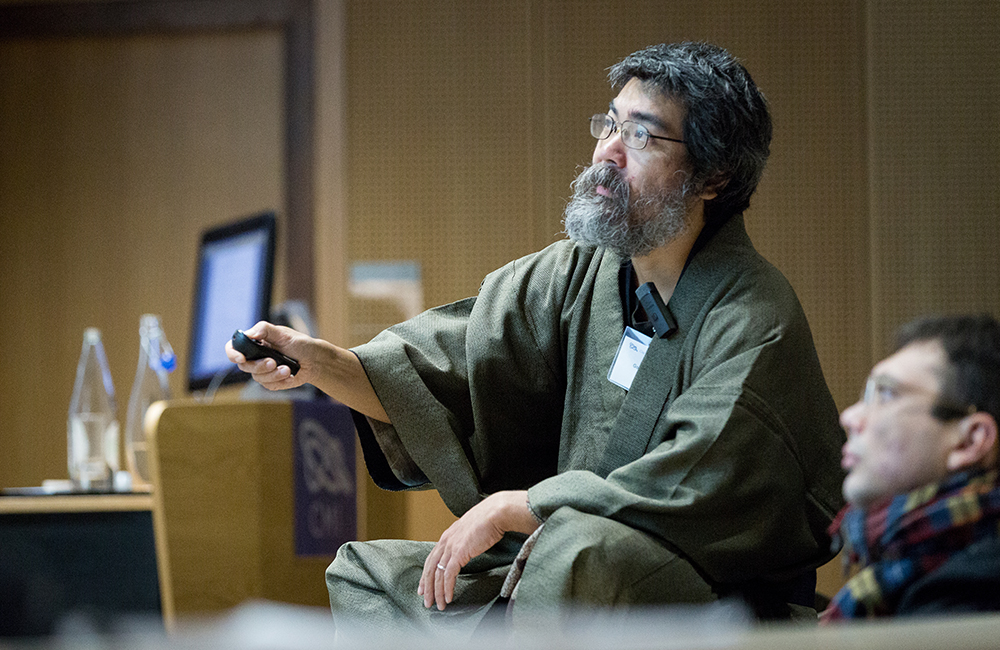
Go Yamashita lecturing on the work of Shinichi Mochizuki.

Thus the algebraic group of the symmetries of the labels actually contains
three times as much information as the geometric object that gave rise to
it. For geometric objects more complicated than squares, such additional
symmetries lead mathematicians to insights that are inaccessible if they
use only the original geometry.

Frobenioids work in much the same way as the group described above. Instead
of a square, they are an algebraic structure extracted from a special kind
of elliptic curve. Just as in the example above, Frobenioids have
symmetries beyond those arising from the original geometric object.
Mochizuki expressed much of the data from Szpiro’s conjecture — which
concerns elliptic curves — in terms of Frobenioids. Just as Wiles moved
from Fermat’s Last Theorem to elliptic curves to Galois representations,
Mochizuki worked his way from the *abc* conjecture to Szpiro’s conjecture
to a problem involving Frobenioids, at which point he aimed to use the
richer structure of Frobenioids to obtain a proof.

“From Mochizuki’s point of view, it’s all about looking for a more
fundamental reality that lies behind the numbers,” Kim said. At each
additional level of abstraction, previously hidden relationships come into
view. “Many more things are related at an abstract level than they are at a
concrete level,” he said.

In presentations at the end of the third day and first thing on the fourth
day, Kiran Kedlaya <http://math.ucsd.edu/~kedlaya/>, a number theorist at
the University of California, San Diego, explained how Mochizuki intended
to use Frobenioids in a proof of *abc*. His talks clarified a central
concept in Mochizuki’s method and generated the most significant progress
at the conference thus far. Faltings, who was Mochizuki’s doctoral adviser,
wrote in an email that he found Kedlaya’s talks “inspiring.”

“Kedlaya’s talk was the mathematical high point of the meeting,” said Brian
Conrad <http://math.stanford.edu/~conrad/>, a number theorist at Stanford
University who attended the conference. “I wrote to a lot of people on
Wednesday evening to say, wow, this thing came up in Kedlaya’s talk, so on
Thursday we’re probably going to see something very interesting.”

It wasn’t to be.

*‘Good Confusion’*

The understanding that Mochizuki had recast *abc* in terms of Frobenioids
was a surprising and intriguing development. By itself, though, it didn’t
say much about what a final proof would look like.

Kedlaya’s exposition of Frobenioids had provided the assembled
mathematicians with their first real sense of how Mochizuki’s techniques
might circle back to the original formulation of Szpiro’s conjecture. The
next step was the essential one — to show how the reformulation in terms of
Frobenioids made it possible to bring genuinely new and powerful techniques
to bear on a potential proof.
[image: Brian Conrad and Minhyong Kim]
<https://www.quantamagazine.org/wp-content/uploads/2015/12/ABC_05.jpg>

*Philipp Ammon <http://www.photoammon.com/#!/index> for Quanta Magazine*

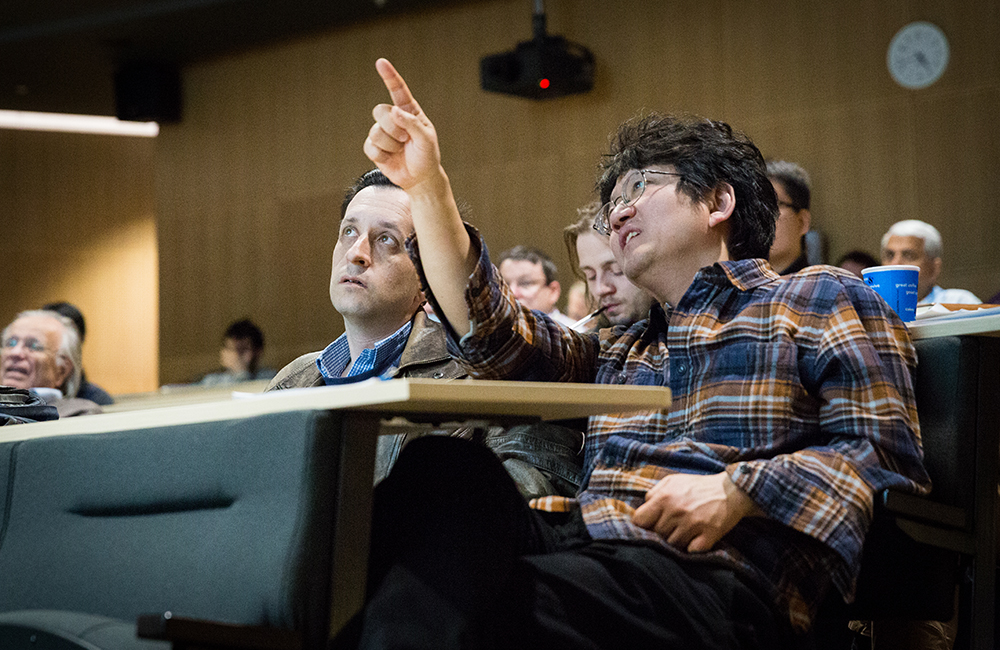
Brian Conrad and Minhyong Kim discussing a presentation.

These techniques appear in Mochizuki’s four IUT theory papers, which were
the subject of the last two days of the conference. The job of explaining
those papers fell toChung Pang Mok
<http://www.mcm.ac.cn/faculty/cpmok/201409/t20140916_255899.html> of Purdue
University and Yuichiro Hoshi
<http://www.kurims.kyoto-u.ac.jp/~yuichiro/index_e.html> and Go Yamashita
<http://www.kurims.kyoto-u.ac.jp/~gokun/>, both colleagues of Mochizuki’s
at the Research Institute for Mathematical Sciences at Kyoto University.
The three are among a small handful of people who have devoted intense
effort to understanding Mochizuki’s IUT theory. By all accounts, their
talks were impossible to follow.

Felipe Voloch <http://www.ma.utexas.edu/users/voloch/>, a number theorist
at the University of Texas, Austin, attended the conference and posted
<https://plus.google.com/106680226131440966362/posts/49TR2Qeb9WR> updates
<https://plus.google.com/106680226131440966362/posts/X9sNPQGfSVF> throughout
<https://plus.google.com/106680226131440966362/posts/LzSBw8zoG6w> the five
<https://plus.google.com/106680226131440966362/posts/LLHPN3QLoqX> days
<https://plus.google.com/106680226131440966362/posts/UHoetkZ7XXK> on the
social-media site Google Plus. Like Conrad, he went into the Thursday talks
anticipating a breakthrough — one that never came. Later that fourth day he
wrote, “At the afternoon tea break, everybody was confused. I asked many
people and nobody had a clue.” Conrad echoes that sentiment, explaining
that the talks were a blizzard of technical terms.

“The reason it fell apart is not meant as a reflection of anything with
Mochizuki,” he said. “I mean, far too much information was thrown at the
audience in far too little time. I spoke with every participant there who
was not previously involved in this work and we were all completely and
totally lost.”

The failure of the final talks to communicate how Frobenioids are used in
IUT theory was partly to be expected, according to some participants.

“I think there was some hope that we’d be able to follow the trail all the
way through to the end, but frankly the material gets substantially more
difficult at that point,” Kedlaya said. “It’s not entirely the fault of the
speakers who came after me.”

Kim thinks the trouble with the final talks is due in part to cultural
differences. Yamashita and Hoshi are both Japanese; Kim explains that in
Japan, mathematicians are more accustomed to dealing with a steady
succession of technical definitions in presentations. “That was one
situation where cultural differences really did play something of a role,”
Kim said. “Many dense slides requiring a good deal of patience and focus —
that kind of thing is more acceptable in Japan. People are more used to a
dialectic, interactive style when you go to a lecture in the U.S.”

Related Articles:

[image: MonstrousMoonshine_996x560]
<https://www.quantamagazine.org/20150312-mathematicians-chase-moonshines-shadow/>

Mathematicians Chase Moonshine’s Shadow
<https://www.quantamagazine.org/20150312-mathematicians-chase-moonshines-shadow/>Researchers
are on the trail of a mysterious connection between number theory, algebra
and string theory.

Unheralded Mathematician Bridges the Prime Gap
<https://www.quantamagazine.org/20130519-unheralded-mathematician-bridges-the-prime-gap/>A
virtually unknown researcher has made a great advance in one of
mathematics’ oldest problems, the twin primes conjecture.

While the conference did not yield an unequivocal outcome (as few people
really expected it to do), it did produce real, if incremental, progress.
Kedlaya said afterward that he felt motivated to correspond with others who
have read more of IUT theory and that he planned to attend the next
conference on the topic, in July at Kyoto University.

“I’m not unhappy with the amount of progress that was made,” Kedlaya said.
“We wanted more, but I think it’s worth the effort of this community to
take at least one more run at this and see if we can get further.”

Others think the onus remains on Mochizuki to better explain his work. “[I]
got the impression that unless Mochizuki himself writes a readable paper,
the matter will not be resolved,” Faltings said by email.

Kim is less certain that this step will be necessary. After everyone had
left Oxford, he reflected on the confusion the attendees took home with
them. As he saw it, it was good confusion, the kind that develops when
you’re on your way to learning something.

“Prior to the workshop I would say most people who came generally had no
idea of what the author was attempting in the IUT papers,” he said. “Last
week people were still confused, but they had a pretty concrete outline of
what the author was trying to do. How does he do it? That was a vague
question. Now there are many more questions, but they’re much more
sophisticated kinds of questions.”