Kelburn Koontz wrote:

> Thanks Marshall and Wayne for your replies.
>
> Wayne, I am looking at a schematic of your circuit.  Is the LED the current
> limiter?  If so according to Marshall I need no more than 1ma per square
> inch, I am assuming of electrode surface area.  Lets say the bridge will
> allow about 50.6V (voltage drop from diodes) to the rest of the circuit.
> LED's drop about 2V so the resistor will drop about 48.6V.  At 8K that means
> a current of about 6ma, that LED will be dim.  So that means I need at least
> 6 square inches of electrodes in the water.
>
> 12 gauge wire is 1/12" in dia, or .08333", so the Area of the wire
> electrodes equals:
>
> I want 6 square inchesof surface area.  Area of the ends of the wires plus
> the area of the sides.
> 6 =(2*pi*r^2)+(2*pi*r*h) = 2*pi( r^2 + r*h)
>
> 6/(2*pi) = r^2 + r*h
>
> .955 = r^2 + r*h
> R equals .041665"
> so,
> .955 = .041665^2 + .041665*h = .00174 + .041665 * (unkown h or total length
> of electrodes)
>
> .955 -.00174 = 0.95326 this is inches squared.
> square rooted .955 equals .976
> .976/.041665 = 23.43 inches total lengths of electrodes.
>
Sounds about right to me. I have gone through the same math with 14 guage wire.

>
> Or 11.7 inches each electrode underwater.  If I use 12" that should put me
> under the 1ma per square inch requirement.
>

No, the 1 mA per square inch refers to the anode surface area, not the sum of
the anode and cathode areas.

>
> Does this seem right to the CS generator veterans on the list?  Should I be
> worried enough to boggle my own mind trying to do this?

You may want to consider a method of stiring, as well as a mechanism to reverse
the polarity every minute.  The first will get the ions away from the anode so
they have less chance to aggregate into large particles, and the reversal will
prevent the buildup of silver crude on the electrodes.

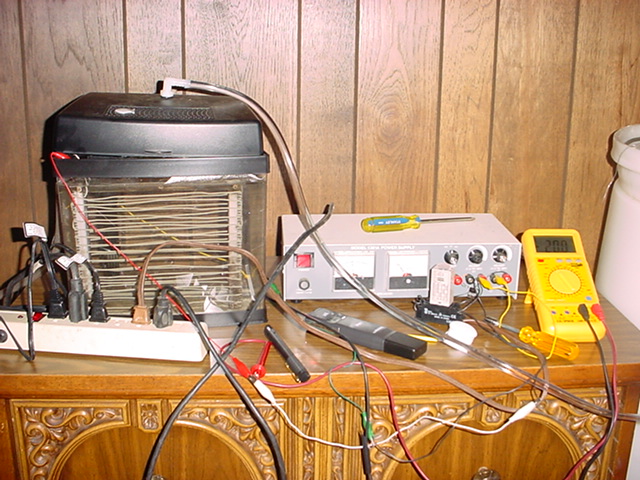
Here is a picture of a unit that produces about 1 gallon an hour of 20 ppm EIS:
http://silver-lightning.com//DSC00737.JPG that I built for under $100, and most
of that was invested in a flow meter and main pump since this is a flow through
process.

It is built from a small aquarium. The top has a pump in it that pumps from the
lower left and dumps the water back in at the top right.  That does the
stirring, Distilled water flows into the top and mixes with the water being
recirculated, and as water goes in, EIS flows out the left side into the
overflow tube that dumps into a 55 gallon barrel. The power supply is set to
30-40 volts, and you can see a voltage regulator with a resistor mounted on the
negative terminal of the supply to give constant current. In front of the supply
is a recycle relay that is set to 1 minute, that reverses the current every
minute.  There is a multimeter on the right to measure the voltage across the
electrodes (which is reading 20 Volts) to make sure everything is running
stable. On front you can see a TDS meter for measuring the conductivity as it is
being made, and to the left of it is a laser pointer.

This unit can run for over 2 days before having to swap out the 55 gallon drum
when producing 20 pm CS.

Marshall

>
>
> Thanks,
> Kel
>
> --
> The Silver List is a moderated forum for discussing Colloidal Silver.
>
> Instructions for unsubscribing are posted at: http://silverlist.org
>
> To post, address your message to: [email protected]
>
> Address Off-Topic messages to: [email protected]
>
> The Silver List and Off Topic List archives are currently down...
>
> List maintainer: Mike Devour <[email protected]>
>