Russia: Is Putin Looking To Impose Solutions To Frozen Conflicts?
 <mailto:[EMAIL PROTECTED]> By Robert Parsons
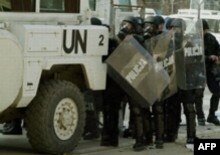
 Kosovo -- UN Patrol
<http://gdb.rferl.org/c7b257ef-2398-47a7-8ddc-d67ed1478742_w220_s.jpg>
Ethnic Serbs and ethnic Albanians will meet soon to discuss Kosovo's status
(AFP)
Russian President Vladimir Putin said during his 31 January Kremlin press
conference that there is a need for "universal principles" to settle "frozen"
conflicts. His comments come against the background of impending talks on the
future status of Kosovo, which many predict will grant it a form of
"conditional independence" from Serbia and Montenegro. As an ally of Serbia,
Moscow has consistently opposed the idea of Kosovar independence. Putin's
remarks suggest he may be shifting his position, but only if the principles
applied to Kosovo are also applied to frozen conflicts in the former Soviet
Union. If Kosovo can be granted full independence, he asked, why should we deny
the same to Abkhazia and South Ossetia?
PRAGUE, 2 February 2006 (RFE/RL) -- It's the context that is all important.
After years of behind-the-scenes negotiations on the future status of Kosovo, a
deal appears imminent. But not the deal that Russia wanted.

Ethnic Serbs and ethnic Albanians were scheduled to begin talks in Vienna on 25
January but were forced to put them on hold because of the death of Ibrahim
Rugova, the leader of Kosovo's majority Albanian population.

But even before the talks were due to begin, the word was that Britain, France,
the United States, and Russia -- the interested international powers -- had
reached a degree of consensus. The talk is of "conditional independence," a
formula that would separate Kosovo from Serbia and Montenegro but leave it
subject to an international mission.
Since Moscow regards Serbia as a political ally, this is a diplomatic battle
that Russia appears to have lost. But Putin hinted at his Kremlin press
conference this week that Russia might try to exact a price.

"If someone believes that Kosovo should be granted full independence as a
state, then why should we deny it to the Abkhaz and the South Ossetians? I am
not talking about how Russia will act," Putin said. "However, we know that
Turkey, for instance, has recognized the Republic of Northern Cyprus. I don't
want to say that Russia will immediately recognize Abkhazia or South Ossetia as
independent, sovereign states, but such precedents do exist in international
practice."

Universal Principles

Is that a heavy hint at the future direction of Russian foreign policy or more
a reflection of wounded pride? Perhaps both, but Aleksei Malashenko of the
Carnegie Endowment in Moscow believes that Putin's search for universal
principles for solving frozen conflicts will get Russia nowhere.

"It will give him an opportunity to press on Georgia and to say all the time
that if it was done in Kosovo the same thing can be done in Abkhazia and maybe
in South Ossetia, but at the same time I don't believe in this way Putin will
be successful because the idea of universalism is rejected by the Western
community," Malashenko said.

That's a view shared by Edward Lucas, the Central and Eastern European
correspondent of "The Economist" magazine, who suggests too that Putin may find
that drawing general conclusions about conflict resolution from Kosovo may be
more difficult than he thinks.

"There's two conflicting principles here of self-determination and territorial
integrity. But I think the key thing is that there is no one outside power that
is backing Kosovo," Lucas said. "Kosovo is not the client of a powerful
neighboring state the way that Abkhazia, South Ossetia, and Transdniester are.
So I think the first thing we would have to say if one were trying to find a
common standard would be that no neighboring country should exercise a big
unilateral blockade or support for one of these frozen conflicts and that, of
course, would put Russia in a very difficult position."

Self-Determination And Territorial Integrity

Russia might also find itself treading on very thin ice. The principle of
self-determination in particular cuts both ways. "And there's also Chechnya,"
Lucas said. "If you accept that there's the right to self-determination, or at
least that it has to be taken into account, and one doesn't only deal with
inviolable territorial integrity, then it does of course raise the question of
Chechnya now and, perhaps at some other date in the future, some other bits of
Russia that are there more by coincidence that by historical right like, for
instance, Karelia or Tatarstan."

Thin ice or not, there is clearly sympathy in Russia for drawing parallels with
Kosovo. Sergei Markov, director of the Institute of Political Studies, a Moscow
think tank with close ties to the Kremlin, noted on 31 January that while
Russia opposed independence for Kosovo because Serbia is Russia's ally, it
would be prepared to accept it on condition that the precedent is extended to
the four frozen conflicts in the Commonwealth of Independent States


http://www.rferl.org/featuresarticle/2006/2/0f827c1a-13d6-4394-aa25-5bd758b70cd0.html

Related...
<http://services.newsgator.com/subscriber/Related.aspx?relurl=http%3a%2f%2fwww.rferl.org%2ffeaturesarticle%2f2006%2f2%2f0f827c1a-13d6-4394-aa25-5bd758b70cd0.html>


[Non-text portions of this message have been removed]


===============
Group Moderator: [EMAIL PROTECTED]
page at http://magazine.sorabia.net
for more informations about current situation in Serbia http://www.sorabia.net
Slusajte GLAS SORABIJE nas talk internet-radio (Serbian Only)
http://radio.sorabia.net

Yahoo! Groups Links

<*> To visit your group on the web, go to:
    http://groups.yahoo.com/group/sorabia/

<*> To unsubscribe from this group, send an email to:
    [EMAIL PROTECTED]

<*> Your use of Yahoo! Groups is subject to:
    http://docs.yahoo.com/info/terms/