---------- Forwarded message ----------
From: "Jean-Francois Darcq" <[email protected]>
Date: 22 May 2015 08:04
Subject: Fwd: South Sudan: A provisional update from the oil regions | 21
May 2015
To: "elisabethjanaina" <[email protected]>
Cc:
---------- Forwarded message ----------
From: "Eric Reeves" <[email protected]>
Date: 22 May 2015 04:33
Subject: South Sudan: A provisional update from the oil regions | 21 May
2015
To: "Eric Reeves" <[email protected]>
Cc:

The fighting that is now occurring in the *oil regions of Upper Nile, South
Sudan* has created dangers greater than at any time since the outbreak of
violence in mid-December 2013. There is very little news reporting at
present, but a range of reliable sources on the ground paint the grimmest
of pictures. While the situation remains fluid, the preponderance of
evidence and some highly authoritative reports suggest that it is only a
matter of time before the *Adar Yel* and *Paloich oil fields* are shut down
by fighting. *Bloomberg* reports (May 21, 2015
<http://www.bloomberg.com/news/articles/2015-05-21/south-sudan-says-oil-staff-back-at-northern-field-after-violence-i9y0wr7o>)
that workers evacuated to Juba from Paloich have returned; but the sources
for this and what few news reports there have been depend excessively on
the claims of the parties to the conflict, who have frequently made
expediently false claims. In any event, it is important to remember that
shutting down an oil pipeline and related infrastructure are complex tasks,
which if not performed correctly with adequate time, can result in
tremendous damage, both the pipeline and infrastructure, as well as the
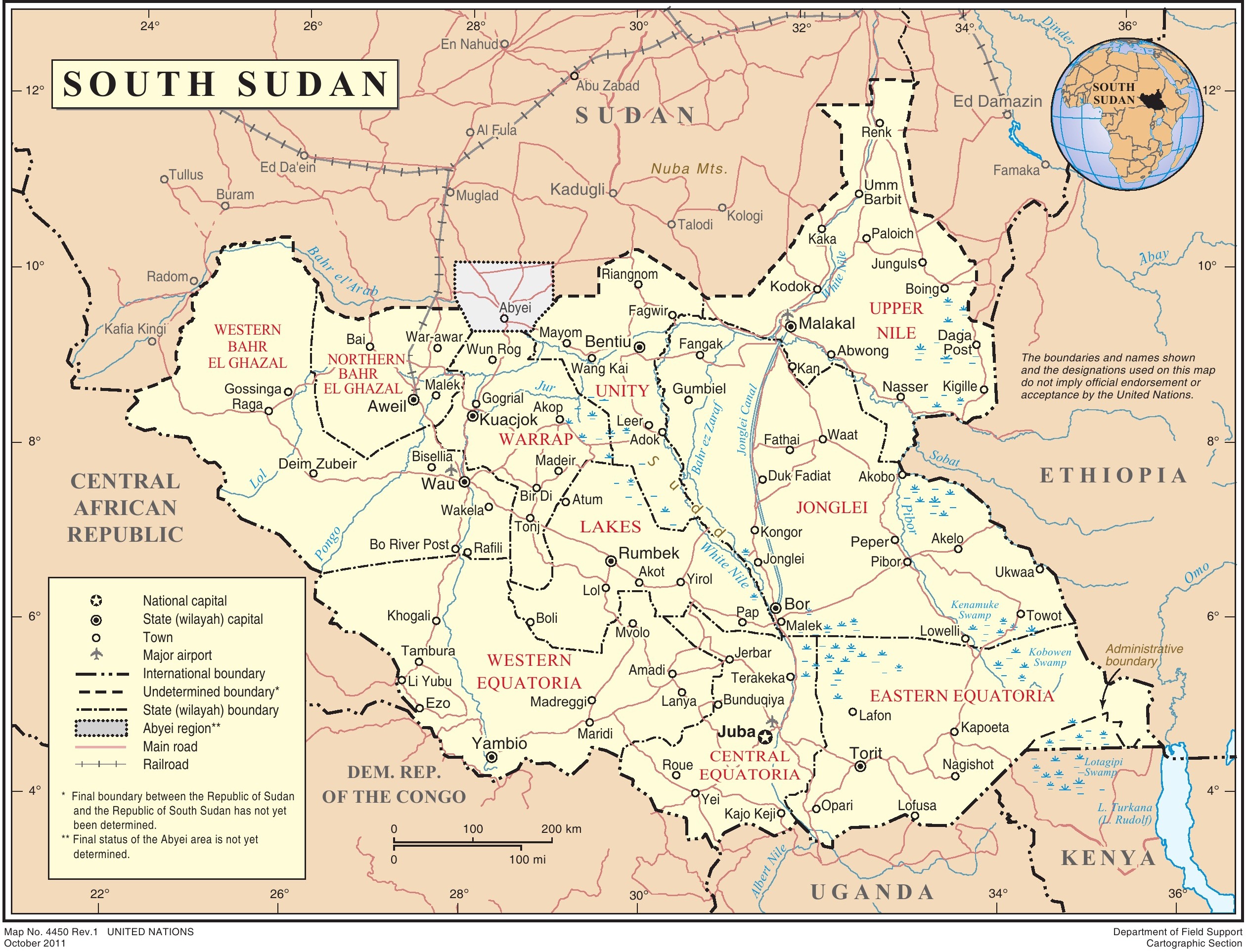
local environment.[image: SouthSudan Map]
<http://sudanreeves.org/wp-content/uploads/2014/09/SouthSudan-Map.jpg>

*Map of South Sudan; Upper Nile is in the northeast section of the country*

It is clear from all reports that* “General” Johnson Olony* has sided with
the rebel forces of the* SPLA/In Opposition (SPLA/IO)*, nominally led by *Riek
Machar*. The degree of Riek’s command and control over opposition forces is
unclear, but is certainly far from complete. Indeed, Olony has declared
publicly that his primarily *Shilluk* force will operate independently of
the SPLA/IO, with a primary goal of protecting regions in which Shilluk
populations are concentrated. But this is belied by what is his apparently
central role in the impending assault on Adar Yel and Paloich, the two
critical points in the oil region of Upper Nile. His forces also apparently
control *Malakal*, which was retaken from the *SPLA/Juba* several days ago.

*[Update from Juba:* *3pm, May 21, 2015*] A highly informed source
indicates that Olony may have suffered a significant military set-back in
Malakal and has requested of Khartoum an airlift to safety. The same source
reports that Malakal is now largely back in SPLA/Juba hands, although
elements of Riek's forces remain in the strategic town.*]*

Heavy fighting is reported in Upper Nile—from *Renk* in the far north to
Malakal in the south, to several areas in the east. This includes
substantial use of tanks, artillery, mortars, heavy machine-guns, as well
as a great many smaller automatic weapons. Although the rainy season will
soon be upon the region, a provisional fate for the oil regions appears may
well be decided in the coming days.

Not only does this suggest that there will be no end to fighting between
the various elements of the SPLA/IO (including Olony’s forces) and the
*SPLA/Juba*, but that retaliatory ethnic violence will follow around the
country. There are already reports from Juba, for example, that Shilluk
have been targeted and attacked, with many fleeing. There are also serious
questions about some of the key components of larger SPLA/Juba military
units in Upper Nile: the majority of soldiers in at least one key unit,
according to a source in Juba, are *Nuer* and Shilluk and may desert to the
SPLA/IO. SPLA/Juba may find that both their tactical and strategic efforts
are badly compromised by such defections.

The heaviest fighting is reported to be at *Melut*, on the *Nile River*,
approximately *40 kilometers to the west of Paloich*. If Melut falls to the
SPLA/IO, it is unlikely that the SPLA/Juba will be able to retain control
of the oil fields. SPLA/Juba military spokesman Philip Aguer today declared
<http://news.videonews.us/s-sudan-says-repulsed-rebel-attack-paloch-oilfields-2117864.html>
:

“The SPLA eliminated the threat to Paloich and the oilfields by defeating
the rebels yesterday,” army spokesman Col. Philip Aguer told Anadolu
Agency. “We have recaptured the town of Melut less than 24 hours after the
rebels entered it.”

But this account does not comport with other, more disinterested accounts.
Based on the evidence available, I believe the oil fields may soon be shut
down and that the workers who have already been evacuated once will be
evacuated again, and will not return for the foreseeable future. And if the
SPLA/IO should take *firm* military control of the oil fields—an unlikely
development but certainly possible—it is an open question as to whether the
skilled oil workers necessary to re-start the oil flow will return at all.

This raises a question that has been in play since fighting took on a
national character in South Sudan shortly after the* events in Juba in
mid-December 2013*: what will be the response of the *Khartoum regime* to
the halting of the flow of oil from Upper Nile, from which it derives
critical transit fees, one of the last remaining sources of hard currency
the regime has? Such transit fees are paid both by the foreign oil
companies that built and control the oil fields of Upper Nile (essentially
*China* and *Malaysia*) as well as by South Sudan. But if South Sudan is
denied oil export revenues because of a shutdown in oil production and
transit, the* Government of South Sudan* will of course make no further
payments to Khartoum.

*Khartoum’s response*

Minutes from an important meeting of senior regime officials on August 31,
2014
<http://sudanreeves.org/2014/10/22/new-and-exceedingly-accurate-translation-into-e/>
make
clear the desire to assist militarily—in strategically significant ways—the
SPLA/IO (for commentary on authenticity of these minutes, see
http://wp.me/p45rOG-1w5). Excerpts appended to the end of this dispatch
make clear the extent of this assistance.

Collectively, the leaked minutes from meetings on July 1, 2014,
<http://wp.me/p45rOG-1Cb> August 31, and September 10, 2014
<http://wp.me/p45rOG-1Ff> suggest the very real possibility of Khartoum’s
takeover of the oil regions; at the very least the regime wants to see a
weakening of South Sudan by having, yet again, Southern fight against
Southerner.

Economic pressures on the regime, and the threat of civil insurrection, are
enormous. Since August of last year, the economy in Sudan has continued to
implode
<http://www.enoughproject.org/reports/enough-forum-watching-bubble-burst> under
the pressures of high inflation, high unemployment, gargantuan external
debt with fewer sources of loan guarantees, a rapidly declining currency,
and an *almost total lack of foreign exchange currency*. It is this last
that may force the regime’s hand: *bread lines and shortages*, as well
as *shortages
of cooking fuel*, have been reported for over a year: there simply isn’t
enough hard currency with which to buy wheat for flour or fuel for cooking.
The agricultural sector in Sudan has declined precipitously during the
twenty-six-year rule of the *National Islamic Front/National Congress Party
regime*, and this only exacerbates the food shortages. Malnutrition is
running at shockingly high levels throughout much of Sudan, especially in
*Darfur*, *eastern Sudan*, the* Nuba Mountains*, and *Blue Nile State*.

If the regime does nothing, oil production may well be halted soon. If
the *Sudan
Armed Forces (SAF)* cross into South Sudan to seize the oil regions of
Upper Nile in order to re-start the flow of oil, it will completely
abrogate the *2005 Comprehensive Peace Agreement*, and sooner or
later—likely sooner—lead to war between Sudan and South Sudan. The
*SPLA/North* (in South Kordofan and Blue Nile) will likely make common
cause with SPLA/Juba, their former comrades in arms. The SAF will be
regarded by both as a mortal enemy, as it is now by the SPLA/North, which
has again withstood the worst that Khartoum can throw at them during this
second dry season *“Final Campaign.”*

Neither *IGAD*, the East African regional intergovernmental body, nor “
*IGAD+*”—nor the *UN* or *African Union*—seem to fully understand these
risks, or the consequences for the region of renewed war between Sudan and
South Sudan. There has, for example, been no pressure on Khartoum to halt
its assistance to the SPLA/IO, or to close the SPLA/IO training bases in
South Kordofan. The *Obama administration* and the* EU* both seem helpless,
with neither diplomatic vision nor an understanding of what pressures might
actually affect the situation on the ground. The much-threatened sanctions
against individuals will have little impact, particularly on people like
Olony and *Peter Gadet* (responsible for shooting down a UN transport
helicopter last August), and risk being disproportionately or erroneously
applied. Many of the men putatively targeted do not operate in any
meaningful chain of command, and do not leave South Sudan in any event.
They are impervious to sanctions.

Without pressure on Khartoum to stop its interference in the military
events in South Sudan, no arms embargo or other punitive measures can be
equitable. Denying the combatants weapons and ammunition will be key, but
will not work if perceived by Juba as one-sided in consequence. What is
much more important is that the international community have at the ready a
vigorous response to any military incursion into Upper Nile by Khartoum’s
forces.

On the ground, reconciliation, if it comes, will come slowly and region by
region. The *South Sudan Council of Churches* has begun in earnest with
this task, but it will require a great deal of civil society assistance.
The major military actors have been put on notice that they will be held
accountable for the atrocity crimes that have defined the violence for
almost a year and a half; to date, such threats seem to have had almost no
impact on either Riek Machar and his generals, or on *Salva Kiir* and the
men who surround and advise him.

[Of particular note in the chronicling of human rights abuses by the troops
loyal to the Government of South Sudan is a statement today (May 21, 2015)
by Amnesty International, attached below *[2] *as reported by Associated
Press from Kampala (Uganda)]

There are no easy answers to the crisis that has now developed and grown
terribly in South Sudan; no “silver bullet” or obvious negotiating
strategy. Tragically, men with guns are making the critical decisions for
all the people of South Sudan, who are suffering terribly, with famine
looming and more than 1.5 million people displaced from their homes.
Creative, robust, truly international diplomacy—sustaining pressure while
not setting artificial deadlines—is the greatest hope for peace in South
Sudan. But it will not come quickly or easily. What is certain is that the
crisis requires a good deal more attention and policy thought than it is
presently receiving.

*************************

*[1]  From minutes recording comments by senior military officials in
Khartoum, August 31, 2014
<http://sudanreeves.org/2014/10/22/new-and-exceedingly-accurate-translation-into-e/>:
on assisting Riek Machar and rebels in opposition to Juba (all emphases
added):*

*•  General Imad al-Din Adawy, Chief of Joint Operations:*

We [in the regime] suggested [to Juba] the formation of joint forces along
the border line, but they refused that too. They are still supporting the
two divisions of Nuba Mountains and Blue Nile. *Accordingly, we must
provide Riek’s forces with great support in order to wage the war against
Juba and clean the whole of Greater Upper Nile area.*

*•  Lt. General Hashim Abdalla Mohammed—Chief of Joint General Staff:*

*We must change the balance of forces in South Sudan. Riek, Taban [Deng],
and Dhieu Mathok came and requested support in the areas of training in
military intelligence and especially in tanks and artillery. They requested
armaments also. They want to be given advanced weapons*. Our reply was that *we
have no objection, provided that we agree on a common objective.* Then we
train and supply with the required weapons.

*•  Lt. General Abdel Rahman Mohamed Hussein—Minister to Defense:*

I met Riek, Dhieu and Taban and they are regretting the decision to
separate the South and *we decided to return his house to him* [Riek long
lived in Khartoum following his defection from the SPLA]. *He requested us
to assist him and that he has shortage in the military intelligence
personnel, operations command and tank technicians. We must use the many
cards we have against the South in order to give them unforgettable lesson.*

*•  Lt. General Bakri Hassan Salih—First Vice President:*

*We are not interested in any relation with South Sudan or the neighboring
countries, but it is a reality that requires us to respond and deal with
it. Dr. Riek paid me a visit on August 11, 2014. He said the Dinka
exterminated his tribe. He requested assistance. The president [Omar
al-Bashir] accepted to host a liaison office.*

*[2]  Amnesty International: South Sudan government troops are burning
villages * (Associated Press *[*Kampala*, *Uganda] May 21, 2015)

South Sudan government troops are setting villages on fire and abusing
civilians in an ongoing military assault on rebels loyal to the country's
former vice president, Amnesty International reported Thursday, the latest
allegations of serious rights abuses since the resumption of heavy fighting
last month. Citing witness accounts in Unity state, the watchdog group
reported Thursday that fighters in South Sudan military uniforms — and
others in civilian clothing —have attacked villages using axes, machetes
and guns.

Despite the spike in fighting the international community is "reluctant to
take bold steps toward addressing repeated atrocities," Michelle Kagari,
deputy director with Amnesty International, said in a statement. Aid groups
have recently pulled out of battle zones, leaving thousands of people in
need as rebel forces fight for control of the country's crucial oil fields.
South Sudan depends heavily on its oil exports to keep the government
running and the military's latest assault is widely seen as an attempt to
secure all the oil fields and get them running. But the rebels are fighting
back, leaving thousands of civilians caught in the crossfire. Rebel forces
on Wednesday said they were poised to take the oil hub of Paloch in Upper
Nile state, but the military said it repulsed the attack.

In its report Thursday, Amnesty International cited the account of women,
including a mother of three who recalled being raped by one fighter while
another pointed a gun at her. It was not immediately possible to get a
comment from South Sudan's military, which routinely denies such charges.
The alleged rights violations are taking place in areas where there are few
independent monitors, with the regional mediating group known as IGAD
saying last week its officials were prevented from monitoring the fighting
near Bentiu, Unity state's capital.

The United Nations on Thursday said heavy fighting resumed in the morning
around the town of Melut in Upper Nile state, where four civilians,
including a woman and a child, were killed on Tuesday when two mortar bombs
exploded inside a U.N. compound. "It remains unclear who is in control of
the town," the deputy spokesman for the U.N. secretary-general, Farhan Haq,
told reporters. He said seven displaced civilians have so far been killed
in the crossfire. Some 20,000 people who had been sheltering outside the
U.N. base there have scattered, he said. Journalist Pow James Raeth was
shot dead Wednesday by unknown perpetrators in Akobo, Jonglei state, said
his employer, South Sudan's Radio Tamazuj. He is the sixth journalist
killed in South Sudan this year.
--

Eric Reeves
Smith College
Northampton, MA  01063
       413-585-3326
       [email protected]

       Skype: ReevesSudan

       Website:   www.sudanreeves.org

*Compromising With Evil: An archival history of greater Sudan, 2007-2012  *
www.CompromisingWithEvil.org

--
To post to this group, send email to [email protected]
To unsubscribe from this group, send email to
[email protected]
Visit this group at https://groups.google.com/d/forum/southsudankob
View this message at
https://groups.google.com/d/msg/southsudankob/topic-id/message-id
For more options, visit https://groups.google.com/d/optout
---
You received this message because you are subscribed to the Google Groups
"South Sudan Info - The Kob" group.
To unsubscribe from this group and stop receiving emails from it, send an email
to [email protected].
To post to this group, send email to [email protected].
Visit this group at http://groups.google.com/group/SouthSudanKob.
To view this discussion on the web visit
https://groups.google.com/d/msgid/SouthSudanKob/CAJb14oouVta%2BGUVngqB0LT%2BbkFYGKHkQhuu-v_kA%3DAUpthmh4w%40mail.gmail.com.
For more options, visit https://groups.google.com/d/optout.