---------- Forwarded message ----------
From: "Eric Reeves" <[email protected]>
Date: 14 Jun 2015 20:27
Subject: Darfur: Radio Dabanga News Digest Number 16 | 14 June 2015
To: "Eric Reeves" <[email protected]>
Cc:
This *sixteenth installment *of* Darfur: Radio Dabanga News Digest* has as
its primary context the evident *decision by the Security Council to
re-authorize the UN/African Union Mission in Darfur (UNAMID) without
changes*, specifically with no withdrawal from *West Darfur* or locations
under discussion in* South* and *North Darfur.* This was the recommendation
of the Secretary General in his May 26, 2015 report to the Security Council
on Darfur and UNAMID <http://www.refworld.org/pdfid/556db09c4.pdf>. A vote
is likely in two weeks.

The report compiled for *UN Secretary General Ban Ki-moon* seems to reflect
a belated but significant re-thinking of the need for transparency and
frankness in characterizing realities in Darfur. Encouragingly, it does not
skirt the larger issues, provides a useful over view of what it calls
“inter-communal” violence (primarily “inter-tribal” violence), and presents
a picture of UNAMID that is both more honest, and thus necessarily
discouraging in many respects. On the other hand, there does seem to have
been a serious effort to improve the performance of the Mission, with some
impressive achievements to its credit. Facilitating talks to end
“inter-communal violence” seems an especially important part of the Mission
as now conceived—an essential development.

It is still far from an adequate source of security for civilians and
humanitarians, and its reporting ability is limited by a host of factors,
including denial of access by the Khartoum regime and its proxy local
officials. And what is clear from a great many reports not referred to in
the Secretary General’s report is that the humanitarian and security
situations have continued to deteriorate in ways that are not considered.
Here *Radio Dabanga* remains an indispensible resource.

The current Digest looks at the most revealing dispatches from Radio
Dabanga for the *past week,* and also includes as *Appendices*: *[1]* a
“bibliography of violence” covering the past six months in *West
Darfur* (culled
from last week’s Digest), and *[2]* key excerpts from the lengthy *May 26,
2015 report by the Secretary General *(over 11,000 words).

[For previous (weekly) Radio Dabanga Digests, see:

Darfur: Radio Dabanga Digest, Number 1 | http://wp.me/p45rOG-1CD

Darfur: Radio Dabanga Digest, Number 2 | http://wp.me/p45rOG-1De

Darfur: Radio Dabanga Digest, Number 3 | http://wp.me/p45rOG-1Dt

Darfur: Radio Dabanga Digest, Number 4 | http://wp.me/p45rOG-1Ei

Darfur: Radio Dabanga Digest, Number 5 | http://wp.me/p45rOG-1EL

Darfur: Radio Dabanga Digest, Number 6 | http://wp.me/p45rOG-1Fp

Darfur: Radio Dabanga Digest, Number 7 | http://wp.me/p45rOG-1FL

Darfur: Radio Dabanga Digest, Number 8 | http://wp.me/s45rOG-6452

Darfur: Radio Dabanga Digest, Number 9 | http://wp.me/p45rOG-1Gi

Darfur: Radio Dabanga Digest, Number 10 | http://wp.me/p45rOG-1Gt

Darfur: Radio Dabanga Digest, Number 11 | http://wp.me/p45rOG-1Hq

Darfur: Radio Dabanga Digest, Number 12 | http://wp.me/p45rOG-1HY

Darfur: Radio Dabanga Digest, Number 13 | http://wp.me/p45rOG-1Ia

Darfur: Radio Dabanga Digest, Number 14 | http://wp.me/p45rOG-1II

Darfur: Radio Dabanga Digest, Number 15 | http://wp.me/p45rOG-1Ji

Darfur: Radio Dabanga Digest, Number 16 | http://wp.me/p45rOG-1JU — and
below

(*NB: *A useful and quite recent administrative map of Darfur appears here
<http://unamid.unmissions.org/LinkClick.aspx?fileticket=SOZJ9VBg2Ag%3D&tabid=11744&language=en-US>
.)

*Eric Reeves, 14 June 2015*
*UNAMID’s future in the face of growing hostility from Khartoum*

While re-authorization of UNAMID without change will represent an important
stand by the Security Council in resisting Khartoum’s demands—notably,
opposition to re-authorization by Russia and China was apparently only
modestly energetic—we should not forget that the regime is on record as
having said they wish to see the *present 17,000* uniformed personnel in
Darfur *reduced to 2,000 by the end of the year*—and this comes this after
previous reductions in the size of the originally authorized UNAMID:
over *10,000
personnel have been deployed out of Darfur*, with *more reductions in the
offing
<https://www.dabangasudan.org/en/all-news/article/unamid-to-cut-770-posts-in-darfur>*.
Some of the previous reductions—e.g., the *reduction of the original 19
Formed Police Units (FPU) to 13*—cannot help but have serious consequences
for the functioning of UNAMID as a protective force. Particularly in camp
situations, FPU can be highly effective, if properly equipped and deployed.
Some of the reductions—e.g., the *firing of more than 200 native Darfuri
translators*
<https://www.dabangasudan.org/en/all-news/article/unamid-fires-209-local-translators-in-darfur>—seem
extraordinarily unwise.

All of these reductions are described as “streamlining,” “reconfiguring,”
“increasing efficiency,” or with other terms that disguise the true nature
of what has *already* been done by *UN Secretary General Ban Ki-moon*
and *Under-Secretary
General for Peacekeeping, Hervé Ladsous*, with the approval of the Security
Council in its *last re-authorization resolution (August 2014).* Their “do
more with less” motto for UNAMID has already compromised the Mission’s
effectiveness, even as remaining personnel are showing signs of becoming
somewhat more determined to be effective.
*Khartoum’s response to a re-authorized Mission with no change in mandate*

What we may sure of is that a Security Council re-authorization of UNAMID
without a change in mandate or terms of deployment will greatly anger the
Khartoum regime, something certainly well known by uniformed personnel on
the ground. The Secretary General’s report highlights, for example, that on *26
April*, “the* National Intelligence and Security Services refused to allow
an emergency medical evacuation of an injured Ethiopian peacekeeper *to
proceed, by air, from *Mukjar* to *Nyala*, citing security concerns. *The
peacekeeper, who had been injured in an accident, died the same day”* (*§26*
).

*[All emphases in all quoted material, whether in* *bold** or **bold
underline**, have been added; all editorial comments are in italics
and blue, with my initials following—ER]*

For the reporting period, the Secretary General notes:

During the reporting period, *60 incidents and hostile acts against UNAMID
and its personnel were recorded throughout Darfur, compared to 46 in the
previous period*. These included armed attacks and carjacking (9
incidents), robbery/road banditry (18 incidents) and office
break-in/burglary/theft (33 incidents). (*§17*)

A highly alarming attack on UNAMID personnel near* Kass, South Darfur *figures
prominently in the report and is *excerpted in Appendix 2*, along with
other key findings. And while the Secretary General’s report notes
that “*UNAMID
continued to experience restrictions of movement, access denials and denial
of security clearances* for its patrols and other activities” (*§25*), we
may be sure that such challenges will increase significantly in the coming
months unless serious international pressure is brought to bear on Khartoum.

The implications for humanitarian work are commensurately ominous:

The worsening security environment in parts of Darfur continued to
have *significant
implications for the safety and security of humanitarian personnel and
assets*. Carjackings, lootings and general banditry reduce the ability of
humanitarian actors to provide assistance, and/or increase the costs of
doing so, creating an untenable situation*. **In most areas of Darfur,
United Nations agencies rely heavily on UNAMID for escorts, area security
and logistical capacity as a means of mitigating security risks and
operating constraints**. *(*§22*)

Among the most notable incidents was one that occurred *on 10 March, when
an unknown armed group attacked a convoy of 19 World Food Programme
logistics trucks escorted by UNAMID in Neni village, Northern Darfur*.
A *UNAMID
national staff driver was severely injured* and evacuated to El Fasher.
During the incident, UNAMID troops escorting the convoy exchanged fire with
the assailants who subsequently escaped with three vehicles, one contracted
fuel tanker and some food items. Only the three vehicles were recovered. *On
12 May, a group of armed men carjacked a World Food Programme car in Um
Dukhun, Central Darfur.* (*§24*)

*During the reporting period, the Government of the Sudan refused clearance
for [UNAMID] 68 sorties.* (*§27*)

Access denial has other implications for humanitarian assistance, as
highlighted at another moment in the Secretary General’s report:

In addition, *local authorities in Zalingei* *turned down a request by the
European Commission Humanitarian Aid and Civil Protection Department* *to
conduct monitoring* *visits on projects in deep-field locations*. This is
the *third time this year* that local authorities have denied donors access
to monitor their projects in Central Darfur*. Such denials hinder efforts
by aid organizations in Darfur to mobilize resources, thereby contributing
to broader funding challenges*. At the time of reporting, *only $280
million of the $1,035 million required to meet humanitarian needs across
the Sudan in 2015 had been provided (27 per cent)*. (*§30*)

*[This is a highly worrisome mid-year shortfall, given donor fatigue and
international concentration on South Sudan, and again portends acute,
life-threatening food shortages—ER]*

[image: PBiro_Ganyliel_320]
<http://sudanreeves.org/wp-content/uploads/2015/06/PBiro_Ganyliel_3201.jpg>

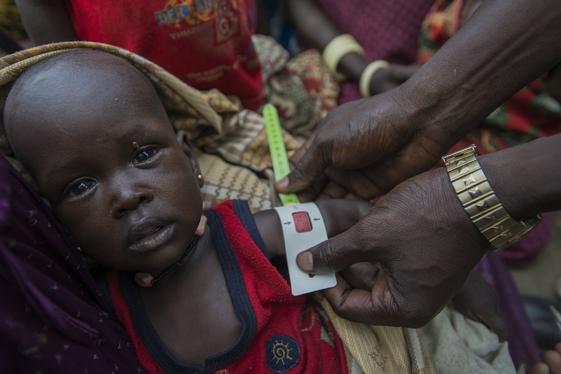
*A child receiving a MUAC (Middle Upper-arm Circumference) malnutrition
assessment*

Such explicit connection of cause and effect is something new in the
Secretary General’s reports on Darfur/UNAMID. But this is exactly on the
mark: in addition to a general donor fatigue that has grown as the
catastrophe in Darfur moves into its thirteen year, many donors and donor
countries are wary of funding projects for which there is no oversight.
This is especially important *since 97 percent of relief workers in Darfur
are Sudanese nationals and subject to intense scrutiny and severe
punishment for offering “too much” information*. Representatives of the
*EU *are just the sort of monitors needed for deep-field projects, and this
explains precisely why they are denied access, at the behest of Khartoum’s
security services (primarily *Military Intelligence* and the *National
Intelligence and Security Services [NISS*].

UNAMID, like International Nongovernmental Organizations (INGOs), is also
hamstrung my bureaucratic obstacles constantly thrown up by Khartoum:

*[C]hallenges resulting from the denial or delayed issuance of visas
continue to have an impact on the ability of the Mission to implement the
mandate*, particularly through gaps in the deployment of personnel
appointed to fill existing and sometimes key vacancies. (*§31*)
*The fate of humanitarian assistance in Darfur*

In considering the present and future state of humanitarian relief in
Darfur, issues of security and access necessarily come first. Nominally,
providing security to humanitarians has *always* been a primary part of
UNAMID’s mandate. This is obscured by the dismaying disingenuousness of
Permanent Security Council Members from the United Kingdom, France, and the
U.S. I highlighted last week in particular the comments of *Ambassador Mark
Lyall Grant of the UK*, which held the rotating presidency of the Security
Council for the month of *August 2014* when the last re-authorization
resolution was passed:

*“The resolution prioritizes protection of civilians and humanitarian
efforts in UNAMID’s work and requests enhanced human rights reporting from
the Mission…” “The resolution requests comprehensive and wide-ranging
recommendations on the future mandate, configuration, composition, and exit
strategy of UNAMID for next February*, and expresses the Council’s clear
intention to take prompt action on those recommendations. And we want to
use this opportunity to make any necessary changes to improve the working
of UNAMID.”

Again, let’s be clear here: protection of civilians and humanitarians was
*always *the primary feature of UNAMID’s mandate under the initial
authorizing Security Council Resolution (*1769*
<http://www.cfr.org/international-organizations-and-alliances/un-security-council-resolution-1769-darfur/p13979>
).   *Section 15 (i)—*in words that are announced immediately
following the *invocation
of Chapter 7 authority*—declares that UNAMID is mandated to “protect its
personnel, facilities, installations and equipment, and *to ensure the
security and freedom of movement of its own personnel and humanitarian
workers.”* Nothing in the *August 2014 resolution* gives more meaningful
“priority” to the protection of the “security and freedom of movement of …
humanitarian workers.” To suggest otherwise is to attempt to boost
humanitarian protection by merely rhetorical means.

[image: IMG_3809]
<http://sudanreeves.org/wp-content/uploads/2015/06/IMG_3809.jpg>

*Mark Lyall Grant, UK Ambassador to the UN*

The excerpts above and in *Appendix 2* provide ample evidence that rhetoric
alone is not enough to protect humanitarians, relief delivery, or free
access to those most in need...  [*Full text with all dispatches, report
excerpts, and analysis at | *http://wp.me/p45rOG-1JU ]
--

Eric Reeves
Smith College
Northampton, MA  01063
       413-585-3326
       [email protected]

       Skype: ReevesSudan

       Website:   www.sudanreeves.org

*Compromising With Evil: An archival history of greater Sudan, 2007-2012  *
www.CompromisingWithEvil.org <http://www.compromisingwithevil.org/>

--

Eric Reeves
Smith College
Northampton, MA  01063
       413-585-3326
       [email protected]

       Skype: ReevesSudan

       Website:   www.sudanreeves.org

*Compromising With Evil: An archival history of greater Sudan, 2007-2012  *
www.CompromisingWithEvil.org

--
To post to this group, send email to [email protected]
To unsubscribe from this group, send email to
[email protected]
Visit this group at https://groups.google.com/d/forum/southsudankob
View this message at
https://groups.google.com/d/msg/southsudankob/topic-id/message-id
For more options, visit https://groups.google.com/d/optout
---
You received this message because you are subscribed to the Google Groups
"South Sudan Info - The Kob" group.
To unsubscribe from this group and stop receiving emails from it, send an email
to [email protected].
To post to this group, send email to [email protected].
Visit this group at http://groups.google.com/group/SouthSudanKob.
To view this discussion on the web visit
https://groups.google.com/d/msgid/SouthSudanKob/CAJb14ooBdki1txyT6AbEpL5%3DEk-0XCST_EzRd1xsvc3Oo1PJHw%40mail.gmail.com.
For more options, visit https://groups.google.com/d/optout.