Book Review Response: the Khartoum Springs, Civil society and State
Security – By W.J. Berridge
Posted on July 30, 2015
<http://africanarguments.org/2015/07/30/book-review-response-the-khartoum-springs-civil-society-and-state-security-by-w-j-berridge/>
by AfricanArgumentsEditor
<http://africanarguments.org/author/africanargumentseditor/>
[image: OctoberRevolution]
<http://africanarguments.org/wp-content/uploads/2014/10/OctoberRevolution.jpg>
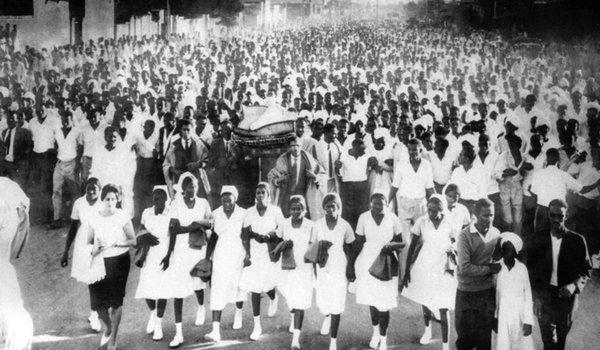
Funeral procession for Ahmad al-Qurashi, a student activist shot by the
Khartoum police in 1964.

I would like to thank Dr Alex De Waal for his very generous review
<http://africanarguments.org/2015/07/20/springtimes-of-the-people-in-sudan-book-review-by-alex-de-waal/>
of my book, *Civil Uprisings in Modern Sudan: The ‘Khartoum Springs’ of
1964 and 1985*. He has raised one or two issues I may have under-emphasized
slightly, so I would like to clarify my position regarding these points.

First of all, I do acknowledge his argument that the professional
activists’ tactical expertise was a real asset to them during the Intifada.
I think De Waal puts it very shrewdly when he says they ‘may not have had
an explicit and well-articulated strategy, but they possessed both a
repertoire of tactics and a depth of leadership that provided
organizational resilience’.

The distinction between strategy and tactics is an important one. What I
was getting at when I observed that the 1985 generation were not
necessarily more ‘meticulous planners’ than the current one (p. 206) was
that in terms of articulating a broader plan of action for the removal of
the regime, today’s oppositionists are – partly due to the legacy of the
Intifada itself – far better prepared for a potential transition even if
they are probably less capable of effecting one.

The New Dawn Charter of January 2013, for instance, specifies a length for
the interim period (four years), whereas in 1985 the divisions between the
parties and the unions over this issue and other contentious points gave
the military the opportunity to take over the Intifada via the Transitional
Military Council.

It is true that the substitute leaderships demonstrated the organizational
resilience of the professional movement, as De Waal observes, and the
majority of the professionals who signed the April 5 National Charter were
replacing imprisoned colleagues. However, due to the absence of a
pre-planned transitional strategy, they also contributed to its divisions.
Jizouli Dafa’allah, the President of the Doctors’ Union and future
transitional prime minister, later insisted that he would never have
sanctioned the decision made by the shadow committee to invite the
political parties to join the National Alliance, which was taken after he
was imprisoned (p.114).

The principal challenge that today’s oppositionists face – and I think we
agree here – is that they no longer possess control over the various civic
institutions that could effect a general strike. Still, there are some
grounds for hope – in 2010 and 2011 the Doctors’ Union asserted its
independence from the regime with two well executed strikes (p. 207).

In 1985 almost all of the labour unions were controlled by the regime, and
it was only recently that the student opposition had reclaimed control over
the Khartoum University unions from the Islamic Movement. Meanwhile,
student democrats won a number of victories over their NCP affiliated
opponents in the Khartoum University Student Union in the 2000s (p. 208),
and if a number of professional unions should happen to acquire independent
leaderships all at once, much might still be possible.

However, I do acknowledge De Waal’s point that making this civil society
‘deep’ will be a problem – it is not clear whether today’s oppositionists
have strong links to the army and police, and even if they do, the various
parallel security organs are far stronger now than they were in 1964 and
even 1985. Moreover, the regime prioritizes using them to control Khartoum,
knowing that it has been the historic epicentre of civil protest (p. 213).

Part of the reason I slightly underemphasized the impact of the general
strike at Khartoum airport was that I felt that by 5 April the President
had very little real chance of getting back into power, and a battle to
define post-Nimeiri scenarios had begun. Nimeiri had lost almost all local
and international support, as demonstrated by the humiliatingly poorly
attended pro-Nimeiri demonstration of 2 April and then the efforts of both
the Americans and the Egyptians to prevent his return to Sudan.

The deputy commander in chief of the army, Taj al-Din Abdullah Fadl, would
later tell al-Siyasa newspaper that Hosni Mubarak was in contact with the
army leadership throughout 5 April and informed them that he was not going
to allow Nimeiri back to Sudan till they had replaced him as President.
Meanwhile, the President’s closest advisors were travelling in the opposite
direction to him – for instance, one of the his most infamously corrupt
officials, Bahieddin Idris, was thwarted by the closure of the airport,
preventing him catching the flight he had booked to take him *outside* of
the country, ensuring that he would have to face transitional justice (p.
190).

With regard to the interception of police radio transmissions, I agree that
this does highlight the ability of the professional activists to fight the
regime’s intelligence apparatus. It is important to bear in mind that it
was police not State Security Organization (SSO) signals that were
intercepted, and the various professional activists had much more support
within the police and army than they did within Nimeiri’s premier
intelligence establishment.

However, since the police themselves were reporting on the movements of the
State Security Organization in the transmissions that were intercepted (p.
60), this could well have helped the professional activists. Meanwhile,
contacts within the military helped to keep the National Alliance
leadership aware of the army’s planning and enabled them to adjust
accordingly (p. 137).

At the same time, the main reason the army and police did not act against
the demonstrators was their disaffection with the regime, not any lack of
intelligence. This was not the case with the SSO, but one might argue that
the reason they failed to pre-empt the Intifada was that by moving against
the Islamic Movement in mid-March 1985 – allegedly as a result of American
pressure – Nimeiri had deprived his security forces of access to the then
nascent ‘Islamist-security network’ De Waal refers to.

As observed in the review, this grew stronger following the Intifada, but
even before 1985 the Islamists had begun to penetrate the SSO and the
future security chief Salah Gosh had helped establish an ‘intelligence
bureau’ as part of the Islamic Movement’s student wing, which helped the
regime control campus dissent (p. 107). However, Nimeiri’s alliance with
the Islamists was always uneasy, and two weeks before the Intifada, he
ordered his security services to arrest the entire leadership of the
Islamic Movement (p. 50).

In breaking with the Islamists, he thus lost access to the campus spy
networks which might have provided his intelligence apparatus with an early
warning of the campus protests that acted as the spark of the Intifada.
This is why I argued that the real success of De Waal’s ‘deep civil
society’ was not the removal of Nimeiri – Nimeiri effectively handed the
Intifada to them by sabotaging his own regime – but in ensuring that there
was a successful transition to democracy, and not simply the emergence of
another military autocrat.

Umar al-Bashir has learned from the manner of Nimeiri’s downfall in this
regard, as well as others – he has cast off his Islamist allies gradually,
one by one, from al-Turabi in 1999, to Salah Gosh in 2011, and finally Ali
Uthman and Nafie Ali Nafie in 2013.

*W.J. Berridge is the author of Civil Uprisings in Modern Sudan: the
‘Khartoum Springs’ of 1964 and 1985
<http://www.bloomsbury.com/uk/civil-uprisings-in-modern-sudan-9781472574015/>*

--
To post to this group, send email to [email protected]
To unsubscribe from this group, send email to
[email protected]
Visit this group at https://groups.google.com/d/forum/southsudankob
View this message at
https://groups.google.com/d/msg/southsudankob/topic-id/message-id
For more options, visit https://groups.google.com/d/optout
---
You received this message because you are subscribed to the Google Groups
"South Sudan Info - The Kob" group.
To unsubscribe from this group and stop receiving emails from it, send an email
to [email protected].
To post to this group, send email to [email protected].
Visit this group at http://groups.google.com/group/SouthSudanKob.
To view this discussion on the web visit
https://groups.google.com/d/msgid/SouthSudanKob/CAJb14orWLcAqkq4z8UBQjbrOBK14V%3DfDw3RHdeF0ogr2b%2BrMBA%40mail.gmail.com.
For more options, visit https://groups.google.com/d/optout.