#WhatWouldMagufuliDo sparks new bout of Tanzaphilia
Posted on November 30, 2015
<http://africanarguments.org/2015/11/30/whatwouldmagufulido-sparks-new-bout-of-tanzaphilia/>
by Hanno Brankamp <http://africanarguments.org/author/hanno-brankamp/>
*A few weeks into his presidency, John Magufuli’s moves towards free
education, anti-corruption and belt-tightening are already recalling
memories of Julius Nyerere.*
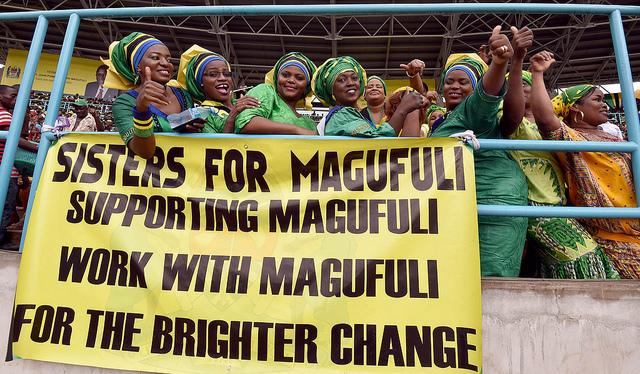
[image: Sisters for Magufuli celebrate President John Magufuli's
inauguration. Photograph by GCIS.]
<http://africanarguments.org/wp-content/uploads/2015/11/magufuli-tanzaphilia.jpg>
Sisters for Magufuli celebrate President John Magufuli’s inauguration.
Photograph by GCIS.

In 1967, professor Ali Mazrui opened the world’s eyes to a new political
phenomenon: Tanzaphilia <http://www.jstor.org/stable/2934403>. In his now
famous article in *Transition,* he defined this concept as “the romantic
spell which Tanzania casts on so many of those who have been closely
associated with her”. For Mazrui, many observers, especially well-meaning
Western leftist intellectuals, were prone to succumb to Tanzania’s magical
charms.

Part of this allure came from the fact that while many other countries in
the region were struggling under autocratic regimes, in January of that
year, Tanzania’s ruling party TANU had passed the Arusha Declaration,
President Julius Nyerere’s political *magnum* *opus*. The Declaration
charted Tanzania’s commitment to self-reliance, freedom, Pan-Africanism and
*Ujamaa* (African socialism) with a major aim being that “the Government
eradicates all types of exploitation, intimidation, discrimination, bribery
and corruption”.

Tanzaphilia, however, was as much a result of this ideology as by the
character of Nyerere himself, who believed strongly in practising humility.
Even as president, he queued when waiting for services in banks, post
offices and during elections. He allegedly refused a presidential motorcade
to guide him through the congested streets of Dar es Salaam. And in one of
the most famous episodes of his early presidency, he cut ministerial,
presidential and higher civil service wages to the irritated surprise of
many cabinet ministers.

*Fall and resurgence*

Nyerere could not avert the eventual failure of his increasingly
authoritarian *Ujamaa* villagisation policies during the late 1970s and
1980s, and under his successor, Ali Hassan Mwinyi (1985-1990), economic
liberalisation programmes gained traction. Alongside these economic
transformations, a whole repertoire of socialist rhetoric, symbols and
values were revised, and despite the ruling party’s reverent use of ‘hammer
and hoe’, a neoliberal wind of change was in the air.

Yet the spirit of Arusha never fully vanished from Tanzania’s political
discourse. Nyererism and *Ujamaa* as a set of moral principles faced a
resurgence in the 2000s, and for the last decade or so, posing with
wheelbarrows and spades has again become an expected performance for
Tanzania’s political cadres.

With the recent election of Tanzania’s new president Dr John Pombe
Magufuli, who was sworn in on 5 November, this trend has reached new
heights.

As Minister for Public Works, Magufuli’s reputation as a technocrat and man
of action bestowed him with the nicknames ‘Bulldozer’ and ‘Jembe’ (hoe).
For his election campaign, Magufuli successfully used socialist aesthetics,
hard work, and a hands-on mentality under the slogan Hapa Kazi Tu! (Work
and nothing else!).

Now, only a few weeks into his presidency, Magufuli seems to be living up
to his promises with some clear echoes of Nyererism. To many people’s
amazement, for instance, the former chemistry teacher recently ordered the
immediate halt of “unnecessary foreign travels” for government officials,
pointing out that with the TSh356.3 billion ($160 million) spent on
government air travel, the country could build some 400 km of desperately
needed tarmac roads.

Magufuli has also said he will re-introduce free primary and secondary
education, as originally devised by Nyerere. The president proclaimed that
by January 2016, school fees will be abolished in an attempt to boost
education levels among the country’s marginalised youth.

Then, on 24 November, Magufuli made an executive decision to do away with
Tanzania’s annual Independence Day celebrations and instead use the money
to purchase new beds for Muhimbili Hospital in Dar es Salaam.

On the face of it, these deeds are symbolic, but they could be much more.
They could indicate a silent renaissance of the spirit of Arusha and a more
equitable economy in Tanzania. Magufuli’s actions are being eagerly
discussed on social media under the hashtag #WhatWouldMagufuliDo with often
humorous and romanticising comments on his Nyereresque austerity measures.
But beneath this light-hearted trend lies a genuine longing for political
accountability and for a new political culture that dispenses with the
usual pomp.

In neighbouring Kenya, where a corruption crisis has forced President Uhuru
Kenyatta to reshuffle his cabinet, Magufuli’s bold manoeuvres have not gone
unnoticed. A wave of ‘Maguphoria’ seems to have swept across East Africa,
making Tanzania again the epicentre of progressive political aspirations
and adds a pinch of utopia for those who want to see politics in their
countries being done differently.

Nonetheless, change cannot come overnight, and Magufuli is bound by
existing structures, treaties, political institutions, and not least by his
own party Chama cha Mapinduzi. But the president’s dynamic social offensive
against graft, wasteful public spending, and poor education as a prelude to
his presidency might herald an innovative new direction in Tanzanian
politics and lay the groundwork for what could become a ‘Magufuli
doctrine’: Work hard, don’t live beyond your means, and listen to the
people.

Magufuli faces many challenges. After the dubious annulling of election
results on semi-autonomous Zanzibar last October, resentment runs high
among opposition politicians and the island’s residents. Together with his
Zanzibari deputy Samia Suluhu Hassan, Magufuli will have to make great
efforts to resolve the crisis and make Nyerere’s legacy of political union
last.

Back on the mainland meanwhile, where the opposition has made allegations
of fraud around the elections, equally fundamental changes are looming. On
the campaign trail, for example, Magufuli promised to review the failed
privatisation of government farms and companies in the 1990s, and, if
necessary, re-nationalise such enterprises. Now in office, he seems keen to
stick to his word and recently gave a 30-day ultimatum to private investors
to present status reports on their businesses or face compulsory
nationalisation.  Although Magufuli is no revolutionary in the traditional
sense and while it will be some time yet before his presidency can be
properly judged, the invocation of a ‘New Arusha’ under Magufuli and a
renaissance of its values of togetherness and equality is not misplaced.

In Ali Mazrui’s words, Tanzania’s success in creating something
extraordinary for its population “ultimately […] depends upon a continuing
compatibility between an intellectual leadership and a popular sense of
mission in that remarkable African country”. And while it is too early to
say anything definite about what Magufuli’s administration will and will
not do for political and social reform, it seems that Tanzania has again
cast its soothing spell of ‘Tanzaphilia’ upon the wider region. Let’s hope
it lasts.

*Hanno Brankamp is a DPhil candidate in the School of Geography and the
Environment, University of Oxford. Follow him on Twitter at @SpreeLumumba
<http://twitter.com/SpreeLumumba>.*
If you enjoyed this post, please consider leaving a comment
<http://africanarguments.org/2015/11/30/whatwouldmagufulido-sparks-new-bout-of-tanzaphilia/#comments>
or subscribing to the RSS feed <http://africanarguments.org/feed/> to have
future articles delivered to your feed reader.
This entry was posted in African Politics Now
<http://africanarguments.org/category/politics-now/>. Bookmark the permalink
<http://africanarguments.org/2015/11/30/whatwouldmagufulido-sparks-new-bout-of-tanzaphilia/>.

--
To post to this group, send email to [email protected]
To unsubscribe from this group, send email to
[email protected]
Visit this group at https://groups.google.com/d/forum/southsudankob
View this message at
https://groups.google.com/d/msg/southsudankob/topic-id/message-id
For more options, visit https://groups.google.com/d/optout
---
You received this message because you are subscribed to the Google Groups
"South Sudan Info - The Kob" group.
To unsubscribe from this group and stop receiving emails from it, send an email
to [email protected].
To post to this group, send email to [email protected].
Visit this group at http://groups.google.com/group/SouthSudanKob.
To view this discussion on the web visit
https://groups.google.com/d/msgid/SouthSudanKob/CAJb14oqP-jmcuh0rs0Abtp32%2B4gVHQtqP0w2a%3D0W79sXZ8xeZA%40mail.gmail.com.
For more options, visit https://groups.google.com/d/optout.