Will the Central African Republic’s elections create more problems than
they solve?
Posted on December 11, 2015
<http://africanarguments.org/2015/12/11/will-cars-elections-create-more-problems-than-they-solve/>
by William Clowes <http://africanarguments.org/author/william-clowes/>
*In light of the CAR’s recent disintegration, many doubt whether the
elections scheduled for this month can be held safely and fairly.*
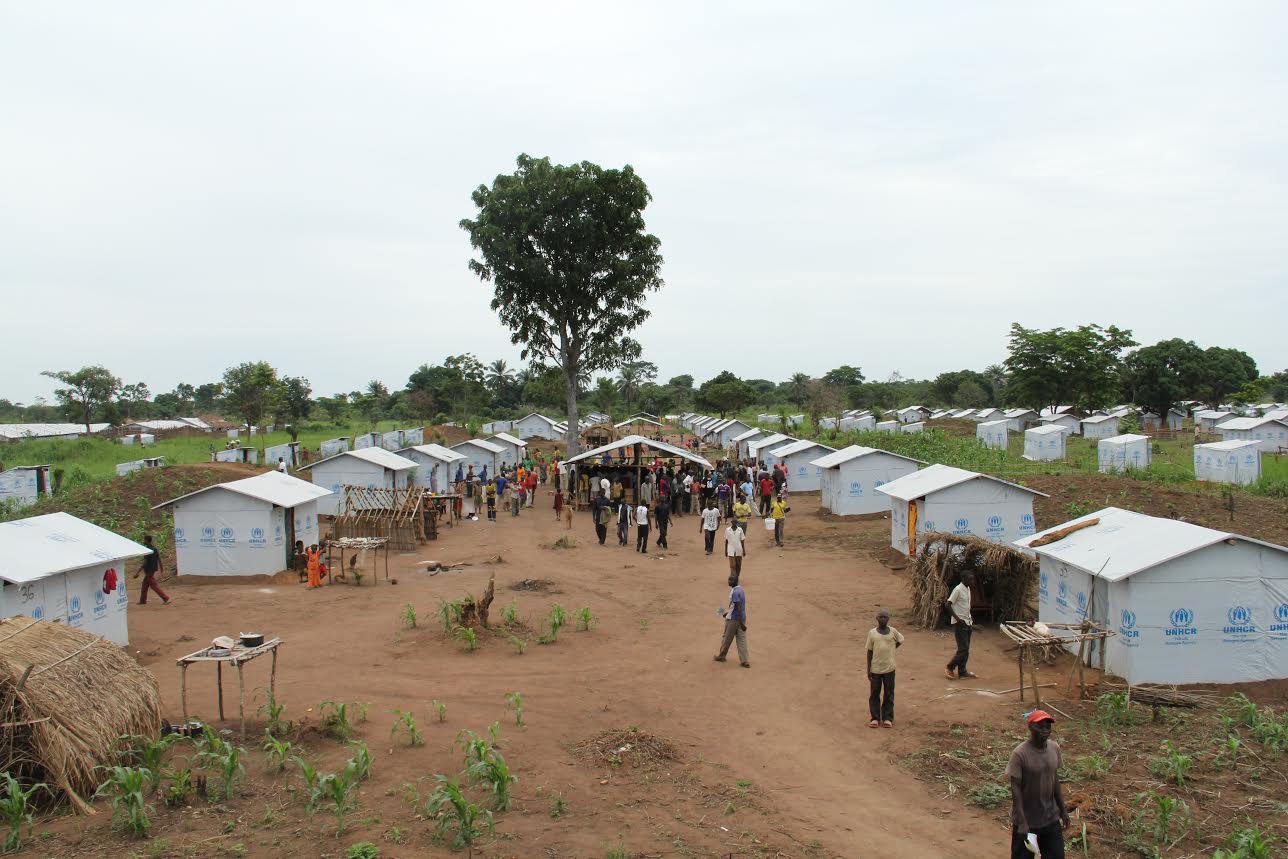
[image: At the Bili refugee camp across the border in the Democratic
Republic of Congo. Credit: William Clowes.]
<http://africanarguments.org/wp-content/uploads/2015/12/central-african-republic-elections.jpg>
At the Bili refugee camp across the border in the Democratic Republic of
Congo. Credit: William Clowes.

In early May of this year, following more than two years of intercommunal
violence in the Central African Republic, positive news
<http://www.brookings.edu/blogs/africa-in-focus/posts/2015/05/15-bangui-forum-central-african-republic-copley-sy>
was finally coming out of Bangui, the riverside capital. Nearly 700
delegates, representing the interim government, political parties, civil
society, traditional chiefs, religious communities and armed groups, had
just concluded a peace and reconciliation forum. The gathering yielded
several key agreements designed to deliver the CAR from a hellish cycle of
tit for tat slaughter and mass displacement.

Ten factions of the Seleka – the largely Muslim coalition which seized
power in March 2013 – and the anti-balaka – the militias, predominantly
Christian and of indigenous religions, which subsequently chased away their
new rulers before turning on the country’s Muslim minority – consented to a
disarmament programme. Following that, the forum had determined,
parliamentary and presidential elections would be held before the end of
2015.

No-one was offering this beleaguered country a panacea, but Central
Africans could perhaps look towards 2016 buoyed by the hope of living in a
country run by accountable politicians rather than an unelected government
and heavily armed militias.

However, with the 13 December referendum on a new constitution and the 27
December presidential and parliamentary elections fast approaching (with a
possible run-off in January 2016), concerns are rising that the polls could
create more problems than they solve.

*Displaced and disenfranchised *

A little way over the border with the Democratic Republic of the Congo,
where more than 100,000 Central Africans live in refugee camps, the forum’s
conclusions were received with a blend of anger and scepticism. Many living
in these tarpaulin cities were particularly preoccupied with the ambitious
electoral timetable and their already denuded rights as citizens of the CAR.

Gravier Bissenou Wenceslas, a 25-year-old student who fled his university
studies when the Seleka descended on Bangui, expressed anger at the forum’s
lack of refugee representation and accused the interim authorities of
“abandoning” the more than 460,000 Central Africans currently displaced
outside the country’s boundaries. Others, such as Angazika Louis Brice, a
former provincial mayor, were insistent that the refugees, comprising about
10% of the CAR’s population, should return home from the DRC, Cameroon,
Chad and Congo-Brazzaville before the holding of elections.

Months later, this acute fear of disenfranchisement and suspicion of the
interim authorities has turned out to be justified. There are still no
coherent plans for repatriation, and the unelected interim administration
of President Catherine Samba Panza initially attempted to exclude the
refugees from elections altogether. Fortunately for CAR’s refugees, the
Constitutional Court overturned the decision and, following persistent
advocacy efforts, the transitional government voted to allow them to
participate
<http://www.unhcr.org/cgi-bin/texis/vtx/refdaily?pass=52fc6fbd5&id=55c2ffcf5>
from outside the country.

The desire to conduct elections without the involvement of refugees
especially worried observers because the involuntary exiles are
disproportionately Muslim and their exclusion would risk reinforcing the
sectarian narrative that Muslims, which make up about 15% of the
population, do not belong in the CAR
<https://www.amnesty.org/en/documents/afr19/2165/2015/en/>. Hundreds of
thousands of Muslims have fled the country while many left behind are
trapped in enclaves they cannot leave for fear of being attacked. According
to Human Rights Watch’s Lewis Mudge, “not allowing refugees to vote
could’ve put in place the conditions for another coup by giving the Seleka
an excuse to go back to the bush and prepare to retake Bangui”.

Nonetheless, practical efforts to register exiled Central Africans have
been only partially successful. The DRC (in which nearly all the refugees
are in fact Christian) refused to allow the Central African authorities to
sign up eligible voters, though the governments of Chad, Cameroon and
Congo-Brazzaville did grant access to the CAR’s electoral commission.

According to the UN refugee agency, these latter three asylum countries
host more than 150,000 potential voters, of which only 35.5% could be
registered in the time available to the ANE. In Cameroon, where over 90% of
refugees are Muslim
<http://www.irinnews.org/report/101995/vote-limbo-for-central-african-refugees>,
a little under 30% of the nearly 115,000 voting age adults have been added
to the electoral roll.

*Election troubles*

The registration of refugees is a serious concern, but it is far from the
only challenge afflicting those arranging the elections.

At the end of October, President Samba Panza told the BBC
<http://www.bbc.co.uk/news/world-africa-34676421> that “95% of eligible
voters have already registered”, an assertion the director of the UN’s
electoral affairs division in Bangui told African Arguments is “more or
less” accurate. Yet many have received this news with raised eyebrows.

According to Veronique Barbelet, a researcher at the Overseas Development
Institute, “there are more than 400,000 people internally displaced and
there are parts of the country where it is unclear how many more may be
displaced so I don’t understand how that is possible”. Another experienced
Bangui watcher said, “I don’t know where those numbers are coming from and
when I asked someone from the UN he looked at me and shrugged his
shoulders. Someone from the interim authorities told me that the
registration rate was about 60% and then a few days later the UN said it
was 95%. I’m not saying they’re invented, but it seems incredibly high.”

Security is another pressing concern, especially after its deterioration
provoked a recent delay of elections
<http://www.ibtimes.co.uk/central-african-republic-elections-dates-will-no-doubt-be-postponed-says-interim-president-1521689>.
After a relatively sedate 2015, sectarian violence returned to Bangui in
September when the murder of a Muslim taxi driver set off intercommunal
revenge attacks which, according to Human Rights Watch
<https://www.hrw.org/tet/node/283893>, resulted in over 100 deaths.
Violence has also flared up in other parts of the country such as Bambari
and Batangafo where armed groups have attacked sites housing internally
displaced peoples
<http://www.un.org/apps/news/story.asp?NewsID=52573#.Vmi723arTHc>, of which
there are more than 350,000 in the CAR.

The UN Office for the Coordination of Humanitarian Affairs’ bulletin from
mid-November refers to a “volatile and unpredictable security situation
countrywide”
<http://reliefweb.int/sites/reliefweb.int/files/resources/FINAL_HUMANITARIAN_BULLETIN_NOVEMBER_2015.pdf>,
and much of the responsibility lies with the failure of the disarmament
component of the Bangui forum. Thibaud Lesueur of the International Crisis
Group told African Arguments that “armed groups still control whole swathes
of territory, still have their weapons, and have lost none of their ability
to cause harm”, adding that “nobody put any pressure on them to disarm”.
Some observers are in no doubt that it is not the time to be asking Central
Africans to go to the polls. “The security situation is certainly not
conducive to holding secure elections”, said Mudge.

Much of the country is under the effective control of armed groups and
there is a risk they will interfere with or deliberately impede the
electoral process. Indeed, Nourredine Adam, the leader of a major Seleka
faction whose fief is in the north of the CAR, has said that elections
cannot go ahead in the areas under his influence
<http://www.reuters.com/article/us-centralafrica-violence-idUSKBN0TP0W820151206>
.

Another serious problem is the lack of information available to the
electorate. On Sunday, the CAR’s voters are required to approve or reject a
constitution which very few people have seen, a state of affairs Lesueur
describes as “completely ridiculous”. One UN official in Bangui who
preferred to remain anonymous explained that there was supposed to be a
voter education programme but, like disarmament, “this phase was very weak”.

It is a similar story with the identity of the CAR’s next president. The
Constitutional Court has only just ruled on which of the 44 hopefuls can
compete on 27 December and disqualified two of the best known
<http://allafrica.com/stories/201512090333.html>: Francois Bozizé, the
CAR’s president from 2003 until his overthrow in 2013, and Patrice Edouard
Ngaissona, a prominent anti-balaka leader, both of whom are under UN
sanctions for their alleged role in the country’s violence.

Supporters of Bozizé and Ngaissona may respond violently, and of those
permitted to run most have been unable to campaign at all, while some of
the better established candidates have managed only token levels of
self-promotion. The scarce time available favours the few contenders with
name recognition and party machines such as Martin Ziguélé, a former prime
minister and presidential candidate, and Désiré Kolingba, a one-time Bozizé
minister and the son of a former head of state.

*Rushed polls*

Many who have observed the period since the conclusion of the Bangui forum
contend that those insisting on elections this year are not acting in the
best interests of this long suffering country. The schedule’s supporters
respond that the quicker Central Africans replace an unelected government
with an accountable one the better (although they do not seem to mind that
voters will head to the polls with little knowledge of what or who they are
voting for). Additionally, Samba Panza’s interim administration whose
mandate expires on 31 December is seen as a venal and incompetent liability.

Many, however, think that there has been an irresponsible
<http://africanarguments.org/2015/09/02/the-cars-rushed-elections-are-a-dangerous-gamble/>
rush <http://allafrica.com/stories/201512030078.html> towards elections
motivated more by powerbrokers’ external calculations than the reality on
the ground. The president of the electoral commission recently resigned his
post
<http://www.nation.co.ke/news/africa/Central-Africa-elections-chief-resigns/-/1066/2907478/-/9o09h/-/index.html>
claiming the international community was forcing an unrealistic timetable
upon him. (Others claim he was removed for financial irregularities.)

The accusation of outside coercion
<http://blog.crisisgroup.org/africa/2014/11/04/car-the-time-for-hard-questions/>
has been levelled at the UN’s peacekeeping mission MINUSCA as well as at
presidents of neighbouring states such as Chad and Congo-Brazzaville, but
it has been most persistently
<http://www.worldpoliticsreview.com/articles/17107/rushed-elections-could-backfire-in-central-african-republic>
levelled at France <http://allafrica.com/stories/201507061941.html>, the
former colonial power which deployed a peacekeeping force known as
 Operation Sangaris to the country in late 2013. “The French were thinking
about their exit strategy the moment they set foot in the CAR”,
said Lesueur. “They want to secure the electoral process and then
immediately send away the troops.”

Everyone agrees that elections are desirable and a fundamental aspect of
transitioning to some sort of normality. Yet the imminent rounds of voting
are causing a great deal of nervousness. Some, such as the ODI’s Barbalet,
question the priorities of the transition process. She told African
Arguments that “it’s hard to think about elections right now when there’s
400,000-plus refugees, similar numbers internally displaced, and millions
without access to livelihoods, homes and proper nutrition”.

There also appear to be well-founded concerns that without more time for
preparation, the elections, both on the days themselves and afterwards,
will be plagued by doubts over their legitimacy and unaddressed anxieties
about the (still) armed groups. According to Mudge, “most people in Bangui,
apart from a few diplomats, acknowledge that this whole thing is
half-baked, and there may be an awful lot of questions after voting”. The
greatest fear is that the polls will amount to what one UN employee called
“artificial elections” which ultimately cause more problems than they solve
<http://blog.crisisgroup.org/africa/2015/10/19/central-african-republic-avoiding-an-electoral-flare-up/>
.

The stakes could not be higher and the future of the CAR’s national
character up for grabs. As Lesueur warns in particular, “if Muslims cannot
vote because of security inside the country or registration of refugees, it
won’t create resentment which lasts 1 or 2 years but 10 or 20 years”.

*William Clowes is a journalist based in Kinshasa, Democratic Republic of
Congo. Follow him on Twitter at **@WTBClowes*
<https://twitter.com/WTBClowes>*.*
If you enjoyed this post, please consider leaving a comment
<http://africanarguments.org/2015/12/11/will-cars-elections-create-more-problems-than-they-solve/#comments>
or subscribing to the RSS feed <http://africanarguments.org/feed/> to have
future articles delivered to your feed reader.
This entry was posted in African Politics Now
<http://africanarguments.org/category/politics-now/>, The Central Africa
Forum <http://africanarguments.org/category/the-central-africa-forum/>.
Bookmark the permalink
<http://africanarguments.org/2015/12/11/will-cars-elections-create-more-problems-than-they-solve/>.

--
To post to this group, send email to [email protected]
To unsubscribe from this group, send email to
[email protected]
Visit this group at https://groups.google.com/d/forum/southsudankob
View this message at
https://groups.google.com/d/msg/southsudankob/topic-id/message-id
For more options, visit https://groups.google.com/d/optout
---
You received this message because you are subscribed to the Google Groups
"South Sudan Info - The Kob" group.
To unsubscribe from this group and stop receiving emails from it, send an email
to [email protected].
To post to this group, send email to [email protected].
Visit this group at https://groups.google.com/group/SouthSudanKob.
To view this discussion on the web visit
https://groups.google.com/d/msgid/SouthSudanKob/CAJb14oo0b0PHyKoSWzAvCYM7i%3DwkQigPvfhnbjYJ6FX36HVUQw%40mail.gmail.com.
For more options, visit https://groups.google.com/d/optout.