---------- Forwarded message ---------
From: Eric Reeves <[email protected]>
Date: Fri, 23 Jun 2017 at 21:12
Subject: Slashing UNAMID Translates Into Numerous Base Closings; Results
Will Likely be Catastrophic in Some Areas
To: Eric Reeves <[email protected]>
Slashing UNAMID Translates Into Numerous Base Closings; Results Will Likely
be Catastrophic in Some Areas

Eric Reeves   |   June 23, 2017   |   http://wp.me/p45rOG-24x

Sources within the UN have released the list of UNAMID bases to be closed
or stripped of a military (as opposed to a police) presence. The list makes
painfully clear just how dangerously consequential are the Mission’s broad
reductions: military presence in Darfur will be reduced by 44 percent and
the police presence by 33 percent. There will also be a significant
drawdown of non-armed UNAMID personnel, with inevitably hindering
consequences for the operations of the remaining armed elements of UNAMID.

I will gloss the specific implications of the list below, but some are
simply unconscionable and will put an end to humanitarian access. *It
should be noted that the UN’s Humanitarian Air Service (UNHAS) will not fly
to locations that are without a military presence. This alone represents an
extreme threat to humanitarian access in Darfur.*

This list many not be fully comprehensive, and may be subject to slight
modification. But given the end-of-June deadline for a UN Security Council
resolution re-authorizing UNAMID in re-configured form, the list is almost
certainly accurate to a very high degree:

*CAMPS IN WHICH BOTH A UNAMID MILITARY AND POLICE PRESENCE WILL BE
TERMINATED *(those names in *orange* designate closings particularly
dangerous to civilians):

*Abu Shouk *(North Darfur)

*Zamzam *(North Darfur

*Al Malihah *(North Darfur)

*Um Kaddadah *(North Darfur)

*Tine* (North Darfur)

*Mellit* (North Darfur)

*Habila* (West Darfur)

*Foro Burunga *(West Darfur)

*Edd al Fursan *(South Darfur)

*Tulus* (South Darfur)

*Muhajiriyah* (East Darfur [formerly South Darfur])

*CAMPS IN WHICH A UNAMID MILITARY PRESENCE WILL BE TERMINATED *(those names
in red designate closings particularly dangerous to civilians):

*Kalma Camp* (South Darfur)

*Sereif *(South Darfur)

*Shearia *(South Darfur)

*Saraf Omra *(near border between North Darfur/Central Darfur)

*Korma *(North Darfur)

*Umm Barru/Buru* (North Darfur)

*Masteri *(West Darfur)
*General commentary on these sites:*

Even if not highlighted in *orange*, all these sites have been the
locations for extreme violence over the fourteen years of the continuing
Darfur genocide. While notorious Janjaweed leader Musa Hilal’s directive
has in one sense largely been implemented—“Change the demography of
Darfur…empty it of African tribes”
<http://sudanreeves.org/2015/11/05/musa-hilal-and-the-changing-of-darfurs-demography/>—violence
continues in many locations and has constantly shifted in location over
these many years. UNAMID bases are all near the many camps for the 2.7
million internally displaced people
<http://sudanreeves.org/2017/05/22/displacement-in-sudan-and-darfur-un-figures-continue-to-be-careless-or-inadequate/>,
and indeed have been the impetus for camp creation (most strikingly, for
example, the Sortony IDP camp in North Darfur following Khartoum’s brutal
Jebel Marra campaign of 2016).

A 44 percent reduction in military forces ensures that many locations will
be beyond humanitarian reach; as noted above the UN’s Humanitarian Air
Service (UNHAS) will not fly to locations that are without military
protection. The (11) UNAMID bases included in this category are near some
of the most troubled and violent regions in all of Darfur. The (7) UNAMID
bases that will henceforth operate with only a police presence may be able
to control local disputes, but will be completely unable to deter
larger-scale attacks on civilians. The camps near these reconfigured UNAMID
bases will be even more acutely vulnerable to attacks by militia or SAF
forces, and completely impotent in the face of Khartoum’s announced plans
to dismantle IDP camps in Darfur.

While Khartoum may show restraint as UNAMID elements are deploying out of
Darfur, when substantial deployment out has been achieved—with so many
fewer non-Sudanese eyes on the ground and a humanitarian effort much more
constrained in its movement—Khartoum will move onto the final phase of
genocidal destruction.

It is an open question as to which of the International Nongovernmental
Humanitarian Organizations (INGOs) now operating in Darfur will feel
insecurity to be too great to continue their life-saving work. Khartoum has
long wished to see the exit of international relief efforts, and has
expelled more than two dozen organizations since 2009; others have already
left because of intolerable insecurity. The drastic reduction in UNAMID’s
footprint, however poorly the Mission has performed in its tasks of
civilian and humanitarian protection, may precipitate more decisions to
leave.

Finally, to the extent that UNAMID military personnel have been able to
provide armed escort services for convoys of UN agencies (such as the World
Food Program) and relief organizations, this service will be severely
truncated, further reducing humanitarian access to areas that require
convoy protection.

In defense of these reductions, the UN and UNAMID officials argue that the
Mission will be re-configured with greater rapid response capabilities.
Judging by all we have seen of UNAMID’s responses to critical moments of
violence and acute threats to civilians, this defense seems utterly
preposterous. Nor is there any credible indication of where the rapid
response transport resources will come from: they don’t exist now, and no
contributors of the necessary equipment have been identified.

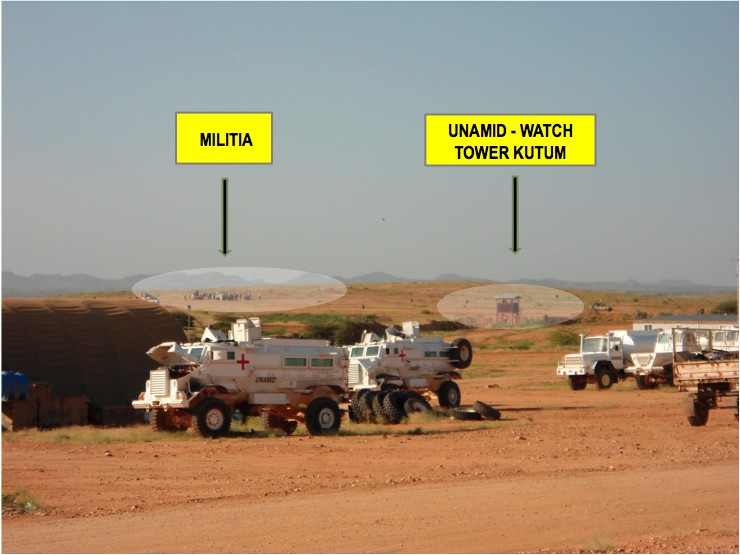
<http://sudanreeves.org/wp-content/uploads/2017/06/Picture-2-UNAMID-watching-militia-attack1.jpg>

*UNAMID has distinguished itself on too many occasions by failing to
respond even to nearby attacks on civilians; the idea that it will be
converted into a "rapid response force" is absurdly unrealistic.*
*Some specific commentary on the UNAMID base locations to be closed or
converted to “police only” status:*

*Abu Shouk *(North Darfur): this very large camp near El Fasher has
depended for security on UNAMID’s observer role; without a UNAMID presence
it is entirely unclear who will provide security and order within the camp.
Khartoum will be in full control of one of the largest and most volatile
camps in North Darfur.

*Zamzam *(North Darfur): notably, this camp is one of the few that has
grown every year recently, something we must take as a sign that UNAMID’s
presence creates a sense of security. This immense and highly volatile camp
is almost certain to see a major increase in insecurity. Most of the people
there have no alternative location to which they might flee if violence
becomes extreme.

*Mellit* (North Darfur): although recently relatively calm, this is an area
that has seen extreme violence during the East Jebel Marra offensive in
North Darfur (2012 – 2015). With UNAMID’s withdrawal from Mellit,
ethnically-targeted violence will resume. UNAMID’s apparent plan to
re-deploy back to the area if this occurs is deeply misguided: the military
force should remain in place there.

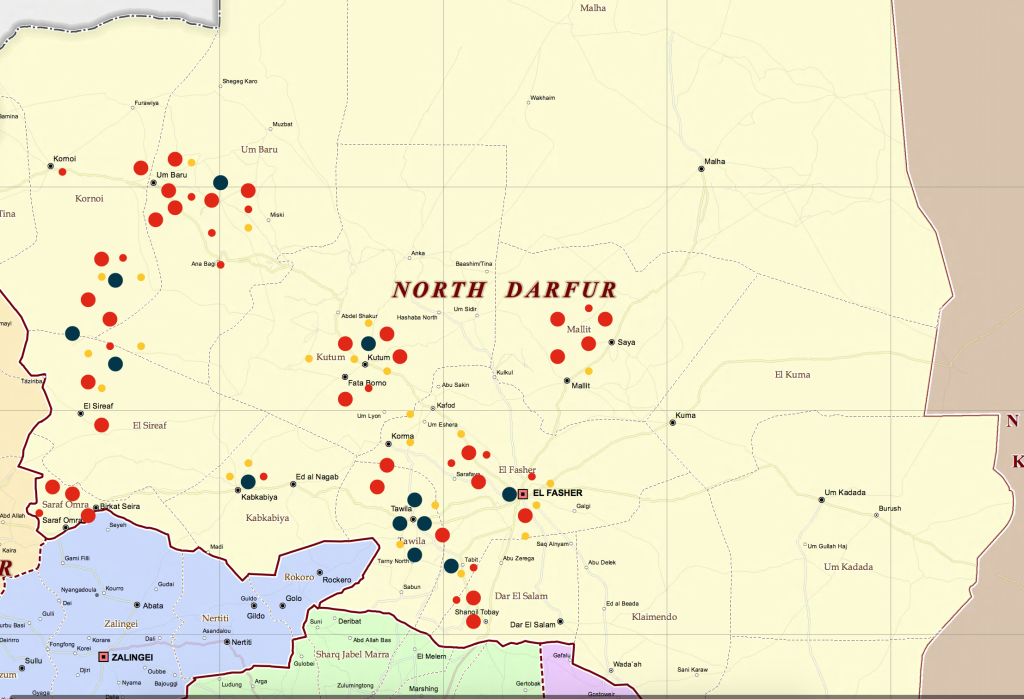
*[Overview of violence in North Darfur during the East Jebel Marra
offensive, 2012 – 2015*

<http://sudanreeves.org/wp-content/uploads/2017/06/North-Darfur-1024x699.png>

*(Click on map twice to expand fully)*

*Scale for mapping events: number of events, reflecting scale of violence:*

*Smaller red or yellow dots*: 1 – 5 events as scaled by number of events
and extent of violence;

*Large red dots*: 6 – 10 events as scaled by number of events and extent of
violence;

*Large black dots*: represent a total of 50 events as scaled by number of
events and extent of violence (this is used only in mapping North Darfur,
where violence has been concentrated and would be impossible to use an
other means of representation that would retain discreteness of location).
Black dots are used for the areas in and around: Eastern Jebel Marra
villages; Kabkabiya; Tawila; Fanga (Eastern Jebel Marra); Tabit; El Fasher.
The balance of the mapping of events uses red or yellow dots of both sizes.

*from “Changing the Demography”:  Violent Expropriation and Destruction of
Farmlands in Darfur,  November 2014 – November 2015"  | Eric Reeves, author
|  *Maya Baca, research and editing  |  December 1, 2015 |
 http://wp.me/p45rOG-1P4 <http://wp.me/p45rOG-1P4> ]

In general, the area around the Jebel Amir gold mines is likely to be a
flashpoint for conflict between the SAF and its RSF militia forces on the
one hand, and Musa Hilal’s militia forces on the other—both seeking control
of one of the most lucrative locations in all of Sudan. It has already
produced a great deal of spill-over violence and UNAMID’s various
withdrawals from North Darfur ensure the situation will only become more
dangerous for civilians.

*Habila* (West Darfur): like all too many areas in Darfur, an apparent
stability is highly deceptive; the non-Arab/African population of this area
feels constantly threated by Khartoum’s proxy Arab militia forces, even if
not directly under the command of the SAF. Withdrawal by UNAMID creates a
situation of unsustainable insecurity for the civilians currently
threatened.

*Foro Burunga *(West Darfur): the situation here is a reprise of what we
see in Habila.

*Muhajiriyah* (East Darfur [formerly South Darfur]): at various times in
the genocide, Muhajiriyah has been ground zero for extremely intense
fighting between rebel groups and Khartoum’s forces. It clearly remains a
flash-point and civilians are well aware of how threatened they are by
militia forces.

*UNAMID BASES THAT WILL REMAIN OPEN BUT WITHOUT A MILITARY PRESENCE* (again,
those names in *orange* designate sites of particular danger to civilians):

*Kalma Camp* (South Darfur): the largest and most volatile, indeed
explosive of all the Darfur IDP camps. A mere UNAMID police presence can do
nothing if there is large-scale violence over parts of this vast, sprawling
“home” to some 150,000 displaced persons. Without a military backup, UNAMID
police will be much less likely to intervene should Khartoum decide to
loose an attack. As I wrote in September 2008, nine months into UNAMID’s
official deployment in Darfur:

At 6am on the morning of August 25, 2008, Kalma camp, home to 90,000
displaced Darfuris, was surrounded by Sudanese government forces. By 7am,
60 heavily armed military vehicles had entered the camp, shooting and
setting straw huts ablaze. Terrified civilians—who had previously fled
their burning villages when they were attacked by this same government and
its proxy killers the Janjaweed—hastily armed themselves with sticks,
spears and knives. Of course, these were no match for machine guns and
automatic weapons. By 9am, the worst of the brutal assault was over. The
vehicles rolled out leaving scores dead and over 100 wounded. Most were
women and children. (“*Now Sudan Is Attacking Refugee Camps,"* *The Wall
Street Journal**, 6 September 2008*, Eric Reeves and Mia Farrow |
http://online.wsj.com/article/SB122065894281205691.html?mod=googlenews_wsj )

The risk of similar such attacks—at Kalma and many other locations—is
intolerably high.

*Saraf Omra *(near border between North Darfur/Central Darfur): this was
one of the central locations for violence during the Jebel Marra offensive
of 2016; the situation remains extremely volatile and potentially violent.

*Umm Barru/Buru* (North Darfur): not only relatively close to the Jebel
Amir site, it was an epicenter of violence during the East Jebel Marra
offensive (2012 – 2015) and could easily slide into the same sort of
ethnically-targeted violence and violent expropriation of African farmland
<http://sudanreeves.org/2016/02/17/changing-the-demography-violent-expropriation-and-destruction-of-farmlands-in-darfur-november-2014-november-2015/>
.

*Korma *(North Darfur): another center of ethnically-targeted violence
during the East Jebel Marra offensive (see map above).

*Sereif *(South Darfur) and *Shearia *(South Darfur): violence in South
Darfur has been on the increase over the past two years, although
overshadowed by the violence associated with Khartoum’s military offensives
in East Jebel Marra and the Jebel Marra massif itself. These areas are
extremely volatile and require continued UNAMID presence to enjoy any
degree of security and humanitarian access.

*What to Make of the UN Security Council Decision*

Yielding to pressure from China, Russia, and Khartoum itself, members of
the Security Council have allowed three brutally cruel, undemocratic
regimes to decide that fate of millions of people in Darfur. If we need an
image of just how broken an instrument for maintaining “international peace
and security” the UN Security Council has become, we could hardly do better
than Darfur.
--

Eric Reeves, Senior Fellow at Harvard University’s François-Xavier Bagnoud
Center for Health and Human Rights


[email protected]

www.sudanreeves.org

Twitter@SudanReeves

About Eric Reeves: http://sudanreeves.org/about-eric-reeves

Philanthropy:
*http://ericreeves-woodturner.com/woodturnings-available-for-purchase-dire
<http://ericreeves-woodturner.com/woodturnings-available-for-purchase-dire>*

--
To post to this group, send email to [email protected]
To unsubscribe from this group, send email to
[email protected]
Visit this group at https://groups.google.com/d/forum/southsudankob
View this message at
https://groups.google.com/d/msg/southsudankob/topic-id/message-id
For more options, visit https://groups.google.com/d/optout
---
You received this message because you are subscribed to the Google Groups
"South Sudan Info - The Kob" group.
To unsubscribe from this group and stop receiving emails from it, send an email
to [email protected].
To post to this group, send email to [email protected].
Visit this group at https://groups.google.com/group/SouthSudanKob.
To view this discussion on the web visit
https://groups.google.com/d/msgid/SouthSudanKob/CAJb14opwL4nQFFXhL8OBZMKWB26dms7EnbZ94WydFd5c%2BK%2BXyA%40mail.gmail.com.
For more options, visit https://groups.google.com/d/optout.