---------- Forwarded message ---------
From: Eric Reeves <[email protected]>
Date: Fri, 30 Jun 2017 at 20:43
Subject: Letter to Congress from Former Special Envoys for Sudan, Throwing
Their Weight Behind Lifting of Sanctions on Sudan: A Critique
To: Eric Reeves <[email protected]>
*Letter to Congress from Former Special Envoys for Sudan, Throwing Their
Weight Behind Lifting of Sanctions on Sudan: A Critique*

Eric Reeves   |   June 30, 2017 |  http://wp.me/p45rOG-24N

Yesterday, June 29, 2017, *former Obama administration Special Envoys for
Sudan Princeton Lyman and Donald Booth, along with former U.S. Charge
d’Affaires in Khartoum Jerry Lanier*, wrote a brief letter to the *Members
of the House Foreign Affairs Committee*, arguing in glib and disingenuous
terms for a permanent lifting of U.S. economic sanctions on the genocidal
Khartoum regime (it is not surprising that there has been no mention by any
of these men, in this letter or elsewhere, of the fact that an arrest
warrant has been issued for *President Omar al-*Bashir, charging him
with *multiple
counts of genocide *and massive crimes against humanity in Darfur by
the *International
Criminal Court*).

The views expressed are not surprising and indeed echo previous and often
demonstrably false claims made by these men. The entire letter appears here
with my commentary interpolated, in blue italics follow by my initials. I
would note by way of preface some of the more remarkable claims and moments
during the tenure of these men, particularly Booth and Lyman.

I would highlight, as I have on a number of occasions, comments made by
Lyman in an *interview of December 2011*. I do so because it represents so
well the preposterous assumptions made by both Lyman and Booth, and how
completely misguided their view of the *National Islamic Front/National
Congress Party regime* has been—a regime today celebrating the *military
coup that brought them to power exactly 28 years ago (June 30, 1989). *In
this almost three decades of brutal, tyrannical, and serially genocidal
rule, this regime has not changed in any significant way. It has certainly
not changed in ways claimed as possible by Lyman in December 2011:

“We [the Obama administration] do not want to see the ouster of the
[Khartoum] regime, nor regime change. We want to see the regime carrying
out reform via constitutional democratic measures.” (Interview with *Asharq
al-Awsat*, December 3, 2011 |
http://english.aawsat.com/2011/12/article55244147/asharq-al-awsat-talks-to-us-special-envoy-to-sudan-princeton-lyman
 )

One hardly knows where to begin in parsing the absurdity of this statement,
justifying the Obama administration’s opposition to regime change,
overwhelmingly favored by the vast majority of Sudanese and indeed now the
linchpin of political and military opposition to the regime throughout
Sudan. In the *five and a half years since Lyman’s statement*, the
following have defined the political history of Sudan:

*[1]* Acceleration of militia violence, especially by the *Rapid Support
Forces (RSF)—*Khartoum’s militia force of choice and now formally
incorporated within the regular army (the Sudan Armed Forces, SAF); this
violence was dramatically in evidence from *2012 through 2016*, culminating
in the savage military assault on the *Jebel Marra region of Central Darfur*,
during which chemical weapons were used against civilians nowhere near
military actions (Amnesty International, September 2016 |
https://www.amnestyusa.org/reports/scorched-earth-poisoned-air-sudanese-government-forces-ravage-jebel-marra-darfur/
;

*[2]* As part of the rise of the *Rapid Support Forces*, we have seen a
massive increase in the *violent expropriation of non-Arab/African farmland*
 | http://wp.me/p45rOG-1P4/;

*[3]* The *epidemic of sexual violence* against girls and young woman—a
central element of Khartoum’s genocidal counter-insurgency efforts—has
continued unabated; see my monograph on the subject (2016 |
http://wp.me/p45rOG-1QG/);

*[4]* *Violence directed against civilians *in Darfur by Khartoum’s regular
forces also continues; most notorious so far this year was the *“Nierteti
massacre” (January 1, 2017):*

*Nierteti “massacre” sparks outrage across Sudan* | Radio Dabanga, January
2, 2017
<https://www.dabangasudan.org/en/all-news/article/nierteti-massacre-sparks-outrage-across-sudan>|
NIERTETI |At least two people have been killed and 39 others wounded in an
attack by Sudanese army soldiers on Nierteti in Central Darfur on Sunday
morning. *[Figures for casualties varied but suggest that some 60 – 70
civilians were killed or wounded during the vicious SAF rampage; Darfur
Union UK lists the names and ages of 11 people killed—five of them under
the age of 17—ER]*

*[5]* Some *3 million Darfuris *remain displaced internally in Darfur or as
refugees in eastern Chad—too fearful to return to their homes and lands,
living amidst intolerable insecurity and badly attenuated humanitarian
operations. *2.7 million IDPs live in some 200 locations* (see |
http://sudanreeves.org/2017/03/19/internally-displaced-persons-in-darfur-the-invisible-catastrophe/
)
and Khartoum has repeatedly threatened to dismantle these camps
<https://www.dabangasudan.org/en/all-news/article/vp-sudan-determined-to-close-darfur-camps>,
which would make humanitarian relief efforts impossible and leave people
utterly bereft and without protection. Moreover, the *UN Security Council *is
today (*June 30, 2017*) re-authorizing the badly incompetent *UN/African
Union peacekeeping mission (UNAMID*), but only after drastically *slashing
both military personnel (a 44 percent cut) and police forces (a 33 percent
cut).* The effect on humanitarian delivery and human security could well be
catastrophic;

*[6]* The Khartoum regime continues its *severe curtailment of humanitarian
access *to many hundreds of thousands of Sudanese civilians: the *humanitarian
embargo imposed in 2011* on areas in *South Kordofan* and *Blue Nile*
controlled
by the *Sudan People’s Liberation Movement/Army-North (SPLM/A-N)* continues
to this day; Khartoum’s refusal to negotiate access in good faith goes back
to its rejection of the *African Union/UN/Arab League “Tripartite” proposal
of February 2012* (see | http://www.sudantribune.com/spip.php?article44516/
);

In Darfur huge numbers of civilians are denied humanitarian access by the
regime use of a wide range of methods: delay/denial of visas and travel
permits; physical intimidation of relief workers; freezing of UNAMID assets
and mobility; outright denial of access for reasons unrelated to security;
and most consequentially, the ongoing expelling of humanitarian
organizations (more than two dozen to date) and the vicious intimidation of
UN agencies, effectively limited what can be said about mortality,
malnutrition, sexual violence, and security conditions generally;

*[7]* *Political repression *has dramatically increased—the very opposite
of the “carrying out [of] reform via constitutional democratic measures”
Lyman so fatuously and/or disingenuously spoke of—and in Sudan repression
takes many forms:

• Steadily increasing what were already *draconian restrictions on the
national press*;

*• Violent dispersal of demonstrations*, most notably in *September 2013* when
the regime was confronted with country-wide demonstrations that were
eventually put down when “shoot to kill” orders were given to police and
security services (a fact established by both *Amnesty International* and
the *African Centre for Justice and Peace Studies*); more than 200 people
were murdered, perhaps several times that number;
https://www.theguardian.com/world/2013/sep/27/sudanese-protesters-attacked-march-fuel-subsidies/
;

• The *use of torture against journalists, humanitarians, and political
opponents*; the examples are too numerous to list (many are known to me
from direct conversation with victims), but the continuing brutal
incarceration of *Mudawi Ibrahim*, human rights advocate and founder
of the *Sudan
Development Organization (SUDO),* is emblematic; he faces the death penalty
for his work |
https://kristof.blogs.nytimes.com/2017/06/07/a-human-rights-defender-facing-the-death-penalty//
;

• Creation of an utterly factitious *“National Dialogue,”* seized on my
opportunistic diplomats like Lyman and Booth, but dismissed by the regime
itself as a mere political ploy in confidential meetings, minutes of which
have been leaked (see | http://wp.me/p45rOG-1In/; these minutes have been
repeatedly confirmed as authentic | http://wp.me/p45rOG-1w5/); the
“re-election” of *génocidaire* al-Bashir in *April 2015 *had all the
electoral authenticity one might infer from his *94 percent victory margin*.
Lyman’s “reform via constitutional democratic measures” seems the worst
sort of grimly bad joke in the wake of this election;

• A number of *Darfuris meeting with then Special Envoy Booth in August
2016*—this in the wake of the savage *Jebel Marra campaign *of the same
year—were promptly arrested once Booth had left. Some remained incarcerated
for weeks, despite claimed efforts by Booth to have them set free. Booth’s
failure to anticipate these arrests is revealing of just how ignorant of
the regime he proved on countless occasions.

• Threatening and arresting journalists who use the laboratory-confirmed
designation of *cholera* to describe the epidemic sweeping through Sudan
<http://sudanreeves.org/2017/06/30/cholera-in-sudan/>, a product in many
ways of the regime’s failure to invest in national infrastructure projects,
including the provision of clean water to an impoverished population (half
the people of Sudan live below the international poverty line);

• The *violent kleptocracy* that is the NIF/NCP regime has created
conditions of acute malnutrition in Sudan, malnutrition that is rising even
as the agricultural sector is collapsing for lack of regime investment over
almost three decades (see |
http://sudanreeves.org/2017/04/04/famine-in-south-sudan-should-not-obscure-urgent-food-crisis-in-sudan/);
the regime has so intimidated the UN humanitarian agencies that even
critical malnutrition data goes unpublished (see | http://wp.me/p45rOG-1pL/).
Acute and Severed Acute Malnutrition affects more than 2 million children
in Sudan; millions more suffering from chronic malnutrition
(“stunting”)—and yet the military and security services commandeer more
than half the national budget, ensuring the regime’s stranglehold on
Sudanese wealth and political power.

In addition to the letter from Booth, Lyman, and Lanier, comments from *present
U.S. Charge d’Affaires Steven Koutsis* seem clearly designed to push for a
permanent lifting of U.S. economic sanctions, first imposed by President
Clinton in 1997 and strengthened by President George W. Bush in 2006.
Koutsis was recently cited by Agence France-Presse (June 24, 2017
<http://www.france24.com/en/20170624-sudan-has-made-positive-steps-meeting-sanctions-terms-us-envoy>)
as declaring:

“None of these other issues were the point of sanctions, and none of these
other issues, therefore, should be linked to the lifting of sanctions."

The “issues” he was referring to are Khartoum’s abysmal human rights
record, its increasing repression and continuing violent suppression of
political dissent, its increasingly strident religious intolerance, and its
continuing deployment of brutal militia forces in Darfur and elsewhere in
Sudan. But this statement if profoundly false and is directly belied by the
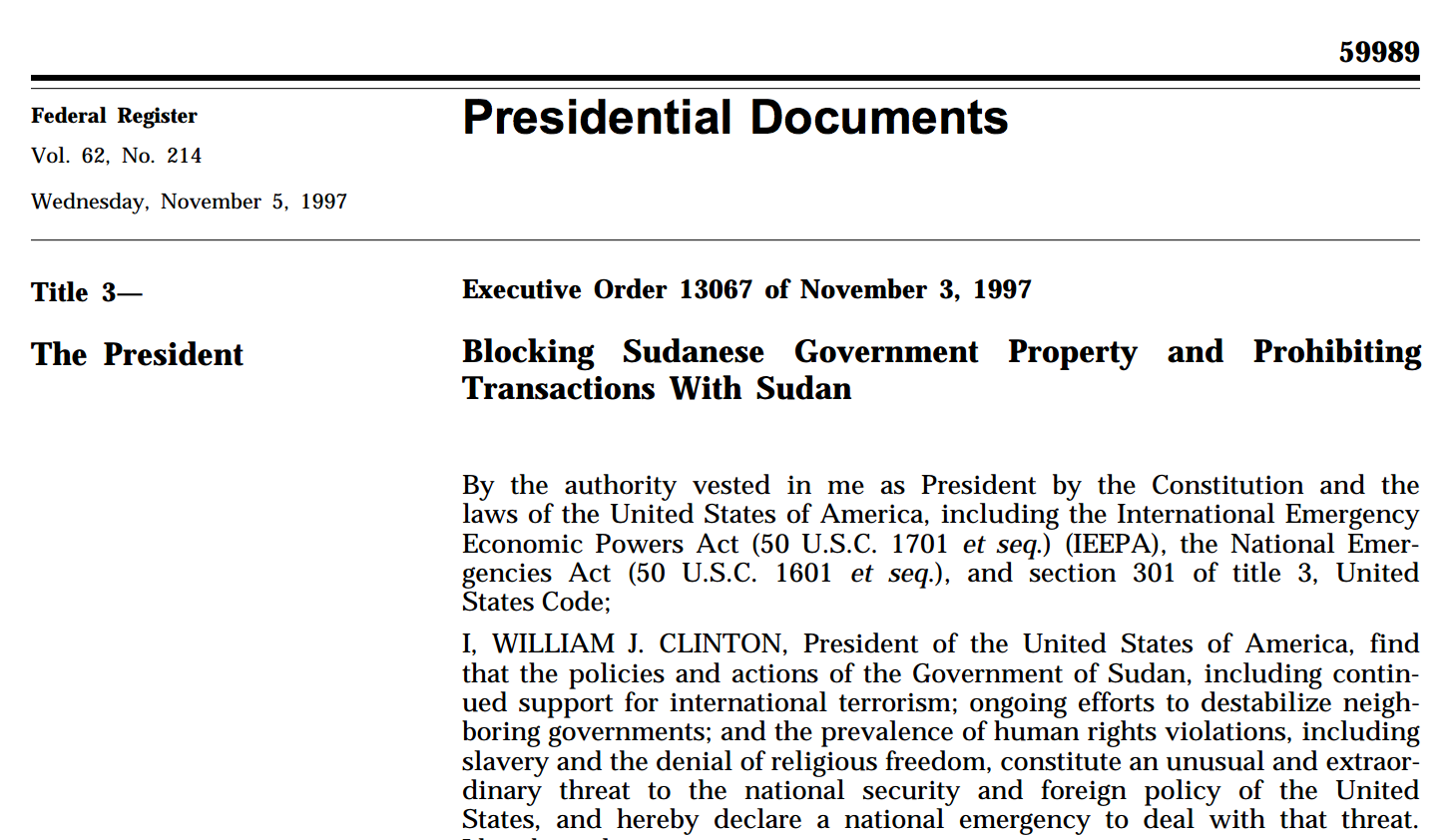
language of the *Preface to Clinton’s Executive Order of 1997*:

*
<http://sudanreeves.org/wp-content/uploads/2017/06/Screen-Shot-2017-06-28-at-9.59.38-AM.png>*

We must wonder what part of *“the prevalence of human rights violations,
including slavery and the denial of religious freedom”* escaped Koutsis’
understanding. Rather more to the point, we must ask whether it was an
unforgiveable ignorance of this language in the *1997 Executive Order*—or a
cynical belief that no one would call him on the outrageous inaccuracy of
his statement.

Many in the *Congress* are quite aware of what an ignorant and tendentious
diplomatic representative Koutsis is; indeed, he is little more than a
hack, tasked with getting sanctions lifted using whatever mean are possible
(see a fuller account of his handiwork at | http://wp.me/p45rOG-24G/). As a
consequence, it is quite likely the Congress will act in the ways it has in
the past on critical sanctions issues, including those directed against
*Russia* and *Iran*. This will include targeted sanctions coupled with
other leverage.

But the argument for lifting sanctions sent to the House Foreign Affairs
Committee deserves close inspection, coming from leading Obama
administration diplomats on Sudan—and now that the Khartoum regime has been
able to hire the powerful legal and lobbying services of *Squire Patton
Boggs*, one of Washington’s most prominent and powerful law firms (this
because of the January decision by President Obama to begin the suspension
of sanctions against Khartoum). The hiring of *Squire Patton Boggs *is
particularly notable since, with good reason, Sudan is one of only three
countries on the State Department’s list of “state sponsors of terrorism”
(along with *Iran* and *Syria*). And there can be no doubt of the Khartoum
regime’s continuing commitment to supporting radical Islamic militants, as
it has done in, for example, *Libya* (see| http://wp.me/s45rOG-7964/).

Ironically, the decision to lift sanctions is motivated not, as Lyman would
have us believe, by a hope that somehow this brutal, genocidal regime will
somehow come to “carry out reform via constitutional democratic measures.”
It is a policy decision by the U.S. intelligence community, which has long
dictated the major terms of engagement between Khartoum and Washington
(see, for example, my lengthy account from late 2011 |
http://wp.me/p45rOG-GT  <http://wp.me/p45rOG-GT>/). The truly enormous *new
U.S. “embassy” in Khartoum *has been filled by the *CIA* and other
intelligence agencies with a full range of surveillance, intercept,
satellite monitoring, and other equipment; it is designed to be the primary
U.S. listening post for northern Africa, a fact celebrated, if a bit
hyperbolically by a regime spokesman:

"There is communication between the two bodies and regular meetings. *The
CIA office in Khartoum is the largest office in the Middle East. Because
the United States is aware of the Sudan strategic importance in the region,
it has established one of the largest diplomatic missions in the region*,
even they had to expand their buildings," said Hanafi in an interview with
the Khartoum based *Al-Sudani* newspaper published on Tuesday. (S*udan
Tribune*, January 31, 2017 |
http://www.sudantribune.com/spip.php?article61565/)
*The Letter from Lyman, Booth, Lanier: Annotated*

June 29, 2017

Honorable MembersHouse Committee on Foreign Affairs U.S. House of
Representatives Washington, DC 20515

*RE: U.S. POLICY ON SUDAN*

Dear Members of the House Foreign Affairs Committee:

We write to you today regarding U.S. policy on Sudan, and the objectives we
all share: ending conflict in Sudan and promoting reforms toward a peaceful
and more sustainable system of governance.

*[This is a terrifying echo of Lyman’s words from December 2011: “**We want
to see the regime carrying out reform via constitutional democratic
measures.”—ER]*

To this end, we urge you to continue supporting the existing five-track
engagement strategy

*[This isn’t a strategy; it is transparently an effort to put a “smile” on
capitulation to the regime in return for the counter-terrorism intelligence
Khartoum is believed capable of providing the U.S.—ER]*

and the opportunity it now affords the United States to advance those
objectives. In the same vein, we urge caution in rushing any new
legislative action that might undermine this opportunity for progress going
forward.

*[This is a preemptive strike against possible Congressional imposition of
a new sanctions regime on Khartoum—ER]*

Over the last seven years, we have together spent considerable time
engaging Sudanese officials inside and outside government; we know how
imperfect are the choices when it comes to Sudan, and how critical is a
strategy of engagement.

*[If in this considerable time these men have decided still to cleave to
Lyman’s 2011 assessment—“**we want to see the regime carrying out reform
via constitutional democratic measures”—then it is all to clear that their
“engagement” is extraordinarily ignorant of what this regime truly is.*

*Here we might bear in mind the staggering ignorance of Charge d’Affaires
Koutsis:* *“None of these other issues [human rights, religious toleration,
ending chattel slavery] were the point of sanctions, and none of these
other issues, therefore, should be linked to the lifting of sanctions."—ER]*

As you know, the State Department is mandated to submit a July 2017
assessment on the five-track engagement plan, which was first initiated in
June 2016. That strategy was initiated with a view toward smarter and more
results-oriented engagement with Sudan.

*[I have cataloged above [and seriatim at **www.sudanreeves.org/*
<http://www.sudanreeves.org/>*] the “results” of U.S. engagement since the
beginning of the Obama administration, and in particular since Lyman’s
extraordinarily, incomprehensibly misguided assessment of the regime’s
“democratic” instincts—ER]*

It is designed to use existing tools to leverage changes in behavior by
Khartoum’s government in key areas, including a ceasefire and humanitarian
access.

*[Let’s judge the “success” of Lyman’s and Booth’s efforts in light of the
facts presented above. In particular, claims about improved “humanitarian
access” have been consistently untrue. **Former U.S. Ambassador to the UN
Samantha Power spoke in January, during her last press conference as
Ambassador, of a “sea change” of improvement in humanitarian access.*
<http://wp.me/p45rOG-20F>* This characterization was rejected by every
knowledgeable figure in the humanitarian community—on the ground in Sudan
and in the broader humanitarian community internationally; even the State
Department could offer no explanation of what led Power to this deeply
troubling falsehood. And the basic reality is that a total humanitarian
embargo remains in place, as it has since summer 2011, on
SPLM/A-N-controlled areas of South Kordofan and Blue Nile States. This
recalcitrant fact led **U.S. Charge d’Affaires Koutsis** to the truly
bizarre strategy of blaming the SPLM/A-N for the continuation of the
embargo* <http://www.sudantribune.com/spip.php?article61783>*—a symptom of
how misguided U.S. thinking about the critical issue of humanitarian access
has been—ER]*

The State Department’s first assessment in late 2016 noted the changes the
government made in response to the plan, which then resulted a first round
of sanctions easing.

*[Again, let’s judge this glib celebration of what President Obama referred
to vaguely as “positive actions” by the realities in Sudan today, and as
represented by the facts presented above—ER]*

The U.S. engagement plan was not intended as a one-off effort, but rather
is intended to initiate a framework for sustained bilateral engagement
toward the realization of U.S. objectives. The United States retains
considerable leverage over Khartoum, which seeks to see additional
sanctions removed, its designation as a State Sponsor of Terrorism
rescinded, its path to debt relief cleared, and full diplomatic and
military relations restored.

It is important that the Trump Administration and Congress show unity in
carrying forward this initiative, and in turning early progress into
sustained reform.

*[In other words, “Believe us: we’re experienced diplomats and former
special envoys for Sudan—ignore the realities that are all too
conspicuous.”—ER]*

Progress on the agreed tracks in this first phase of engagement, and
lifting the agreed sanctions, moves the U.S and Sudan to the next phase of
engagement,

*[This is hopelessly vague and non-specific, ignoring both
military/security and humanitarian realities in Sudan; evidently all three
men count on the ignorance of those in the Trump administration making the
decision, and are trying to silence the Congress—ER]*

to include more steps toward respect for human rights,

*[But the point is that there have been no steps toward respect for human
rights”—none! –ER]*

sustained humanitarian access,

*[These callous men simply can’t bring themselves to discuss honestly the
realities of humanitarian access in Sudan, and the degree to which the
Khartoum regime obstructs the work of the world’s finest international
relief organizations—this is finally despicable—ER]*

and a lasting peace.

*“Peace” for the regime means, and has always meant, military victory—now,
after fourteen unspeakably bloody years, essentially achieved in Darfur—and
the goal for South Kordofan once U.S. sanctions are lifted permanently.
That these men were both content to assert the viability of the “Doha
Document for Peace in Darfur,” long after its failure on all counts was
conspicuous, should be noted—ER]*

Stopping the process now would undermine progress to date and prevent
forward movement.

*[Again, there has been no progress**—merely an expedient suspension of
aerial attacks and military offensives in South Kordofan; these will resume
when sanctions have been removed permanently. And judged by every other
meaningful criterion—human rights, humanitarian access, economic
development, democratization, infrastructure investment—the regime has
continued to fail miserably and international rankings in each of these
areas bear out this characterization—ER]*

It would also bind the hands of the new administration and erase the
momentum it has inherited.

*[Again, there is no” momentum”—merely capitulation before Khartoum’s
patient determination to get what is wants; it may trim its military
behavior as necessary, make noises about improving humanitarian access—but
there has been no “progress,” there is no “momentum”—the regime remains
fully in power, although it presides over a collapsing economy that is
galvanizing Sudan’s political opposition. Lifting sanctions permanently
throws and economic lifeline to the regime at precisely the wrong
moment—ER]*

The U.S. plan represents an acknowledgement that sanctions alone had long
failed to produce the changes we all hope to see—while also imposing unduly
negative consequences on many ordinary Sudanese citizens.

*[The “unduly negative consequences” suffered by “ordinary Sudanese
citizens” are not a function of U.S. sanctions but of the catastrophic
mismanagement of Sudan’s economy by the NIF/NCP regime over 28 years,
enriching itself and its politically important cabal of cronies in a vast
kleptocracy (see** | *
*http://www.enoughproject.org/blogs/enough-forum-release-kleptocracy-khartoum*
<http://www.enoughproject.org/blogs/enough-forum-release-kleptocracy-khartoum>
*)*

*•  Failure to invest in the agricultural sector and instead selling and
leasing vast tracts of arable land to Arab and Asian countries interested
in securing their own future food security; the collapse of the once
thriving Gezira Scheme is symptomatic—and has nothing to do with U.S.
sanctions;*

*•  Failure to invest in infrastructure, hence the badly deteriorating
water delivery system, which is a primary cause of the wild spread of
cholera in the country, including Darfur as the rainy season begins in
earnest;*

*• Failure to plan for the consequences of the secession South Sudan (July
2011) and the consequent extremely severe shortage of Foreign Exchange
Currency (Forex), now required for the import of more than $1 billion of
wheat per year and even refined petroleum products (the regime refused to
use the ample oil revenues of 1999 – 2011 to build a significant domestic
refining capacity—again, this has nothing to do with U.S. sanctions.
Skyrocketing inflation, the precipitous drop in the value of the Sudanese
Pound, the inability to import key commodities—including food and basic
medicines—these are not a function of U.S. sanctions but gross economic
mismanagement and terribly skewed budgetary priorities, devoting resources
primarily to the military and security services;*

History has demonstrated that a punitive sanctions regime cannot alone
yield progress in Sudan.

*[Of course one must ask, then, why is the regime so eager to see them
lifted permanently—it is most certainly not out of concern for the
“ordinary Sudanese citizens,” who have suffered grievously under this
regime’s tyranny for 28 years—ER]*

Only through the credible and consistent use of both incentives and
pressures, and a view toward long-term reform, can we realize our
objectives.

*[“Long-term reform” becomes the illusory fiction to rely on when there
is no short-term reform to point to—politically, economically, or in the
humanitarian arena; this is the response to the conspicuous absurdity of
Lyman’s declaration of five and a half years ago: *“We want to see the
regime carrying out reform via constitutional democratic measures.” *There
is no reform in evidence and no evidence that it will occur under this
regime—no evidence whatsoever, which is why this perverse letter is so
completely without specifics—ER]*

To this end:

It is imperative that the United States follows through on the letter of
the engagement plan, and do so on the basis of the Administration’s
multi-pronged assessment.

*[This “imperative” has not been demonstrated, merely asserted by
interested parties—interested insofar as they represent policies that have
enabled a genocidal regime to continue its tyranny and kleptocratic ways
for the entire duration of the Obama administration these men
represented—ER]*

Delaying the process may seem an attractive option, but in reality it would
damage U.S. credibility and squander the opportunity now before us.

*[Again, the “opportunity” is completely unspecified—we are somehow to take
it on faith from men who have been shown to be repeatedly and grossly in
error in the past—ER]*

We must continue to work with those who seek long-term reform

*[And again, the revealing emphasis on “long-term reform”: this is what one
stipulates when there is no “short-term reform” to point to—ER]*

and Sudan’s re-integration into the global community. And we must avoid
doing any favors for Sudanese hardliners who represent the worst of the
government, and who oppose the very objectives we are seeking to achieve.

*[This is simply bizarre and reflects an extraordinary ignorance of who
really controls power in Khartoum: “*Sudanese hardliners who represent the
worst of the government.” *It is precisely the hardliners who have exerted
most control since 2011 and the military decisions that led to the seizure
of Abyei and to war in South Kordofan and Blue Nile; it was the hardliners
who created the Rapid Support Forces, now the dominant militia force in
Darfur and destined to play a similarly large role when Khartoum inevitably
moves to seize full military control of South Kordofan and Blue Nile. The
characterization offered here by Booth, Lyman, and Lanier is but an updated
version of an old claim that “if only the ‘moderates’ in the regime can be
strengthened…” There are no moderates! Minutes of an August 31, 2014
meeting of the regime’s most powerful military and security officials make
fully clear who commands power within the regime—and they are all
“hardliners” by any meaningful definition of the phrase (these minutes have
been fully authenticated, including by the U.S. State Department)—ER]*

We believe that now is not the time for legislation that would complicate
our sanctions regime and confuse our diplomatic strategy.

*[If Booth and Lyman revealed anything during their tenure, it was that
they had no “diplomatic strategy”—hence, for example, the celebration of
the Doha Document for Peace in Darfur, a peace agreement without any buy-in
from either Darfuri civil society or the significant rebel movements. What
has distinguished the Obama administration is not a diplomatic strategy but
rather fashioning the best tactical means by which to secure Khartoum’s
cooperation in providing counter-terrorism intelligence—ER]*

Introducing new benchmarks—especially those that cannot be effectively
measured or achieved—will not help us in realizing our objectives.

*[This is pure tendentiousness: there is no coherent set of objectives that
has any chance of being realized once sanctions are lifted—again, the lack
of specifics in this letter, and the refusal to acknowledge errors and
failures of judgment of the past, are all too revealing—ER]*

If Sudan walks back progress to date,

*[“Progress to date”: how can this phrase possibly be made to comport with
the realities I’ve detailed above? This is “argument by bald assertion,”
untroubled by realities on the ground in Sudan—ER]*

or fails on the next phase of engagement, the Administration and Congress
can re-assess and take appropriate steps— including punitive measures if
necessary—at that juncture.

Thank you, as always, for your continued interest and commitment, and we
stand ready to discuss these important issues with you further.

Sincerely,

*Ambassador (Ret.) Princeton Lyman*

Former U.S. Special Envoy to Sudan and South Sudan

*Ambassador (Ret.) Donald Booth*

Former U.S. Special Envoy to Sudan and South Sudan

*Ambassador (Ret.) Jerry Lanier*

Former U.S. Chargé d'Affaires to Sudan

--

Eric Reeves, Senior Fellow at Harvard University’s François-Xavier Bagnoud
Center for Health and Human Rights


[email protected]

www.sudanreeves.org

Twitter@SudanReeves

About Eric Reeves: http://sudanreeves.org/about-eric-reeves

Philanthropy:
*http://ericreeves-woodturner.com/woodturnings-available-for-purchase-dire
<http://ericreeves-woodturner.com/woodturnings-available-for-purchase-dire>*

--
To post to this group, send email to [email protected]
To unsubscribe from this group, send email to
[email protected]
Visit this group at https://groups.google.com/d/forum/southsudankob
View this message at
https://groups.google.com/d/msg/southsudankob/topic-id/message-id
For more options, visit https://groups.google.com/d/optout
---
You received this message because you are subscribed to the Google Groups
"South Sudan Info - The Kob" group.
To unsubscribe from this group and stop receiving emails from it, send an email
to [email protected].
To post to this group, send email to [email protected].
Visit this group at https://groups.google.com/group/SouthSudanKob.
To view this discussion on the web visit
https://groups.google.com/d/msgid/SouthSudanKob/CAJb14oq51pcQ0CfFPy-VuONKe-SDwCWTyg9WecZ0EpmSWVnvxQ%40mail.gmail.com.
For more options, visit https://groups.google.com/d/optout.