-----BEGIN PGP SIGNED MESSAGE-----
Hash: SHA1

sorry for >< posting :: feel free to >>  thank you
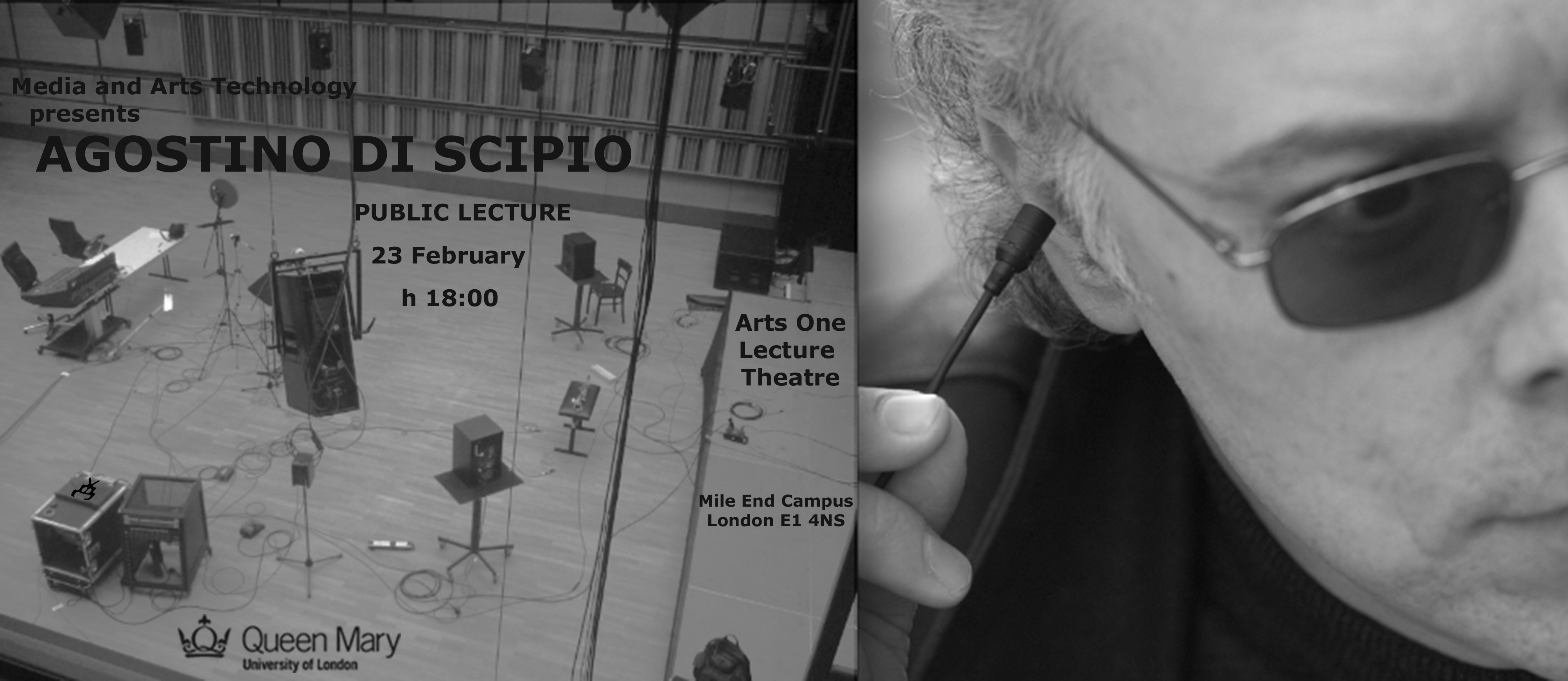
- --- Dear All, As part of my PhD research I have invited Agostino Di Scipio to present his amazing work at Queen Mary University of London. This is a free and open event, all welcome!! Timezone: 23 February 2015 h 18:00 Queen Mary University of London Arts One Lecture Theatre Mile End Campus E1 4NS London Event page: http://xname.cc/emsensing/agostino-di-scipio-lecture/ RSVP: http://agostino-di-scipio-lecture.eventbrite.com Flyer: http://xname.cc/flyers/discipio_flyer.jpg ::: The place of computing in situated sonic interactions of performers, machines, and environment ::: In this presentation I address the place and meaning of computing resources in the context of the hybrid technological infrastructures necessary in sound-making practices, and the surrounding physical space where such practices take place. I illustrate examples from personal experience with sound installation and performance works based where the structural coupling is elaborated between the room acoustics and the technical equipment (including pro- and consumer-level electroacoustic transducers, and mechanical resonators). While the approach may fit well in a broader scenario of artistic practices in which data from various sources in the environment are admitted as component parts of the computing process, the particular perspective I try to elaborate bears almost exclusively on sound and auditory perception. Sound is experienced as the only interface in a network of situated interactions having both energetic and informational dimensions. It is suggested that, in such a context, a notion of ‘computing’ seems to materialise that can’t be reduced to ‘information processing’ (safe if we fully subscribe to an utterly reductionistic epistemology), and gets closer to a view of ‘embodied and situated cognition’ rooted in the biology of cognition and the phenomenology of the living. ::: Biographical note ::: Agostino Di Scipio (Naples, Italy, 1962) composer, sound artist, scholar. Graduated in Composition and Electronic Music from the Conservatory of L’Aquila, and studied Computer Music at CSC, University of Padova. Di Scipio explores original methods in the generation and transmission of sound, often featuring phenomena of emergence and chaotic dynamics. His works include live electronics performance (often with musical instruments, too) and installation works designed as “man-machine-environonment” networks of purely sonic interactions (e.g. the Audible Ecosystemics series, and the more recent Modes of Interference series). His output includes two stage works mixing poetry reading and electroacoustics. His music is available on various labels (RZ Edition, Chrysopeé Electronique, Wergo, Neuma, etc.). With pianist Ciro Longobardi, Di Scipio published a full-concert realization of John Cage’s Electronic Music for Piano, presented at the 2012 Venice Biennale. With saxophonist Mario Gabola, he forms the Upset duo, in the context of which he explores recycled analog circuitry (Upset, Viande Records). A recent special issue of Contemporary Music Review collects various perspectives on Di Scipio’s work. Artist-in-residence of DAAD, Berlin (2004-2005) and other international residency programs, Di Scipio served as full-time professor in Electroacoustic Composition at the Conservatory of Naples (2001-2013), and today holds the same position in L’Aquila. Edgar-Varèse-Professor at Technische Universität, Berlin (2007-2008), guest professor in various institutions in Europe and North America. In 2013, Di Scipio delivered the opening keynote speech of the Int’l Computer Music Conference (Edith Cowan University, Perth, Western Australia). His writings focus on a variety of subjects, specially including cognitive and political implications of music technologies (e.g. the volume Pensare le tecnologie del suono e della musica, Naples 2013). Di Scipio served as guest editor of the Journal of New Music Research for a special issue on Iannis Xenakis, and was the editor of various volumes including Xenakis’s Universi del suono (Milan 2003) and Michael Eldred’s Heidegger, Holderlin & John Cage (Rome 2000). http://agostinodiscipio.xoom.it/adiscipi/ This lecture is part of the ‘Artists presentations series’ organised by the students of the Media and Arts Technology programme funded by the EPSRC. Thanks to Queen Mary University of London. Students website: http://qmat.net Programme website: http://www.mat.qmul.ac.uk - --- Brought to you by _xname_ http://xname.cc -----BEGIN PGP SIGNATURE----- Version: GnuPG v1.4.10 (GNU/Linux) iEYEARECAAYFAlTRJIAACgkQNvasaG3ULUx58wCfVCOc5dvnAMHuy1kiKHX5Av5v 0usAoImVWtkDaeA+CawdHtVetDHw6iKw =2YUB -----END PGP SIGNATURE----- ______________________________________________ SPECTRE list for media culture in Deep Europe Info, archive and help: http://post.in-mind.de/cgi-bin/mailman/listinfo/spectre