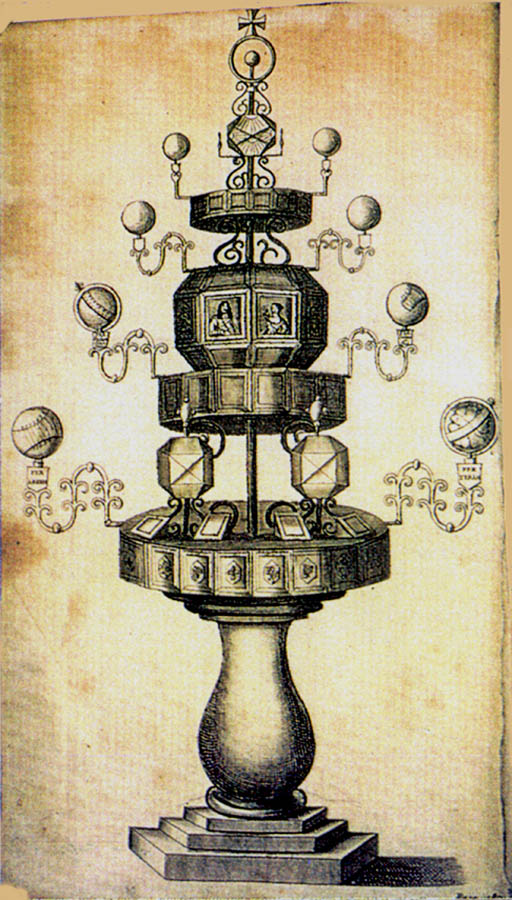
Fred,

In BSS bulletin 90.2, june 1990, is an article about this dial: "A brief
Explication of a Pyramidical Dial".
In 1991 De Zonnewijzrkring visited BSS at Cambridge and then a poster with
this dial was made.
It still is in my hobby room and every day I see the dial.

Jan de Graeve, Zonnewijzerkring Vlaanderen, Belgium,  gave a lecture about
the dial but I havn't seen a publication.
One of the items in his lecture was "a sundial for blinds".

Best wishes, Fer.

Fer J. de Vries

De Zonnewijzerkring
mailto:[EMAIL PROTECTED]
http://www.de-zonnewijzerkring.nl

Eindhoven, Netherlands
lat.  51:30 N      long.  5:30 E
----- Original Message -----
From: "Fred Sawyer" <[EMAIL PROTECTED]>
To: "John Carmichael" <[EMAIL PROTECTED]>
Cc: "Sundial List" <[email protected]>
Sent: Thursday, March 02, 2006 5:08 PM
Subject: Re: The Libertine
Hi John,

Yes that's the dial.  Bob Terwilliger has also given a link to an image of
it on the NASS website.  I've also just learned from John Davis that Mike
Cowham will have an article on the dial in the June issue of the BSS
Bulletin.  Given your interest in the sundial for the blind - you might be
interested to know that one of the glass spheres on this dial was probably
the first instance of this idea.

Since you cited your entry on the stained glass website (and since I have
some material for a talk that I will probably not give now since Mike will
be publishing his article on the dial), I should point out that in my view
there is very little doubt about what happened to the dial: Rochester
destroyed it on the night of 25 June 1675.  Some modern works on this have
suggested that the dial might have survived in a bad state - but I don't
believe there's any real evidence.

Chris Daniel does suggest that it survived and made its way to Buckingham
House.  I believe this claim originates with Mrs. Gatty's book on Sundials
and she is not always reliable.  She cites Vertue as her source, but this
is what was actually said (note that Francis Hall and Francis Line are one
and the same person) : "Afterwards there was other dials of Glass, like
pyramids, erected in Whitehall Garden by Francis Hall, but were not so
durable being of Glass.  I think I saw them in the Duke of Buckinghams
gardens near the St. James Park, and then was told they had been erected
first in Whitehall garden." (Vertue  B.M.Add. MS 23086, f.40)

Hardly a definitive statement.
From the Survey of London (v. 13) we have: p.94  1675   26 June 1675
letter,
"My Lord Rochester in a frolick after a rant did yesterday beat doune the
dyill which stood in the midle of the Privie [Gard]ing, which was esteemed
the rarest in Europe.  I doe not know if. it is by the fall beat in
peeces."

Aubrey identifies this dial as the one by Dr. Hall
"which were one night.broken all to pieces (for they were of glass
spheres) by the Earl of Rochester, Lord Buckhurst, Fleetwood, Shephard,
etc, comeing in from their revells.

p.95  The incident seems to have marked the end of the dial, for it does
not appear in the view of 1695-8.  Vertue doubtfully suggests that some of
the remains were afterwards at Buckingham House, and Walcott records that
"about 1710 Mr. William Allingham, mathematician in Canon Row, demanded
£500 to repair this dial, but his offer was refused."  It has not been
possible to confirm this statement, which more likely refers to the great
sun-dial.

Note the reference to the 'great sun-dial'.  This is actually a different
sundial - a large horizontal dial designed by Edmund Gunter and placed in
the Privy Garden.  I believe these two dials are often confused.  For
example, it is sometimes stated, in reference to Lines' dial, that Charles
II loved to set his watch by the dial.  But in fact he was most probably
using the Gunter dial - which was also in the Privy Garden, was there
before Lines' dial, and was much more accessible for providing an exact
time. Line's dial had a great many small dials on it and I doubt that it
would have been particularly useful for setting a watch - whereas Gunter's
dial was a great horizontal that allowed for some precision.

Gunter's great stone dial was regularly being repainted - and it is
probably this repair that Allingham was offering to do for £500 - an
amount in line with the earlier bills for doing this same thing - and
certainly too low an amount for recreating the elaborate glass structure
of Line's dial.

There seems to be a wish to absolve Rochester of his heinous crime.  Conor
Reilly, a biographer of Francis Line, stated:   "By 1681 the dial had been
dismantled and removed from the garden, as William Leybourn tells us in
his Dialling."  But this appears to be just wishful thinking.  If we look
at what Leybourn actually wrote, we see only: "Thus have I given a brief
Account of this (now demolished) Dial.."  And John Holwell writing in 1685
says "The Dyals that were set up in His Majesties Privy Garden in the Year
1669 have been some years demolished.. "

Relevant portions from Jeffreys' Scene 7:

"Sackville:  What time is it?  You're standing next to the most
sophisticated timepiece in Europe, you tell me.
Rochester:  It's a sundial, shufflehead, we're in the dark."

The dial is not described in detail.. An expensive, phallic object.. A big
glass whatsit..

"Rochester:  He calls himself King!  The greatest patron of the arts and
sciences in Europe.  The nimble mind, bounding with ease from subject to
subject.  . spends sixty thousand pounds on a clock and it doesn't work in
the dark. "

So they destroy the dial - and Rochester says:

"Rochester:  All right.  Take me away in chains. I admit.  I did it.
Whatever is the King's pleasure shall be mine.  I must always go too far,
you see, it is my genius to go too far."

In A Profane Wit - a Rochester biography by James William Johnson - we
find:

"Word of Rochester's latest folly swept through London.  The King learned
about his ruined plaything soon after the dial was wrecked.  In a fury he
left London for Plymouth and, on June 26, began a cruise on his yacht..
The whereabouts of the yacht were unknown for ten days.. "

Rochester was banned from court - this was a regular occurrence with him -
but the King always eventually let him come back.

and

"The theatrics of the Sun Dial episode appealed widely. In September,
Thomas Otway's play Alcibiades debuted in London, with the King in
attendance.  The very first speech of the play alludes to Rochester's
escapade in "tumbling down" the sundial. "

In closing:

Comments on Rochester the man:  "The very name of Rochester is offensive
to modest ears." - David Hume.   "The writer of the filthiest verse in the
language."  - Sir Sidney Lee

Fred Sawyer
----- Original Message -----
From: John Carmichael
To: Fred Sawyer
Cc: Sundial List
Sent: Thursday, March 02, 2006 10:10 AM
Subject: Re: The Libertine


Hello Fred:

I think we have a photo of an old drawing of The King's Sundial that you
mentioned.  It's in the stained glass website Image Archive.  It must be
the same sundial, don't you think?  Here is a direct link to the photo I
got from Chris Daniel:
http://advanceassociates.com/Sundials/Stained_Glass/sundials_files/StainedGlassSundial68original.jpg

And here is all the info we have on it:

His Majesty's Pyrimidical Dial

Maker: Reverand Francis Hall (alias Line), Professor of Mathematics at
Liege
University for His Majesty.
Date: 1669
Original Location: In his Majesty's Private Garden at whitehall, somewhere
in UK
Present Location: Lost or destroyed
Orientation: undetermined, but some are inclined to vertical.
Size: unknown
Adornment: many painted glass sundials
Mottos: unknown
Condition: Quickly destroyed by weather and vandals
Comment: Famous "pyramidical" sundial. According to C. Daniel, it was made
of stone, iron, brass, wood and glass with about 270 individual component
dials including a number of spherical glass dials and painted plane glass
dials. Carefully recorded details in an 'Explication' published in London
in 1673.
Original Photo: Here
Photo © C StJ H D


---------------------------------------------------
https://lists.uni-koeln.de/mailman/listinfo/sundial
---------------------------------------------------
https://lists.uni-koeln.de/mailman/listinfo/sundial