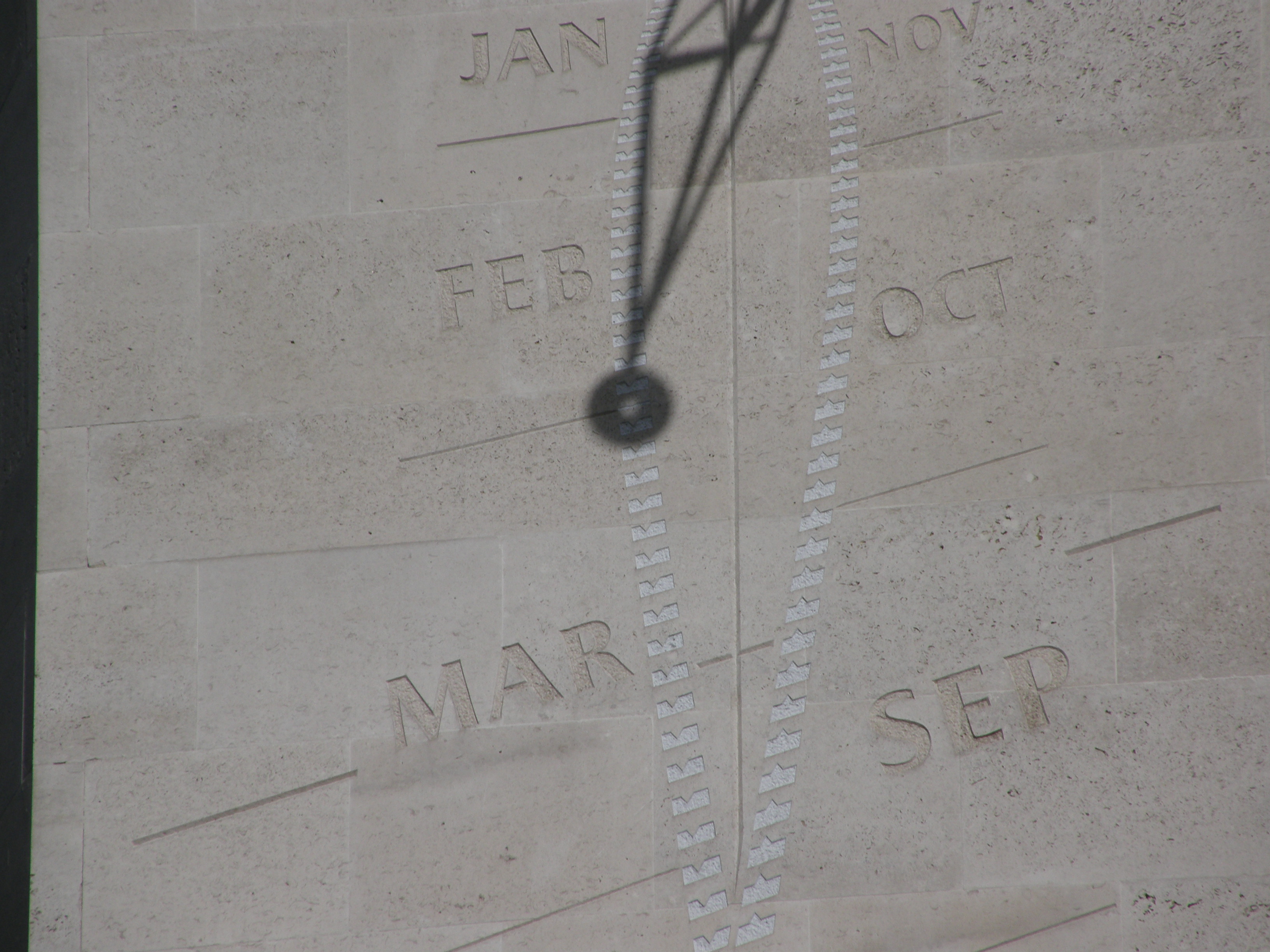
Google Images of the entire dial:
Sundial
<https://www.google.com/search?q=sundial+Paternoster+Square&rlz=1T4GUEA_enUS
645US645&source=lnms&tbm=isch&sa=X&ved=0ahUKEwjTl76N6p3OAhXDth4KHQhzCKsQ_AUI
CigD&biw=1360&bih=737%23imgrc=GnA4srINrL09cM%3A>  Paternoster Square


-----Original Message-----
From: sundial [mailto:[email protected]] On Behalf Of Frank King
Sent: Sunday, July 31, 2016 9:23 AM
To: [email protected]
Subject: Re: Sawyer Dialing Prize 2016


Dear All,


I add my congratulations to Roger Bailey

and note that he generously refers to my

article on "Sundials and Leap Years" in

the BSS Bulletin of December 2011.


Bob Kellogg referred to this in one of his

excellent "Sundials for Starters" pieces:

"Bisextile Years and the Analemma" in the

NASS Compendium of December 2014.


Roger refers to the noon mark at

10 Paternoster Square in London.

This is indeed its correct address

but the building is, perhaps, better

known at the New London Stock Exchange!


Each day for two minutes before and

two minutes after LOCAL MEAN NOON, the

spot of light from an aperture nodus

runs along A NARROW STRIP which is

associated with THE DAY'S DATE.


Most readers will instantly appreciate

that 2+2 minutes of time equates to

1 degree of hour angle.


Paternoster Square is just under

6 arc minutes WEST of the Greenwich

Meridian which equates to just under

24 seconds of time.  GMT is marked

by an analemma-within-an-analemma.

The inner analemma is marked by

the vertices of little triangular

appendages.


A log of the position of the spot

as it crosses a strip is therefore

as follows, with all times in GMT:


  11:58:24 crosses left-hand side

  12:00:00 crosses inner analemma

  12:00:24 crosses centreline

  12:02:24 crosses right-hand side


Note 12:00:24 is local mean noon.


There is an extra-specially-thin

strip for 29 February; this is

just under a quarter the width

of its neighbours (reflecting the

fact that the tropical year is

just under 365 and a quarter days).


The spot of light runs along this

strip only in leap years.  In

common years it runs along the

28 February strip one day and

the 1 March strip the next day,

skiping the 29 February strip.


Since the noon mark was put up,

there have been 4 instances of

29 February...


 2004 It was snowing hard

 2008 It was raining hard

 2012 There was 100% cloud cover

 2016 Clear Sky!!  Hurrah!


Now look at:


http://www.cl.cam.ac.uk/users/fhk1/Sundials/NoonGMT29Feb.jpg


You will see the appearance of the

spot of light::


  on  2016-02-29 at 12:00:00 GMT


This photograph is hereby

published for the first time.


No one else has ever seen this.

I was the only person looking

at the Stock Exchange at the

critical moment.


   YOU SAW IT HERE FIRST!!


The mathematics is not too

challenging.  The surveying

was horrendously difficult!!


Engineering is harder than

mathematics!


Frank


Frank H. King

Cambridge, U.K.


---------------------------------------------------

https://lists.uni-koeln.de/mailman/listinfo/sundial
---------------------------------------------------
https://lists.uni-koeln.de/mailman/listinfo/sundial