hi folks, i'm an experienced software engineer wandering into unchartered
mathematical territory, and i've set myself a challenge to reverse-engineer
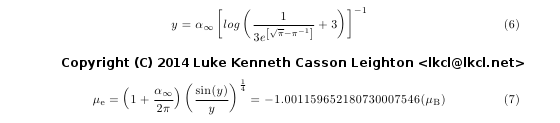
the properties of the electron.  the referenced PNG
http://lkcl.net/moment_formula.png (easiest way to show it) is a screenshot
of a formula that i'd like to factorise into the form 1 + a0 * x + a1 * x^2
+ a2 * x^3 .... where x needs to be the *specific* value "alpha / (2 *
pi)".  this allows it to be compared against QED's formula for the electron
magnetic moment which, if this formula could be shown to be a potential
(accidental) factorisation of the enormously-complex equation from QED
would be a really rather large hairy deal.
now, i'm aware that simpy has the ability to expand out equations including
sine, exp and to express equations as a power series in x like that but
what i _don't_ know is if it can be done where x must be in terms of two
(or in this case 3) related constants.

first question, then: can simpy do this type of factorisation?  second
question: if not, what (possibly iterative) approach could be taken to
twist scipy's arm into doing the job?

if i'm absolutely honest i have no clue where to start here, so could
really use some pointers to examples and so on.  if anyone _can_ help then
i am more than willing to formally give credit in the paper i'm writing up.

many thanks,

l.

p.s. there _is_ a precise mathematical formula (another power series) for
alpha-infinity, if that helps at all, not sure if it does but i mention it
anyway just in case.
p.p.s. hmm let's see if google groups allows images to be put inline into
text... it does!  ok that may help.

<https://lh5.googleusercontent.com/-I-dYeWy5loM/UzAzJoyqYgI/AAAAAAAAALY/OizVd4uiRy4/s1600/moment_formula.png>

--
You received this message because you are subscribed to the Google Groups
"sympy" group.
To unsubscribe from this group and stop receiving emails from it, send an email
to [email protected].
To post to this group, send email to [email protected].
Visit this group at http://groups.google.com/group/sympy.
To view this discussion on the web visit
https://groups.google.com/d/msgid/sympy/b758029a-3c98-4a82-92ff-38c1f2873264%40googlegroups.com.
For more options, visit https://groups.google.com/d/optout.