On 03/02/2013 02:31, Michael Patrick wrote:
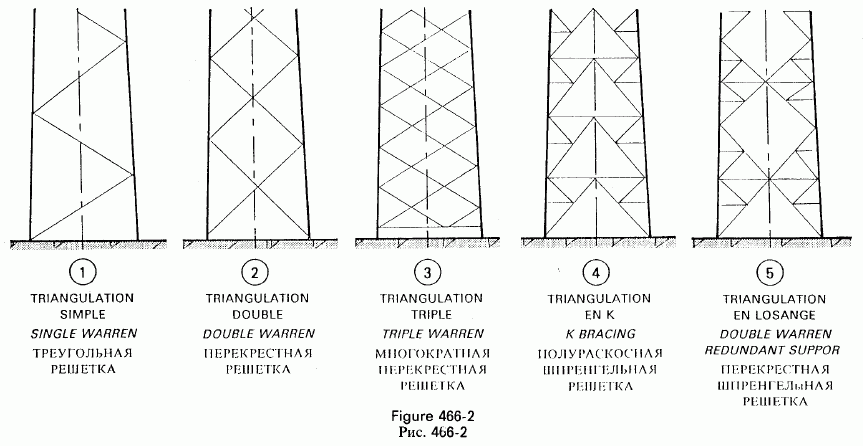
For reference, see the International Electrotechnical Commission (
http://www.iec.ch/about/ ) Electropedia ( http://www.electropedia.org/ )
or from the Glossary search at ( http://std.iec.ch/glossary  ),  to the
Overhead lines / Towers description page (
http://www.electropedia.org/iev/iev.nsf/display?openform&ievref=466-08-08 )
where we see a diagram (
http://www.electropedia.org/iev/iev.nsf/master/466-08-08:fr/$FILE/466-fig2.gif
) and nomenclature in multiple languages: (English) double warren
redundant support ..
This is a highly useful reference that I would have liked to know about earlier. Now I see why the Germans are so fond of the "power=station" tag: en:substation = de:Station (authoritative!).
Whether we should go into details about how towers are braced etc can be discussed. If somebody wants to tag bracing types, ok with me, but I would find it of little added value in osm. There is already a scheme to tag different types or designs of towers, see http://wiki.openstreetmap.org/wiki/Tag:power%3Dtower, but it does not go into that kind of details.
While I get that crowd generated attribute tagging has some unique
advantages, huge flexibility, allows whatever level of detail in any
language to be incorporates, at the other end of the pipe are editing
tools, maintenance bots, and rendering engines which do expect some sort
of conventions. There might be some advantages to at least examining
these vocabularies ( like the IEC). For instance, it might be revealed
that a proposed tag might actually be several additional tags ( I
usually can't see every possible variation when looking at a  specific
case). As dedicated user communities seek to add their own tags, there
would be a path to add more level of detail without breaking downstream
tools. Expanding tag sets to other languages is somewhat easier because
the basic objects and concepts are already translated. There also seems
to be a growing space of communities and applications outside of OSM
that would benefit from interoperability ( 'routing' as a quick example ).
I agree that it would have been better to define osm features according to internationally accepted standards to facilitate the use of such data. However the existing power tagging scheme is going to be difficult to adapt although our terminology and definitions are clearly different from IEC and often illogical ('cables' and 'wires' being some of the more strange tags). As an example we are currently trying to eliminate the station/substation confusion but even that isn't appreciated by everybody. For some features it may be possible to subtag further details according to the IEC definitions and I would certainly recommend to consult the IEC vocabulary when drafting new power related proposals.
Ole

_______________________________________________
Tagging mailing list
[email protected]
http://lists.openstreetmap.org/listinfo/tagging