texascavers Digest 3 Apr 2012 00:21:47 -0000 Issue 1525

Topics (messages 19789 through 19801):
leafcutter bees
        19789 by: Mixon Bill
        19790 by: Andy Gluesenkamp
        19791 by: Kurt L. Menking
        19792 by: Mark.Alman.L-3com.com
        19793 by: Don Arburn
        19794 by: Mark.Alman.L-3com.com
        19795 by: Kurt L. Menking
        19800 by: Gill Edigar

Subterranean Tsunami in Devil's Hole, Nevada
        19796 by: Lee H. Skinner
        19799 by: tbsamsel.verizon.net
        19801 by: Gill Edigar

Week Long NCRC Class 2012
        19797 by: Geary Schindel

Thank you again!
        19798 by: Espeleo Coahuila

Administrivia:

To subscribe to the digest, e-mail:
        <[email protected]>

To unsubscribe from the digest, e-mail:
        <[email protected]>

To post to the list, e-mail:
        <[email protected]>


----------------------------------------------------------------------
--- Begin Message ---
Many of us have enjoyed watching parades of leafcutter ants, such as
can be seen in Bustamante Canyon in northern Mexico. Don't think they
get very far into Texas. Here's a curious things from Jim Conrad's
Naturalist Newsletter about leafcutter bees, which I'd never heard of
before.
You can sign up to get his e-mail weekly newsletter at
www.backyardnature.net/news/natnat.php
Very rarely anything about caves, but lots of interesting nature
stuff, especially about plants and birds. -- Mixon
JIM CONRAD’S NATURALIST NEWSLETTER
Issued from the woods not far from Natchez, in
southwestern Mississippi, USA

April 1, 2012

*****

LEAFCUTTER BEES
On my last day in the Yucatán I untied the rope that
for so long had been suspending my backpack from the
hut's ceiling, hopefully out of mind for nest-seeking
rats and mice, and took my old backpack in hand. Ashes
from daily campfires had settled all over it so I
stepped outside and gave it a good whack. The
resulting cloud was half ash and half green tatters of
dried, coiled-up leaf-parts stuck together into tube-
like affairs. The leaf tatters surprised me.

But, I knew what they were, for back in 2006 during my
stay at Genesis Retreat in Ek Balam, Yucatán, the Maya
staff there had showed me the same thing. You can read
about that encounter and see the leafy, tube-like item
at http://www.backyardnature.net/yucatan/jo_olon.htm

A young Maya woman had told me that the green leaf-
tube was a collection of nests stuck end-to-end, and
that the tube construction itself was known by a
special Maya name, which was pa'ak. The creature
inside the cocoon was Jo'olon. I was told that a bee
made the nest, but I hardly believed it.

But, now I believe her, for once I had disturbed all
those nests in my roof-suspended backpack, hoards of
bees came complaining, thumping against me and
entangling themselves in my hair but never stinging.
And they were surely the most unusual bees I've ever
seen, for instead of carrying clumps of pollen on
their back-leg "baskets," they transported it on hairs
covering the entire bottoms of their abdomens. With
their golden-yellow abdomen bottoms they look like
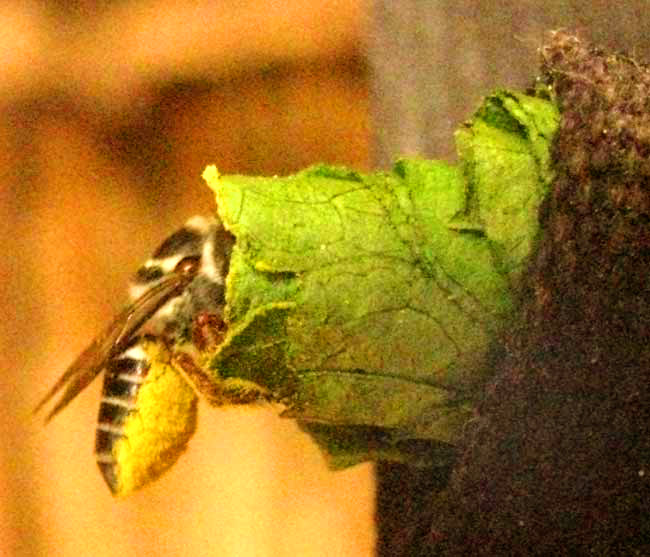
dimly lit fireflies. You can the pollen-dusted lower
abdomen on a bee entering its pa'ak cocoon, one
stuffed into one of my backpack's looped belt-tips, in
the hut's dim light, so it's a grainy picture, at
http://www.backyardnature.net/n/12/120401be.jpg

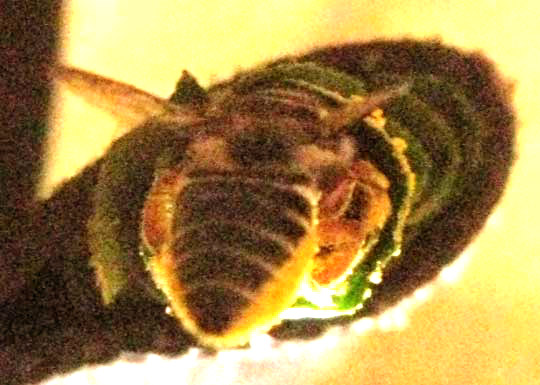
A rear view of the same bee showing golden pollen
stuffed inside a green pa'ak tube is shown at
http://www.backyardnature.net/n/12/120401bf.jpg

So, this was my last Yucatán identification challenge
for volunteer IDer Bea in Ontario. Here's what she
came up with: It's a Leafcutter Bee. Many times we've
spoken of leafcutter ants, but this was something new.

Leafcutter Bees, I find, are members of the genus
MEGACHILE, and despite my ignorance of its existence
that genus is one of the largest among bees, home to
well over 500 species and over 50 subgenera. A list of
insects of Río Lagartos, Yucatán includes eight
species of Megachile leafcutter bees, but I can't say
which species is shown here.

Of leafcutter bees I read that, exactly as we see with
our pa'ak tubes, Megachile nests typically are
composed of single long columns of cells constructed
from cut-out leaf sections. Females place pollen or a
pollen/nectar mix in each cell as food for the egg
laid there, then the cell is capped so that a wall
separates that cell from the next one. The larva
hatching from the egg eats the food supply and after a
few molts and maybe a period of hibernation spins a
cocoon and pupates, emerging from the nest as an adult
bee. Males are typically smaller than females and
emerge before them. Males die shortly after mating but
females survive for several weeks, building new nests.

What a fine last discovery to end my Yucatán days!
----------------------------------------
The winner of the rat race is still a rat.
----------------------------------------
You may "reply" to the address this message
came from, but for long-term use, save:
Personal: [email protected]
AMCS: [email protected] or [email protected]
--- End Message ---
--- Begin Message ---
They love rose bushes!  An ento-buddy said that there's really nothing to do
about them.  Solitary bees that take a confetti-sized chunk of leaf don't do
much damage.


Andrew G. Gluesenkamp, Ph.D.

700 Billie Brooks Drive

Driftwood, Texas 78619

(512) 799-1095

[email protected]

--- On Mon, 4/2/12, Mixon Bill <[email protected]> wrote:

From: Mixon Bill <[email protected]>
Subject: [Texascavers] leafcutter bees
To: "Cavers Texas" <[email protected]>
List-Post: [email protected]
Date: Monday, April 2, 2012, 2:32 PM

Many of us have enjoyed watching parades of leafcutter ants, such as can be
seen in Bustamante Canyon in northern Mexico. Don't think they get very far
into Texas. Here's a curious things from Jim Conrad's Naturalist Newsletter
about leafcutter bees, which I'd never heard of before.

You can sign up to get his e-mail weekly newsletter at
www.backyardnature.net/news/natnat.php

Very rarely anything about caves, but lots of interesting nature stuff,
especially about plants and birds. -- Mixon

JIM CONRAD’S NATURALIST NEWSLETTER
Issued from the woods not far from Natchez, in
southwestern Mississippi, USA

April 1, 2012

*****

LEAFCUTTER BEES
On my last day in the Yucatán I untied the rope that
for so long had been suspending my backpack from the
hut's ceiling, hopefully out of mind for nest-seeking
rats and mice, and took my old backpack in hand. Ashes
from daily campfires had settled all over it so I
stepped outside and gave it a good whack. The
resulting cloud was half ash and half green tatters of
dried, coiled-up leaf-parts stuck together into tube-
like affairs. The leaf tatters surprised me.

But, I knew what they were, for back in 2006 during my
stay at Genesis Retreat in Ek Balam, Yucatán, the Maya
staff there had showed me the same thing. You can read
about that encounter and see the leafy, tube-like item
at http://www.backyardnature.net/yucatan/jo_olon.htm

A young Maya woman had told me that the green leaf-
tube was a collection of nests stuck end-to-end, and
that the tube construction itself was known by a
special Maya name, which was pa'ak. The creature
inside the cocoon was Jo'olon. I was told that a bee
made the nest, but I hardly believed it.

But, now I believe her, for once I had disturbed all
those nests in my roof-suspended backpack, hoards of
bees came complaining, thumping against me and
entangling themselves in my hair but never stinging.
And they were surely the most unusual bees I've ever
seen, for instead of carrying clumps of pollen on
their back-leg "baskets," they transported it on hairs
covering the entire bottoms of their abdomens. With
their golden-yellow abdomen bottoms they look like
dimly lit fireflies. You can the pollen-dusted lower
abdomen on a bee entering its pa'ak cocoon, one
stuffed into one of my backpack's looped belt-tips, in
the hut's dim light, so it's a grainy picture, at
http://www.backyardnature.net/n/12/120401be.jpg

A rear view of the same bee showing golden pollen
stuffed inside a green pa'ak tube is shown at
http://www.backyardnature.net/n/12/120401bf.jpg

So, this was my last Yucatán identification challenge
for volunteer IDer Bea in Ontario. Here's what she
came up with: It's a Leafcutter Bee. Many times we've
spoken of leafcutter ants, but this was something new.

Leafcutter Bees, I find, are members of the genus
MEGACHILE, and despite my ignorance of its existence
that genus is one of the largest among bees, home to
well over 500 species and over 50 subgenera. A list of
insects of Río Lagartos, Yucatán includes eight
species of Megachile leafcutter bees, but I can't say
which species is shown here.

Of leafcutter bees I read that, exactly as we see with
our pa'ak tubes, Megachile nests typically are
composed of single long columns of cells constructed
from cut-out leaf sections. Females place pollen or a
pollen/nectar mix in each cell as food for the egg
laid there, then the cell is capped so that a wall
separates that cell from the next one. The larva
hatching from the egg eats the food supply and after a
few molts and maybe a period of hibernation spins a
cocoon and pupates, emerging from the nest as an adult
bee. Males are typically smaller than females and
emerge before them. Males die shortly after mating but
females survive for several weeks, building new nests.

What a fine last discovery to end my Yucatán days!
----------------------------------------
The winner of the rat race is still a rat.
----------------------------------------
You may "reply" to the address this message
came from, but for long-term use, save:
Personal: [email protected]
AMCS: [email protected] or [email protected]


---------------------------------------------------------------------
Visit our website: http://texascavers.com
To unsubscribe, e-mail: [email protected]
For additional commands, e-mail: [email protected]
--- End Message ---
--- Begin Message ---
Paradise Canyon, the home to several TCR events has several large colonies of
leaf cutter ants.  They're all in the newer developed areas.  They seem to have
declined in the past few years, probably due to the drought.  It will be
interesting to see if they rebound with the decent rains in the past few
months.

Kurt

-----Original Message-----
From: Mixon Bill [mailto:[email protected]]
Sent: Monday, April 02, 2012 2:33 PM
To: Cavers Texas
Subject: [Texascavers] leafcutter bees

Many of us have enjoyed watching parades of leafcutter ants, such as can be
seen in Bustamante Canyon in northern Mexico. Don't think they get very far
into Texas. Here's a curious things from Jim Conrad's Naturalist Newsletter
about leafcutter bees, which I'd never heard of before.

You can sign up to get his e-mail weekly newsletter at
www.backyardnature.net/news/natnat.php

Very rarely anything about caves, but lots of interesting nature stuff,
especially about plants and birds. -- Mixon

JIM CONRAD'S NATURALIST NEWSLETTER
Issued from the woods not far from Natchez, in southwestern Mississippi, USA

April 1, 2012

*****

LEAFCUTTER BEES
On my last day in the Yucatán I untied the rope that for so long had been
suspending my backpack from the hut's ceiling, hopefully out of mind for
nest-seeking rats and mice, and took my old backpack in hand. Ashes from daily
campfires had settled all over it so I stepped outside and gave it a good
whack. The resulting cloud was half ash and half green tatters of dried,
coiled-up leaf-parts stuck together into tube- like affairs. The leaf tatters
surprised me.

But, I knew what they were, for back in 2006 during my stay at Genesis Retreat
in Ek Balam, Yucatán, the Maya staff there had showed me the same thing. You
can read about that encounter and see the leafy, tube-like item at
http://www.backyardnature.net/yucatan/jo_olon.htm

A young Maya woman had told me that the green leaf- tube was a collection of
nests stuck end-to-end, and that the tube construction itself was known by a
special Maya name, which was pa'ak. The creature inside the cocoon was Jo'olon.
I was told that a bee made the nest, but I hardly believed it.

But, now I believe her, for once I had disturbed all those nests in my
roof-suspended backpack, hoards of bees came complaining, thumping against me
and entangling themselves in my hair but never stinging.
And they were surely the most unusual bees I've ever seen, for instead of
carrying clumps of pollen on their back-leg "baskets," they transported it on
hairs covering the entire bottoms of their abdomens. With their golden-yellow
abdomen bottoms they look like dimly lit fireflies. You can the pollen-dusted
lower abdomen on a bee entering its pa'ak cocoon, one stuffed into one of my
backpack's looped belt-tips, in the hut's dim light, so it's a grainy picture,
at http://www.backyardnature.net/n/12/120401be.jpg

A rear view of the same bee showing golden pollen stuffed inside a green pa'ak
tube is shown at http://www.backyardnature.net/n/12/120401bf.jpg

So, this was my last Yucatán identification challenge for volunteer IDer Bea in
Ontario. Here's what she came up with: It's a Leafcutter Bee. Many times we've
spoken of leafcutter ants, but this was something new.

Leafcutter Bees, I find, are members of the genus MEGACHILE, and despite my
ignorance of its existence that genus is one of the largest among bees, home to
well over 500 species and over 50 subgenera. A list of insects of Río Lagartos,
Yucatán includes eight species of Megachile leafcutter bees, but I can't say
which species is shown here.

Of leafcutter bees I read that, exactly as we see with our pa'ak tubes,
Megachile nests typically are composed of single long columns of cells
constructed from cut-out leaf sections. Females place pollen or a pollen/nectar
mix in each cell as food for the egg laid there, then the cell is capped so
that a wall separates that cell from the next one. The larva hatching from the
egg eats the food supply and after a few molts and maybe a period of
hibernation spins a cocoon and pupates, emerging from the nest as an adult bee.
Males are typically smaller than females and emerge before them. Males die
shortly after mating but females survive for several weeks, building new nests.

What a fine last discovery to end my Yucatán days!
----------------------------------------
The winner of the rat race is still a rat.
----------------------------------------
You may "reply" to the address this message came from, but for long-term use,
save:
Personal: [email protected]
AMCS: [email protected] or [email protected]


---------------------------------------------------------------------
Visit our website: http://texascavers.com To unsubscribe, e-mail:
[email protected]
For additional commands, e-mail: [email protected]
--- End Message ---
--- Begin Message ---
And home to the next TCR?

One can only hope!


Mark


-----Original Message-----
From: Kurt L. Menking [mailto:[email protected]]
Sent: Monday, April 02, 2012 2:40 PM
To: Mixon Bill; Cavers Texas
Subject: RE: [Texascavers] leafcutter bees

Paradise Canyon, the home to several TCR events has several large colonies of
leaf cutter ants.  They're all in the newer developed areas.  They seem to have
declined in the past few years, probably due to the drought.  It will be
interesting to see if they rebound with the decent rains in the past few
months.

Kurt

-----Original Message-----
From: Mixon Bill [mailto:[email protected]]
Sent: Monday, April 02, 2012 2:33 PM
To: Cavers Texas
Subject: [Texascavers] leafcutter bees

Many of us have enjoyed watching parades of leafcutter ants, such as can be
seen in Bustamante Canyon in northern Mexico. Don't think they get very far
into Texas. Here's a curious things from Jim Conrad's Naturalist Newsletter
about leafcutter bees, which I'd never heard of before.

You can sign up to get his e-mail weekly newsletter at
www.backyardnature.net/news/natnat.php

Very rarely anything about caves, but lots of interesting nature stuff,
especially about plants and birds. -- Mixon

JIM CONRAD'S NATURALIST NEWSLETTER
Issued from the woods not far from Natchez, in southwestern Mississippi, USA

April 1, 2012

*****

LEAFCUTTER BEES
On my last day in the Yucatán I untied the rope that for so long had been
suspending my backpack from the hut's ceiling, hopefully out of mind for
nest-seeking rats and mice, and took my old backpack in hand. Ashes from daily
campfires had settled all over it so I stepped outside and gave it a good
whack. The resulting cloud was half ash and half green tatters of dried,
coiled-up leaf-parts stuck together into tube- like affairs. The leaf tatters
surprised me.

But, I knew what they were, for back in 2006 during my stay at Genesis Retreat
in Ek Balam, Yucatán, the Maya staff there had showed me the same thing. You
can read about that encounter and see the leafy, tube-like item at
http://www.backyardnature.net/yucatan/jo_olon.htm

A young Maya woman had told me that the green leaf- tube was a collection of
nests stuck end-to-end, and that the tube construction itself was known by a
special Maya name, which was pa'ak. The creature inside the cocoon was Jo'olon.
I was told that a bee made the nest, but I hardly believed it.

But, now I believe her, for once I had disturbed all those nests in my
roof-suspended backpack, hoards of bees came complaining, thumping against me
and entangling themselves in my hair but never stinging.
And they were surely the most unusual bees I've ever seen, for instead of
carrying clumps of pollen on their back-leg "baskets," they transported it on
hairs covering the entire bottoms of their abdomens. With their golden-yellow
abdomen bottoms they look like dimly lit fireflies. You can the pollen-dusted
lower abdomen on a bee entering its pa'ak cocoon, one stuffed into one of my
backpack's looped belt-tips, in the hut's dim light, so it's a grainy picture,
at http://www.backyardnature.net/n/12/120401be.jpg

A rear view of the same bee showing golden pollen stuffed inside a green pa'ak
tube is shown at http://www.backyardnature.net/n/12/120401bf.jpg

So, this was my last Yucatán identification challenge for volunteer IDer Bea in
Ontario. Here's what she came up with: It's a Leafcutter Bee. Many times we've
spoken of leafcutter ants, but this was something new.

Leafcutter Bees, I find, are members of the genus MEGACHILE, and despite my
ignorance of its existence that genus is one of the largest among bees, home to
well over 500 species and over 50 subgenera. A list of insects of Río Lagartos,
Yucatán includes eight species of Megachile leafcutter bees, but I can't say
which species is shown here.

Of leafcutter bees I read that, exactly as we see with our pa'ak tubes,
Megachile nests typically are composed of single long columns of cells
constructed from cut-out leaf sections. Females place pollen or a pollen/nectar
mix in each cell as food for the egg laid there, then the cell is capped so
that a wall separates that cell from the next one. The larva hatching from the
egg eats the food supply and after a few molts and maybe a period of
hibernation spins a cocoon and pupates, emerging from the nest as an adult bee.
Males are typically smaller than females and emerge before them. Males die
shortly after mating but females survive for several weeks, building new nests.

What a fine last discovery to end my Yucatán days!
----------------------------------------
The winner of the rat race is still a rat.
----------------------------------------
You may "reply" to the address this message came from, but for long-term use,
save:
Personal: [email protected]
AMCS: [email protected] or [email protected]


---------------------------------------------------------------------
Visit our website: http://texascavers.com To unsubscribe, e-mail:
[email protected]
For additional commands, e-mail: [email protected]


---------------------------------------------------------------------
Visit our website: http://texascavers.com
To unsubscribe, e-mail: [email protected]
For additional commands, e-mail: [email protected]
--- End Message ---
--- Begin Message ---
It's true! TCR will be at Paradise Canyon.

Sent cellularly.
-Don

On Apr 2, 2012, at 2:43 PM, [email protected] wrote:

> And home to the next TCR?
>
> One can only hope!
>
>
>
> Mark
>
>
>
> -----Original Message-----
> From: Kurt L. Menking [mailto:[email protected]]
> Sent: Monday, April 02, 2012 2:40 PM
> To: Mixon Bill; Cavers Texas
> Subject: RE: [Texascavers] leafcutter bees
>
> Paradise Canyon, the home to several TCR events has several large colonies of
> leaf cutter ants.  They're all in the newer developed areas.  They seem to
> have declined in the past few years, probably due to the drought.  It will be
> interesting to see if they rebound with the decent rains in the past few
> months.
>
> Kurt
>
> -----Original Message-----
> From: Mixon Bill [mailto:[email protected]]
> Sent: Monday, April 02, 2012 2:33 PM
> To: Cavers Texas
> Subject: [Texascavers] leafcutter bees
>
> Many of us have enjoyed watching parades of leafcutter ants, such as can be
> seen in Bustamante Canyon in northern Mexico. Don't think they get very far
> into Texas. Here's a curious things from Jim Conrad's Naturalist Newsletter
> about leafcutter bees, which I'd never heard of before.
>
> You can sign up to get his e-mail weekly newsletter at
> www.backyardnature.net/news/natnat.php
>
> Very rarely anything about caves, but lots of interesting nature stuff,
> especially about plants and birds. -- Mixon
>
> JIM CONRAD'S NATURALIST NEWSLETTER
> Issued from the woods not far from Natchez, in southwestern Mississippi, USA
>
> April 1, 2012
>
> *****
>
> LEAFCUTTER BEES
> On my last day in the Yucatán I untied the rope that for so long had been
> suspending my backpack from the hut's ceiling, hopefully out of mind for
> nest-seeking rats and mice, and took my old backpack in hand. Ashes from
> daily campfires had settled all over it so I stepped outside and gave it a
> good whack. The resulting cloud was half ash and half green tatters of dried,
> coiled-up leaf-parts stuck together into tube- like affairs. The leaf tatters
> surprised me.
>
> But, I knew what they were, for back in 2006 during my stay at Genesis
> Retreat in Ek Balam, Yucatán, the Maya staff there had showed me the same
> thing. You can read about that encounter and see the leafy, tube-like item at
> http://www.backyardnature.net/yucatan/jo_olon.htm
>
> A young Maya woman had told me that the green leaf- tube was a collection of
> nests stuck end-to-end, and that the tube construction itself was known by a
> special Maya name, which was pa'ak. The creature inside the cocoon was
> Jo'olon. I was told that a bee made the nest, but I hardly believed it.
>
> But, now I believe her, for once I had disturbed all those nests in my
> roof-suspended backpack, hoards of bees came complaining, thumping against me
> and entangling themselves in my hair but never stinging.
> And they were surely the most unusual bees I've ever seen, for instead of
> carrying clumps of pollen on their back-leg "baskets," they transported it on
> hairs covering the entire bottoms of their abdomens. With their golden-yellow
> abdomen bottoms they look like dimly lit fireflies. You can the pollen-dusted
> lower abdomen on a bee entering its pa'ak cocoon, one stuffed into one of my
> backpack's looped belt-tips, in the hut's dim light, so it's a grainy
> picture, at http://www.backyardnature.net/n/12/120401be.jpg
>
> A rear view of the same bee showing golden pollen stuffed inside a green
> pa'ak tube is shown at http://www.backyardnature.net/n/12/120401bf.jpg
>
> So, this was my last Yucatán identification challenge for volunteer IDer Bea
> in Ontario. Here's what she came up with: It's a Leafcutter Bee. Many times
> we've spoken of leafcutter ants, but this was something new.
>
> Leafcutter Bees, I find, are members of the genus MEGACHILE, and despite my
> ignorance of its existence that genus is one of the largest among bees, home
> to well over 500 species and over 50 subgenera. A list of insects of Río
> Lagartos, Yucatán includes eight species of Megachile leafcutter bees, but I
> can't say which species is shown here.
>
> Of leafcutter bees I read that, exactly as we see with our pa'ak tubes,
> Megachile nests typically are composed of single long columns of cells
> constructed from cut-out leaf sections. Females place pollen or a
> pollen/nectar mix in each cell as food for the egg laid there, then the cell
> is capped so that a wall separates that cell from the next one. The larva
> hatching from the egg eats the food supply and after a few molts and maybe a
> period of hibernation spins a cocoon and pupates, emerging from the nest as
> an adult bee. Males are typically smaller than females and emerge before
> them. Males die shortly after mating but females survive for several weeks,
> building new nests.
>
> What a fine last discovery to end my Yucatán days!
> ----------------------------------------
> The winner of the rat race is still a rat.
> ----------------------------------------
> You may "reply" to the address this message came from, but for long-term use,
> save:
> Personal: [email protected]
> AMCS: [email protected] or [email protected]
>
>
> ---------------------------------------------------------------------
> Visit our website: http://texascavers.com To unsubscribe, e-mail:
> [email protected]
> For additional commands, e-mail: [email protected]
>
>
> ---------------------------------------------------------------------
> Visit our website: http://texascavers.com
> To unsubscribe, e-mail: [email protected]
> For additional commands, e-mail: [email protected]
>
>
> ---------------------------------------------------------------------
> Visit our website: http://texascavers.com
> To unsubscribe, e-mail: [email protected]
> For additional commands, e-mail: [email protected]
>
--- End Message ---
--- Begin Message ---
To quote Montgomery Burns, "Excellent!".


Looking forward to it already!


Mark


-----Original Message-----
From: Don Arburn [mailto:[email protected]]
Sent: Monday, April 02, 2012 2:47 PM
To: Alman, Mark @ SSG - WSG - EOS
Cc: Kurt L. Menking; Mixon Bill; Cavers Texas
Subject: Re: [Texascavers] leafcutter bees

It's true! TCR will be at Paradise Canyon.

Sent cellularly.
-Don

On Apr 2, 2012, at 2:43 PM, [email protected] wrote:

> And home to the next TCR?
>
> One can only hope!
>
>
>
> Mark
>
>
>
> -----Original Message-----
> From: Kurt L. Menking [mailto:[email protected]]
> Sent: Monday, April 02, 2012 2:40 PM
> To: Mixon Bill; Cavers Texas
> Subject: RE: [Texascavers] leafcutter bees
>
> Paradise Canyon, the home to several TCR events has several large colonies of
> leaf cutter ants.  They're all in the newer developed areas.  They seem to
> have declined in the past few years, probably due to the drought.  It will be
> interesting to see if they rebound with the decent rains in the past few
> months.
>
> Kurt
>
> -----Original Message-----
> From: Mixon Bill [mailto:[email protected]]
> Sent: Monday, April 02, 2012 2:33 PM
> To: Cavers Texas
> Subject: [Texascavers] leafcutter bees
>
> Many of us have enjoyed watching parades of leafcutter ants, such as can be
> seen in Bustamante Canyon in northern Mexico. Don't think they get very far
> into Texas. Here's a curious things from Jim Conrad's Naturalist Newsletter
> about leafcutter bees, which I'd never heard of before.
>
> You can sign up to get his e-mail weekly newsletter at
> www.backyardnature.net/news/natnat.php
>
> Very rarely anything about caves, but lots of interesting nature stuff,
> especially about plants and birds. -- Mixon
>
> JIM CONRAD'S NATURALIST NEWSLETTER
> Issued from the woods not far from Natchez, in southwestern Mississippi, USA
>
> April 1, 2012
>
> *****
>
> LEAFCUTTER BEES
> On my last day in the Yucatán I untied the rope that for so long had been
> suspending my backpack from the hut's ceiling, hopefully out of mind for
> nest-seeking rats and mice, and took my old backpack in hand. Ashes from
> daily campfires had settled all over it so I stepped outside and gave it a
> good whack. The resulting cloud was half ash and half green tatters of dried,
> coiled-up leaf-parts stuck together into tube- like affairs. The leaf tatters
> surprised me.
>
> But, I knew what they were, for back in 2006 during my stay at Genesis
> Retreat in Ek Balam, Yucatán, the Maya staff there had showed me the same
> thing. You can read about that encounter and see the leafy, tube-like item at
> http://www.backyardnature.net/yucatan/jo_olon.htm
>
> A young Maya woman had told me that the green leaf- tube was a collection of
> nests stuck end-to-end, and that the tube construction itself was known by a
> special Maya name, which was pa'ak. The creature inside the cocoon was
> Jo'olon. I was told that a bee made the nest, but I hardly believed it.
>
> But, now I believe her, for once I had disturbed all those nests in my
> roof-suspended backpack, hoards of bees came complaining, thumping against me
> and entangling themselves in my hair but never stinging.
> And they were surely the most unusual bees I've ever seen, for instead of
> carrying clumps of pollen on their back-leg "baskets," they transported it on
> hairs covering the entire bottoms of their abdomens. With their golden-yellow
> abdomen bottoms they look like dimly lit fireflies. You can the pollen-dusted
> lower abdomen on a bee entering its pa'ak cocoon, one stuffed into one of my
> backpack's looped belt-tips, in the hut's dim light, so it's a grainy
> picture, at http://www.backyardnature.net/n/12/120401be.jpg
>
> A rear view of the same bee showing golden pollen stuffed inside a green
> pa'ak tube is shown at http://www.backyardnature.net/n/12/120401bf.jpg
>
> So, this was my last Yucatán identification challenge for volunteer IDer Bea
> in Ontario. Here's what she came up with: It's a Leafcutter Bee. Many times
> we've spoken of leafcutter ants, but this was something new.
>
> Leafcutter Bees, I find, are members of the genus MEGACHILE, and despite my
> ignorance of its existence that genus is one of the largest among bees, home
> to well over 500 species and over 50 subgenera. A list of insects of Río
> Lagartos, Yucatán includes eight species of Megachile leafcutter bees, but I
> can't say which species is shown here.
>
> Of leafcutter bees I read that, exactly as we see with our pa'ak tubes,
> Megachile nests typically are composed of single long columns of cells
> constructed from cut-out leaf sections. Females place pollen or a
> pollen/nectar mix in each cell as food for the egg laid there, then the cell
> is capped so that a wall separates that cell from the next one. The larva
> hatching from the egg eats the food supply and after a few molts and maybe a
> period of hibernation spins a cocoon and pupates, emerging from the nest as
> an adult bee. Males are typically smaller than females and emerge before
> them. Males die shortly after mating but females survive for several weeks,
> building new nests.
>
> What a fine last discovery to end my Yucatán days!
> ----------------------------------------
> The winner of the rat race is still a rat.
> ----------------------------------------
> You may "reply" to the address this message came from, but for long-term use,
> save:
> Personal: [email protected]
> AMCS: [email protected] or [email protected]
>
>
> ---------------------------------------------------------------------
> Visit our website: http://texascavers.com To unsubscribe, e-mail:
> [email protected]
> For additional commands, e-mail: [email protected]
>
>
> ---------------------------------------------------------------------
> Visit our website: http://texascavers.com
> To unsubscribe, e-mail: [email protected]
> For additional commands, e-mail: [email protected]
>
>
> ---------------------------------------------------------------------
> Visit our website: http://texascavers.com
> To unsubscribe, e-mail: [email protected]
> For additional commands, e-mail: [email protected]
>
--- End Message ---
--- Begin Message ---
The owner would be happy to have us back out there.

Has anyone stepped up to the plate to do TCR this year?

Kurt

-----Original Message-----
From: [email protected] [mailto:[email protected]]
Sent: Monday, April 02, 2012 2:44 PM
To: Kurt L. Menking; Mixon Bill; Cavers Texas
Subject: RE: [Texascavers] leafcutter bees

And home to the next TCR?

One can only hope!


Mark


-----Original Message-----
From: Kurt L. Menking [mailto:[email protected]]
Sent: Monday, April 02, 2012 2:40 PM
To: Mixon Bill; Cavers Texas
Subject: RE: [Texascavers] leafcutter bees

Paradise Canyon, the home to several TCR events has several large colonies of
leaf cutter ants.  They're all in the newer developed areas.  They seem to have
declined in the past few years, probably due to the drought.  It will be
interesting to see if they rebound with the decent rains in the past few
months.

Kurt

-----Original Message-----
From: Mixon Bill [mailto:[email protected]]
Sent: Monday, April 02, 2012 2:33 PM
To: Cavers Texas
Subject: [Texascavers] leafcutter bees

Many of us have enjoyed watching parades of leafcutter ants, such as can be
seen in Bustamante Canyon in northern Mexico. Don't think they get very far
into Texas. Here's a curious things from Jim Conrad's Naturalist Newsletter
about leafcutter bees, which I'd never heard of before.

You can sign up to get his e-mail weekly newsletter at
www.backyardnature.net/news/natnat.php

Very rarely anything about caves, but lots of interesting nature stuff,
especially about plants and birds. -- Mixon

JIM CONRAD'S NATURALIST NEWSLETTER
Issued from the woods not far from Natchez, in southwestern Mississippi, USA

April 1, 2012

*****

LEAFCUTTER BEES
On my last day in the Yucatán I untied the rope that for so long had been
suspending my backpack from the hut's ceiling, hopefully out of mind for
nest-seeking rats and mice, and took my old backpack in hand. Ashes from daily
campfires had settled all over it so I stepped outside and gave it a good
whack. The resulting cloud was half ash and half green tatters of dried,
coiled-up leaf-parts stuck together into tube- like affairs. The leaf tatters
surprised me.

But, I knew what they were, for back in 2006 during my stay at Genesis Retreat
in Ek Balam, Yucatán, the Maya staff there had showed me the same thing. You
can read about that encounter and see the leafy, tube-like item at
http://www.backyardnature.net/yucatan/jo_olon.htm

A young Maya woman had told me that the green leaf- tube was a collection of
nests stuck end-to-end, and that the tube construction itself was known by a
special Maya name, which was pa'ak. The creature inside the cocoon was Jo'olon.
I was told that a bee made the nest, but I hardly believed it.

But, now I believe her, for once I had disturbed all those nests in my
roof-suspended backpack, hoards of bees came complaining, thumping against me
and entangling themselves in my hair but never stinging.
And they were surely the most unusual bees I've ever seen, for instead of
carrying clumps of pollen on their back-leg "baskets," they transported it on
hairs covering the entire bottoms of their abdomens. With their golden-yellow
abdomen bottoms they look like dimly lit fireflies. You can the pollen-dusted
lower abdomen on a bee entering its pa'ak cocoon, one stuffed into one of my
backpack's looped belt-tips, in the hut's dim light, so it's a grainy picture,
at http://www.backyardnature.net/n/12/120401be.jpg

A rear view of the same bee showing golden pollen stuffed inside a green pa'ak
tube is shown at http://www.backyardnature.net/n/12/120401bf.jpg

So, this was my last Yucatán identification challenge for volunteer IDer Bea in
Ontario. Here's what she came up with: It's a Leafcutter Bee. Many times we've
spoken of leafcutter ants, but this was something new.

Leafcutter Bees, I find, are members of the genus MEGACHILE, and despite my
ignorance of its existence that genus is one of the largest among bees, home to
well over 500 species and over 50 subgenera. A list of insects of Río Lagartos,
Yucatán includes eight species of Megachile leafcutter bees, but I can't say
which species is shown here.

Of leafcutter bees I read that, exactly as we see with our pa'ak tubes,
Megachile nests typically are composed of single long columns of cells
constructed from cut-out leaf sections. Females place pollen or a pollen/nectar
mix in each cell as food for the egg laid there, then the cell is capped so
that a wall separates that cell from the next one. The larva hatching from the
egg eats the food supply and after a few molts and maybe a period of
hibernation spins a cocoon and pupates, emerging from the nest as an adult bee.
Males are typically smaller than females and emerge before them. Males die
shortly after mating but females survive for several weeks, building new nests.

What a fine last discovery to end my Yucatán days!
----------------------------------------
The winner of the rat race is still a rat.
----------------------------------------
You may "reply" to the address this message came from, but for long-term use,
save:
Personal: [email protected]
AMCS: [email protected] or [email protected]


---------------------------------------------------------------------
Visit our website: http://texascavers.com To unsubscribe, e-mail:
[email protected]
For additional commands, e-mail: [email protected]


---------------------------------------------------------------------
Visit our website: http://texascavers.com To unsubscribe, e-mail:
[email protected]
For additional commands, e-mail: [email protected]
--- End Message ---
--- Begin Message ---
So, are these bees stingerless?
--Ediger

On Mon, Apr 2, 2012 at 2:32 PM, Mixon Bill <[email protected]> wrote:
> Many of us have enjoyed watching parades of leafcutter ants, such as can be
> seen in Bustamante Canyon in northern Mexico. Don't think they get very far
> into Texas. Here's a curious things from Jim Conrad's Naturalist Newsletter
> about leafcutter bees, which I'd never heard of before.
>
> You can sign up to get his e-mail weekly newsletter at
> www.backyardnature.net/news/natnat.php
>
> Very rarely anything about caves, but lots of interesting nature stuff,
> especially about plants and birds. -- Mixon
>
> JIM CONRAD’S NATURALIST NEWSLETTER
> Issued from the woods not far from Natchez, in
> southwestern Mississippi, USA
>
> April 1, 2012
>
> *****
>
> LEAFCUTTER BEES
> On my last day in the Yucatán I untied the rope that
> for so long had been suspending my backpack from the
> hut's ceiling, hopefully out of mind for nest-seeking
> rats and mice, and took my old backpack in hand. Ashes
> from daily campfires had settled all over it so I
> stepped outside and gave it a good whack. The
> resulting cloud was half ash and half green tatters of
> dried, coiled-up leaf-parts stuck together into tube-
> like affairs. The leaf tatters surprised me.
>
> But, I knew what they were, for back in 2006 during my
> stay at Genesis Retreat in Ek Balam, Yucatán, the Maya
> staff there had showed me the same thing. You can read
> about that encounter and see the leafy, tube-like item
> at http://www.backyardnature.net/yucatan/jo_olon.htm
>
> A young Maya woman had told me that the green leaf-
> tube was a collection of nests stuck end-to-end, and
> that the tube construction itself was known by a
> special Maya name, which was pa'ak. The creature
> inside the cocoon was Jo'olon. I was told that a bee
> made the nest, but I hardly believed it.
>
> But, now I believe her, for once I had disturbed all
> those nests in my roof-suspended backpack, hoards of
> bees came complaining, thumping against me and
> entangling themselves in my hair but never stinging.
> And they were surely the most unusual bees I've ever
> seen, for instead of carrying clumps of pollen on
> their back-leg "baskets," they transported it on hairs
> covering the entire bottoms of their abdomens. With
> their golden-yellow abdomen bottoms they look like
> dimly lit fireflies. You can the pollen-dusted lower
> abdomen on a bee entering its pa'ak cocoon, one
> stuffed into one of my backpack's looped belt-tips, in
> the hut's dim light, so it's a grainy picture, at
> http://www.backyardnature.net/n/12/120401be.jpg
>
> A rear view of the same bee showing golden pollen
> stuffed inside a green pa'ak tube is shown at
> http://www.backyardnature.net/n/12/120401bf.jpg
>
> So, this was my last Yucatán identification challenge
> for volunteer IDer Bea in Ontario. Here's what she
> came up with: It's a Leafcutter Bee. Many times we've
> spoken of leafcutter ants, but this was something new.
>
> Leafcutter Bees, I find, are members of the genus
> MEGACHILE, and despite my ignorance of its existence
> that genus is one of the largest among bees, home to
> well over 500 species and over 50 subgenera. A list of
> insects of Río Lagartos, Yucatán includes eight
> species of Megachile leafcutter bees, but I can't say
> which species is shown here.
>
> Of leafcutter bees I read that, exactly as we see with
> our pa'ak tubes, Megachile nests typically are
> composed of single long columns of cells constructed
> from cut-out leaf sections. Females place pollen or a
> pollen/nectar mix in each cell as food for the egg
> laid there, then the cell is capped so that a wall
> separates that cell from the next one. The larva
> hatching from the egg eats the food supply and after a
> few molts and maybe a period of hibernation spins a
> cocoon and pupates, emerging from the nest as an adult
> bee. Males are typically smaller than females and
> emerge before them. Males die shortly after mating but
> females survive for several weeks, building new nests.
>
> What a fine last discovery to end my Yucatán days!
> ----------------------------------------
> The winner of the rat race is still a rat.
> ----------------------------------------
> You may "reply" to the address this message
> came from, but for long-term use, save:
> Personal: [email protected]
> AMCS: [email protected] or [email protected]
>
>
> ---------------------------------------------------------------------
> Visit our website: http://texascavers.com
> To unsubscribe, e-mail: [email protected]
> For additional commands, e-mail: [email protected]
>
--- End Message ---
--- Begin Message ---
Very interesting article from Scientific American:

http://tinyurl.com/chggebk
Does anyone know of this happening in other caves that intersect the
water table?
Lee Skinner
--- End Message ---
--- Begin Message ---
Here's what happened in Virginia... near Blacksburg.
http://waterdata.usgs.gov/va/nwis/uv?cb_72019=on&format=gif_default&begin_date=2012-03-19&end_date=2012-03-22&site_no=370812080261901
On 04/02/12, Lee H. Skinner<[email protected]> wrote:
--- End Message ---
--- Begin Message ---
There are a number of recording wells that respond to seismic events.
--Ediger

On Mon, Apr 2, 2012 at 3:18 PM, Lee H. Skinner <[email protected]> wrote:
> Very interesting article from Scientific American:
>
> http://tinyurl.com/chggebk
>
> Does anyone know of this happening in other caves that intersect the water
> table?
>
> Lee Skinner
>
> ---------------------------------------------------------------------
> Visit our website: http://texascavers.com
> To unsubscribe, e-mail: [email protected]
> For additional commands, e-mail: [email protected]
>
--- End Message ---
--- Begin Message ---
Forward from TAG-NET this morning.


Geary


NCRC Weeklong 2012

            By: Steve Hudson  (LaFayette, Georgia)

          [email protected]<mailto:[email protected]>


Want to learn about cave rescue? Want to go to NCRC again but don't want to
take the same class over? Now you have options.


This year at the Mentone NCRC seminar you have the option of taking a new NCRC
class. Besides the standard levels 1, 2, and 3 the seminar offers a class in
Caving and Wilderness First Aid. For years we've encouraged folks to take a
wilderness first aid class. Now we're offering it. This includes a two day
wilderness first aid class (ASHI certified), psychological first aid (Red Cross
certified), and a bunch more exploration of first aid/medic issues related to
cave rescue like suspension trauma, advanced packaging, and creative splinting.
We will do medical field exercises and review level 2 rigging in the class and
the field. At the end of the week everyone will participate in the mock rescue.
This is great preparation for anyone going on an expedition. The prerequisite
is having taken level 2 since 2000. This will also renew your level two status
so you can take level 3 in the future. And don't forget the class we added last
year called Team Operations and Field Exercise (TOFE) if medical is not your
thing. So come hang out with your NCRC friends and learn something new. It will
be fun.


For more information, go to the NCRC website and look for the 2012 seminar
information and online registration link. Prices go up April 22nd.


http://www.caves.org/commission/ncrc/national/2012Seminar/seminar2012.htm


Steve Hudson National Training Coordinator National Cave Rescue Commission


[email protected]<mailto:[email protected]>
--- End Message ---
--- Begin Message ---
Dear Cavers
Today i visit the doctor and she say me:

Since 2009 at 2012, I still continuous on  cancer treatment and has a "very
good prognostic"
the cancer is not present, yeayyyy!!!
so... the next appointment is at September this year.

Thank you very much for give me hugs  and good feelings
always with your love, I have health

Moni

See you on EspeleoQuintana Roo2012.


--
LCC. Monica Grissel Ponce Gonzalez
Asociacion Coahuilense de Espeleologia, A.C. (fundadora)
Assoziatione Italiana Geografiche Explorazioni La Venta  (socia)
Grupo Espeleologico Vaxakmen, A.C. (socia)
Association for Mexican Cave Studies (colaboradora)
Texas Speleological Association (Socia)
Union Mexicana de Agrupaciones Espeleologicas (Socia)
045-844-1478311 cel.
monicaponce1 by skype.
--- End Message ---