It's true! TCR will be at Paradise Canyon.

Sent cellularly.
-Don
On Apr 2, 2012, at 2:43 PM, [email protected] wrote:

> And home to the next TCR?
>
> One can only hope!
>
>
>
> Mark
>
>
>
> -----Original Message-----
> From: Kurt L. Menking [mailto:[email protected]]
> Sent: Monday, April 02, 2012 2:40 PM
> To: Mixon Bill; Cavers Texas
> Subject: RE: [Texascavers] leafcutter bees
>
> Paradise Canyon, the home to several TCR events has several large colonies of
> leaf cutter ants.  They're all in the newer developed areas.  They seem to
> have declined in the past few years, probably due to the drought.  It will be
> interesting to see if they rebound with the decent rains in the past few
> months.
>
> Kurt
>
> -----Original Message-----
> From: Mixon Bill [mailto:[email protected]]
> Sent: Monday, April 02, 2012 2:33 PM
> To: Cavers Texas
> Subject: [Texascavers] leafcutter bees
>
> Many of us have enjoyed watching parades of leafcutter ants, such as can be
> seen in Bustamante Canyon in northern Mexico. Don't think they get very far
> into Texas. Here's a curious things from Jim Conrad's Naturalist Newsletter
> about leafcutter bees, which I'd never heard of before.
>
> You can sign up to get his e-mail weekly newsletter at
> www.backyardnature.net/news/natnat.php
>
> Very rarely anything about caves, but lots of interesting nature stuff,
> especially about plants and birds. -- Mixon
>
> JIM CONRAD'S NATURALIST NEWSLETTER
> Issued from the woods not far from Natchez, in southwestern Mississippi, USA
>
> April 1, 2012
>
> *****
>
> LEAFCUTTER BEES
> On my last day in the Yucatán I untied the rope that for so long had been
> suspending my backpack from the hut's ceiling, hopefully out of mind for
> nest-seeking rats and mice, and took my old backpack in hand. Ashes from
> daily campfires had settled all over it so I stepped outside and gave it a
> good whack. The resulting cloud was half ash and half green tatters of dried,
> coiled-up leaf-parts stuck together into tube- like affairs. The leaf tatters
> surprised me.
>
> But, I knew what they were, for back in 2006 during my stay at Genesis
> Retreat in Ek Balam, Yucatán, the Maya staff there had showed me the same
> thing. You can read about that encounter and see the leafy, tube-like item at
> http://www.backyardnature.net/yucatan/jo_olon.htm
>
> A young Maya woman had told me that the green leaf- tube was a collection of
> nests stuck end-to-end, and that the tube construction itself was known by a
> special Maya name, which was pa'ak. The creature inside the cocoon was
> Jo'olon. I was told that a bee made the nest, but I hardly believed it.
>
> But, now I believe her, for once I had disturbed all those nests in my
> roof-suspended backpack, hoards of bees came complaining, thumping against me
> and entangling themselves in my hair but never stinging.
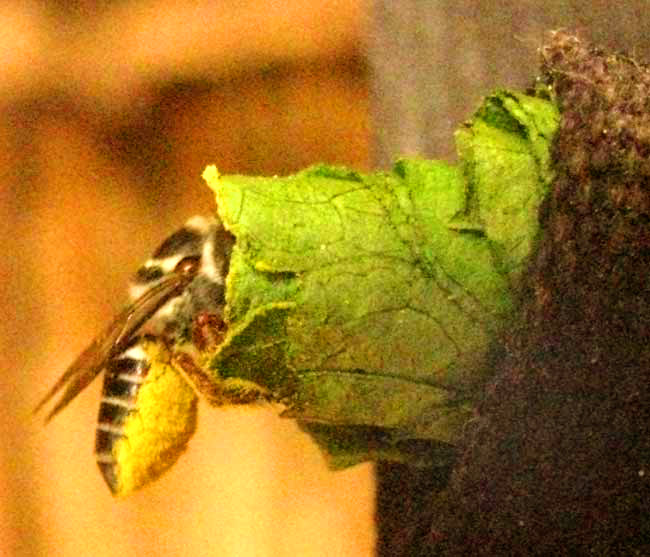
> And they were surely the most unusual bees I've ever seen, for instead of
> carrying clumps of pollen on their back-leg "baskets," they transported it on
> hairs covering the entire bottoms of their abdomens. With their golden-yellow
> abdomen bottoms they look like dimly lit fireflies. You can the pollen-dusted
> lower abdomen on a bee entering its pa'ak cocoon, one stuffed into one of my
> backpack's looped belt-tips, in the hut's dim light, so it's a grainy
> picture, at http://www.backyardnature.net/n/12/120401be.jpg
>
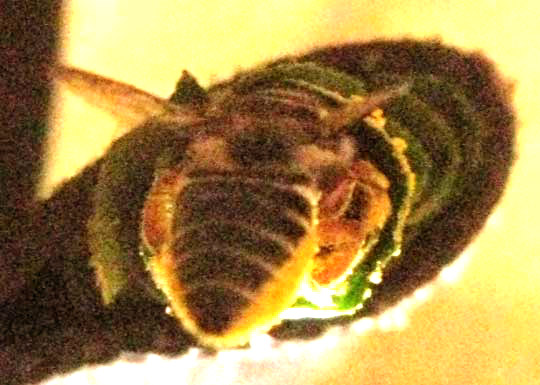
> A rear view of the same bee showing golden pollen stuffed inside a green
> pa'ak tube is shown at http://www.backyardnature.net/n/12/120401bf.jpg
>
> So, this was my last Yucatán identification challenge for volunteer IDer Bea
> in Ontario. Here's what she came up with: It's a Leafcutter Bee. Many times
> we've spoken of leafcutter ants, but this was something new.
>
> Leafcutter Bees, I find, are members of the genus MEGACHILE, and despite my
> ignorance of its existence that genus is one of the largest among bees, home
> to well over 500 species and over 50 subgenera. A list of insects of Río
> Lagartos, Yucatán includes eight species of Megachile leafcutter bees, but I
> can't say which species is shown here.
>
> Of leafcutter bees I read that, exactly as we see with our pa'ak tubes,
> Megachile nests typically are composed of single long columns of cells
> constructed from cut-out leaf sections. Females place pollen or a
> pollen/nectar mix in each cell as food for the egg laid there, then the cell
> is capped so that a wall separates that cell from the next one. The larva
> hatching from the egg eats the food supply and after a few molts and maybe a
> period of hibernation spins a cocoon and pupates, emerging from the nest as
> an adult bee. Males are typically smaller than females and emerge before
> them. Males die shortly after mating but females survive for several weeks,
> building new nests.
>
> What a fine last discovery to end my Yucatán days!
> ----------------------------------------
> The winner of the rat race is still a rat.
> ----------------------------------------
> You may "reply" to the address this message came from, but for long-term use,
> save:
> Personal: [email protected]
> AMCS: [email protected] or [email protected]
>
>
> ---------------------------------------------------------------------
> Visit our website: http://texascavers.com To unsubscribe, e-mail:
> [email protected]
> For additional commands, e-mail: [email protected]
>
>
> ---------------------------------------------------------------------
> Visit our website: http://texascavers.com
> To unsubscribe, e-mail: [email protected]
> For additional commands, e-mail: [email protected]
>
>
> ---------------------------------------------------------------------
> Visit our website: http://texascavers.com
> To unsubscribe, e-mail: [email protected]
> For additional commands, e-mail: [email protected]
>

---------------------------------------------------------------------
Visit our website: http://texascavers.com
To unsubscribe, e-mail: [email protected]
For additional commands, e-mail: [email protected]