I would sure like to know if guano from an insectivore works! I like the
idea of going after the leafcutters garden. I am going to try growing some Jack
Beans and putting the  leaves on the mounds - supposed to kill the leafcutter's
fungus.
      --- On Mon, 2/1/10, JSSchneider1 <[email protected]> wrote:


        From: JSSchneider1 <[email protected]>
        Subject: Fw: Fw: [Texascavers] leaf-cutter ants in Mexico
        To: "Edie Ymail Clark" <[email protected]>
        Date: Monday, February 1, 2010, 10:22 PM


        Edie,

        Another reply from your leaf-cutter ant notes

        ----- Original Message -----
        From: Cook, Brett
        To: JSSchneider1 ; [email protected]
        Sent: Monday, February 01, 2010 9:42 AM
        Subject: RE: Fw: [Texascavers] leaf-cutter ants in Mexico


        I’m with you. They stop being fascinating when they strip plants that
are important to you.

        The only thing I’ve found that stops them is Tanglefoot. They check it
out, find out it’s too gooey to cross, and move on. It works, but it takes a
lot of time to apply and re-apply to each plant.

        I finally decided that if they’re going to attack my garden, I’m going
after theirs.

        I’ve been looking for a good fungicide I can spray my plants or the
ground with that will deter them, but no luck so far. Bait doesn’t work, and
poison on the mound only makes them look for an alternate route. I even tried a
systemic on my plants called Imidacloprid. It kept the aphids away, but not the
leaf-cutters.

        This year, I’m going to try fertilizing with guano from an insectivore.
Bat guano is supposed to have anti-fungal properties, and being an insectivore
means there’s a possibility of spreading an insect-specific pathogen that will
affect the ants.

        I’ve read that some folks have had success with collecting the wastes
from the ants themselves and scattering that around their plants. I have yet to
find an ant waste pile.


        Brett


------------------------------------------------------------------------

        From: JSSchneider1 [mailto:[email protected]]
        Sent: Tuesday, January 19, 2010 4:36 PM
        To: Texas Cavers
        Subject: Fw: Fw: [Texascavers] leaf-cutter ants in Mexico


              I used to think they were fascinating until they began to cart
off most of  my garden seedlings. A & M's website has some useful information
on Texas Leafcutters. The only thing I have found that works is to follow their
trail back to the mound, and either use Amdro Ant Block ( not just regular
Amdro), or Viper ( permethrin- which is a synthetic pyrethrin). Viper works
right away, and Amdro Ant Block takes a couple of weeks to work.You have to
keep at it.  The label says you can dust your plants with Viper, but I don't
put anything directly on my vegetable garden plants, just on the ant mound.

              --- On Mon, 1/18/10, JSSchneider1 <[email protected]>
wrote:


              ----- Original Message -----

              From: Gill Edigar

              To: Denise P

              Cc: TexasCavers

              Sent: Monday, January 18, 2010 10:31 AM

              Subject: Re: [Texascavers] leaf-cutter ants in Mexico


              I am pretty sure--like 99%--that we had them in South Texas when
I was a kid. I remember well watching them but don't recall a specific
location--meaning, probably, that they were a common enough occurrence that
they didn't invoke any great interest worthy of remembering.


              There were some ants in South Texas that made underground nests
which humped up above ground (sorta like fireant mounds except 10x bigger) and
which created large subsurface voids. On more than one occasion we were unlucky
enough to drive over these mounds hidden by tall pasture grass and the front
tire of the pick-up fell into them and the truck got stuck and we had to get
towed out. It is my recollection that these were a type of leaf-cutter ant
which, by the way, don't (or didn't) sting. Those events DID create specific
memories.

              --Ediger


              On Mon, Jan 18, 2010 at 9:29 AM, Denise P <[email protected]>
wrote:

              I have heard a number of gardeners in the central Texas area
complaining about them decimating their crops. I hear they are very hard to
control.

              -d

              > From: [email protected]
              > To: [email protected]
              > Date: Mon, 18 Jan 2010 09:23:50 -0600
              > Subject: [Texascavers] leaf-cutter ants in Mexico


              >
              > A few months ago there was a thread about leaf-cutter ants.
Here's
              > something new about them from the Yucatan . Such ants can
usually be
              > seen busily at work in Bustamante Canyon . I don't recall
seeing them
              > in Texas , but I wouldn't be surprised if some were found in
the
              > valley. -- Mixon
              >
              > > JIM CONRAD’S NATURALIST NEWSLETTER
              > > Issued from Hacienda Chichén beside the Maya ruin of
              > > Chichén Itzá in the central Yucatán, MÉXICO
              > >
              > > January 17, 2010
              > **********
              > > RETURN OF THE LEAFCUTTER ANTS
              > > The owners of Hacienda Chichen are justly proud of their pro-
              > > environment policies, which includes using as few
              > > chemicals as possible. The other day a worker not yet
              > > clear about the policy poisoned a large leafcutter
              > > nest because the ants had begun defoliating a Tropical
              > > Almond tree in the parking lot. As soon as we saw what
              > > had been done we made every effort to scoop all the
              > > poison and contaminated soil into plastic bags and
              > > dispose of the bags properly.
              > >
              > > Before the poisoning attempt, every day I'd seen the
              > > ants carrying bits of herbage back to their nest.
              > > However, after the poisoning for two weeks not a
              > > single ant was seen at the nest. I felt sure that the
              > > whole colony had been wiped out. It had been a colony
              > > as large as the one we saw last year at Yokdzenot. You
              > > still can read about that big nest and see it at
              > > http://www.backyardnature.net/yucatan/ant-lfcu.htm
              > >
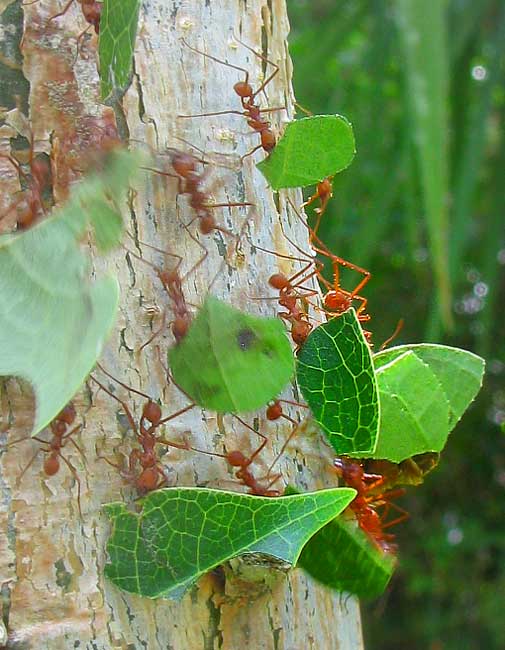
              > > Wednesday morning, there were ants again. Moreover,
              > > not only had the colony resumed its earlier foraging
              > > habits, but also they seemed to have redoubled their
              > > efforts, for now many more ants than before were
              > > carrying cut-out leaf sections and they were moving
              > > faster. Anthropomorphically, they looked exactly as if
              > > they were trying to make up for lost time! You can see
              > > several on the trunk of a Gumbo-Limbo -- which after
              > > two days they'd defoliated nearly completely -- at
              > > http://www.backyardnature.net/n/10/100117lc.jpg
              > >
              > > That picture was made about 30 yards or meters from
              > > their nest and every inch of the trail between there
              > > and the nest was just as cluttered and bustling with
              > > leaf-carrying ants as in the picture.
              > >
              > > Of course I'm relieved that the nest seems to have
              > > survived. Sometimes visitors say that for them
              > > watching the ants is as fascinating as visiting the
              > > ruins! Also the experience has reminded me how like a
              > > single living organism an ant colony is. The colony
              > > became sick, stopped functioning, but then one day
              > > finally burst from home looking as healthy as ever,
              > > trying to make up for lost time. In fact, they're out
              > > there as I type this, a long, long line of them,
              > > gradually defoliating a hibiscus.
              > ***********
              > > Best wishes to all Newsletter Readers.
              > >
              > > Jim
              > >
              > > Subscribe AND unsubscribe to this Newsletter at
              > > http://www.backyardnature.net/news/natnat.php
              >
              > ----------------------------------------
              > A bore is a person who talks when you wish him to listen.
              > ----------------------------------------
              > You may "reply" to the address this message
              > came from, but for long-term use, save:
              > Personal: [email protected]
              > AMCS: [email protected] or [email protected]
              >
              >
              >
---------------------------------------------------------------------
              > Visit our website: http://texascavers.com
              > To unsubscribe, e-mail: [email protected]
              > For additional commands, e-mail:
[email protected]
              >


------------------------------------------------------------------

              Hotmail: Trusted email with Microsoft’s powerful SPAM protection.
Sign up now.