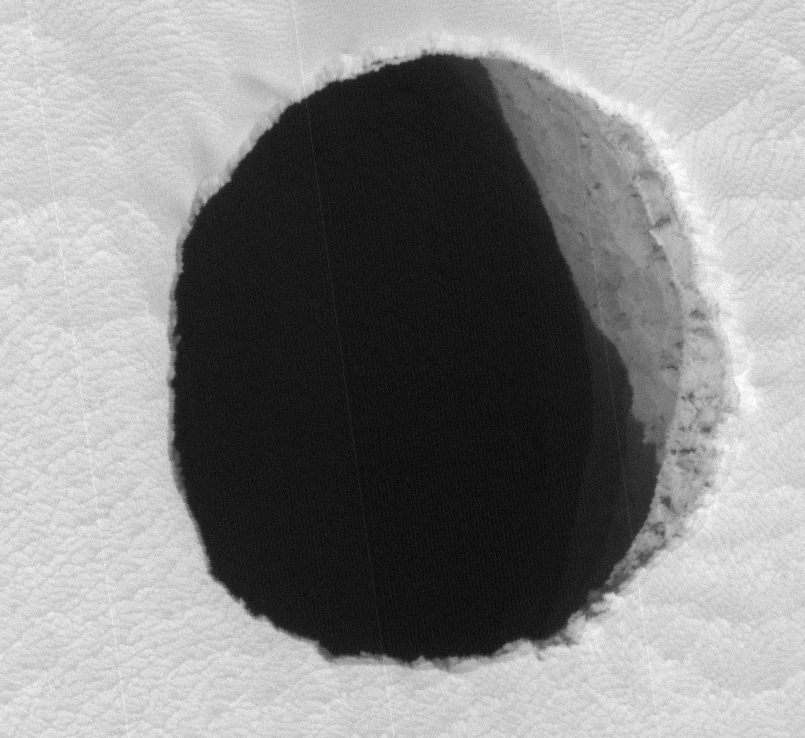
Well, the gig is up!

You can now tell that the walls are overhanging.
I downloaded the uncompressed file of the original photo a few weeks ago
and did my own processing. I could see both the illuminated wall and
the shadowed wall in reflected light, both of them far too thin for that
to be anything other than overhanging or the very dark submartian lake
that some people have speculated about.
Now I get to go download the next zillion MB file and try to hack it
with my tiny amount of RAM
Gregg


Don Cooper wrote:
This is copied from a post Lee Skinner placed on the Yahoo
Cave-Diggers group:
NASA's Mars Reconnaissance Orbiter's HiRISE camera has a new photo of
one of the pits on Mars:
Dark pits on some of the Martian volcanoes have been speculated to be
entrances into caves. A previous HiRISE image,
<
http://hirise.lpl.arizona.edu/PSP_003647_1745> looking essentially
straight down, saw only darkness in this pit.
This time the pit was imaged from the west. Since the picture was taken
at about 2:30
p.m. local (Mars) time, the sun was also shining from the
west. We can now see the eastern wall
<
http://hirise.lpl.arizona.edu/images/2007/details/cut/PSP_004847_1745_cut_b.jpg>
of the pit catching the sunlight.
This confirms that this pit is essentially a vertical shaft cut through
the lava flows on the flank of the volcano. Such pits form on similar
volcanoes in Hawaii and are called "pit craters." They generally do not
connect to long open caverns but are the result of deep underground
collapse. From the shadow of the rim cast onto the wall of the pit we
can calculate that the pit is at least 78 meters (255 feet) deep. The
pit is 150 x 157 meters (492 x 515 feet) across.
---------------------------------------------------------------------
Visit our website: http://texascavers.com
To unsubscribe, e-mail: [email protected]
For additional commands, e-mail: [email protected]