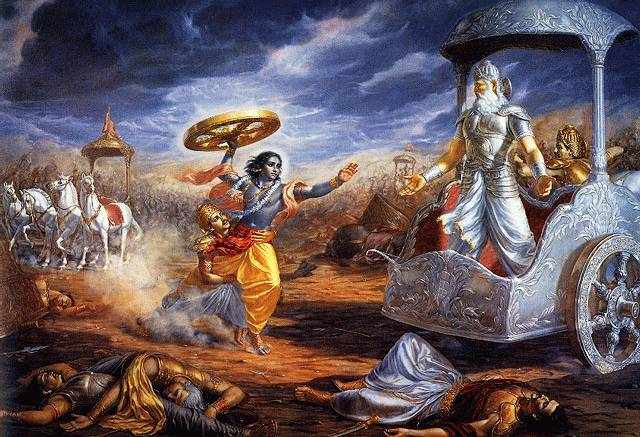
*Published in Devlok-Sunday Midday by DevDutt.*
Jaya is the real winner..
 Reading the Mahabharata makes one experience *rage*; reading the Ramayana
makes one experience *peace*. But things do an about turn when one reaches
the last chapter.
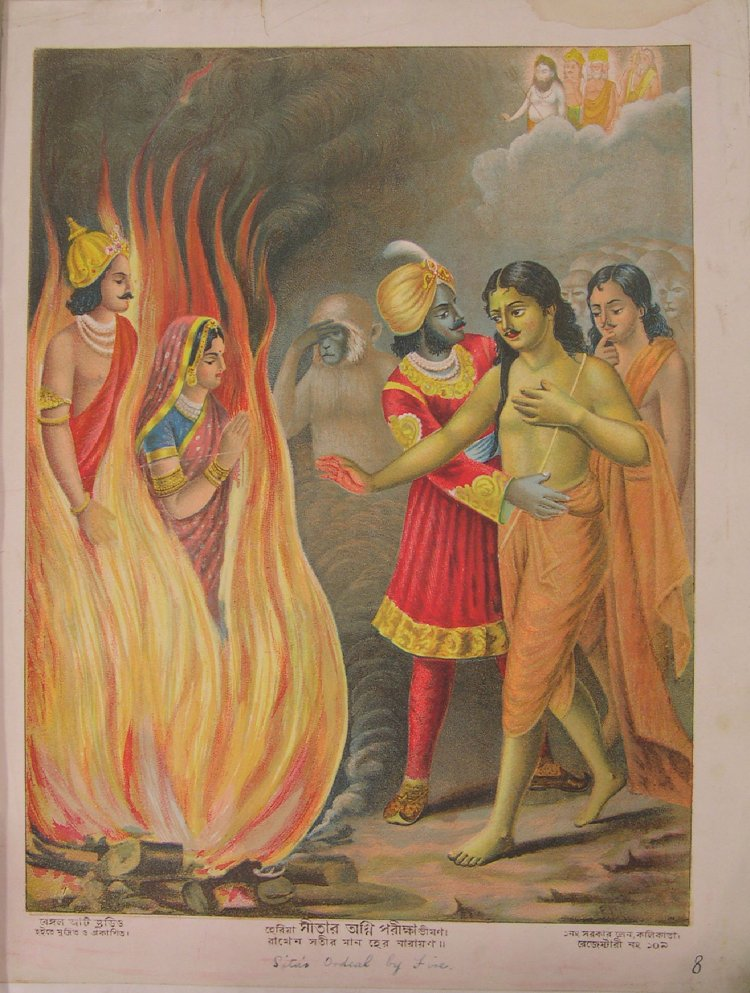
The last chapter of the Ramayana speaks of how Ram abandons Sita; it
shatters the peace and fills one with horror and disgust. The last chapter
of the Mahabharata explains how Yudhishtira finally experienced heaven, and
one is filled with great joy.

<http://1.bp.blogspot.com/-oyJ-NfP9zzA/TscSIgDR9NI/AAAAAAAAbsA/GtsYqFFfFJA/s1600/0.PNG>

Why did the authors of the two epics twist the tales so? It is like
creating a grating sound at the end of a superb musical concert or giving
succulent fruits after a lousy meal. The experience transforms at the
moment of climax. The negative ends on a positive note and the positive
ends on a negative note. Was this deliberate? Or was this a coincidence, an
accident?.

The two epics are twin epics – meaning one cannot be understood without the
other.. And so they display remarkable congruence in form. *Ramayana is
about rule-upholding* at any cost. *Mahabharata is about rule-breaking*.
Rule-upholding seems good in the Ramayana until the last chapter, when
innocent Sita is at the receiving end of draconian family traditions.
Rule-breaking seems necessary in the Mahabharata, until one realizes the
underlying truth through Yudhishtira’s epiphany in the last chapter.

Most retellings of the Ramayana ignore the dark last chapter of Sita’s
abandonment.
<http://4.bp.blogspot.com/-R9hTRkaqmtw/TscQRPXKJwI/AAAAAAAAbro/mhWFdevtQP4/s1600/0.0.PNG>

It is too much to take. It destroys our image of Ram. Likewise, few
narrators of the Mahabharata amplify the epiphany of Yudhishtira in the
last chapter. It is overshadowed by the complex plots full of dark secrets,
intrigue, exploitation, rage, rape, yearning, frustration and bitterness.

Not surprisingly, Mahabharata has not merited as much translation as the
Ramayana. Most storytellers focus only on a few episodes, those that bring
joy, like Bhima killing Bakasura, Drona teaching Arjuna, or Krishna
rescuing Draupadi. Modern sanitized versions of the tale edit out the
controversial characters like Shikhandi and disturbing stories related to
sex. Not good for the children, is the standard excuse. So many generations
of Indians have grown up with little knowledge of the true extent of this
grand cultural inheritance.

The original epic was called *Jaya*, then it was called Vijaya, then
Bharata and finally Mahabharata. Jaya had about twenty five thousand verses
while the final form had over one hundred thousand verses.* Jaya was about
spiritual victory,* *Vijaya was about material victory*, Bharata was the
story of a clan and Mahabharata included also the wisdom of the land called
Bharat-varsha. What began as an auspicious idea, ended up becoming a
massive documentation of realities that frightened the common man. Many
modern scholars, writers and playwrights, exhausted and overwhelmed by the
maze of stories of the final version of the epic, are convinced that the
Mahabharata is only about the futility of war.

But if one strips out the excess fat, one realizes that the Mahabharata is
not a preachy tale appealing for peace. *It is a determined exploration of
the root of conflict*. Hence the original title Jaya, which means victory
where there are no losers, contrasting it with Vijaya, which is victory
over another where there is always a loser. We realize that the Pandavas
achieve Vijaya in Kurukshetra but only *Yudhishtira attains Jaya, much
later, six chapters after the war ends.*


--
With best wishes

S Chander