At 8 p.m. on Nov. 8, India’s Prime Minister Narendra Modi unexpectedly
banned 86% of the country’s legal tender from circulation. The goal was to
wipe out “black money” — a term used in India for cash that’s stashed
outside the banking system to evade taxes. Old notes of Rs. 500 and Rs.
1,000 would no longer be legal. Instead, the government would issue new,
redesigned Rs. 2,000 notes.
Hours after the prime ministerial bombshell, the rumors started flying fast
and thick over WhatsApp, the Facebook-owned instant messaging app used by
more than 160 million Indians
<http://www.bgr.in/news/whatsapp-reaches-160-million-monthly-active-users-in-india-highest-in-the-world/>:
The new notes would include an embedded GPS chip that would allow the
government to track down hoarders.

★ All now 500 & 2000 notes will have NGC - Nano GPS Chips installed.
Satellite will track accumulation of all notes around the world. ★
— Nisha Singh #HDL (@Nisha__Hindu)
<https://twitter.com/BuzzFeed/status/796035464876658688>

Soon a video <https://www.youtube.com/watch?v=kaUBcg8yhCk&feature=youtu.be>
purporting
to show one of these GPS notes being tracked on Google Maps went viral on
WhatsApp, and then Facebook. And less than 24 hours after the rumor started
, Zee News, a leading Hindi television news channel, ran a 90-second report
<https://www.youtube.com/watch?v=8eeD4hRKMXM> about the high-tech note,
leading the country’s reserve bank to finally debunk
<http://www.news18.com/news/tech/rbi-dismisses-rumours-of-gps-enabled-rs-2000-notes-1310033.html>
 it.

The United States is currently experiencing a fake news crisis — bogus news
articles disguised to look like real ones to mislead people, influence
public opinion, and/or to simply use their massive reach
<https://www.buzzfeed.com/craigsilverman/partisan-fb-pages-analysis> to reap
advertising profits
<https://www.buzzfeed.com/craigsilverman/how-macedonia-became-a-global-hub-for-pro-trump-misinfo?utm_term=.ai3Vv569X#.fcQOZ2G0M>.
These operations are sophisticated, data-driven, and highly targeted
<https://www.buzzfeed.com/craigsilverman/the-strangest-fake-news-empire>.
But in countries like India where internet penetration and literacy still
lag far behind the US, misinformation tends to have a more grassroots
quality. Twitter is a fertile ground for all kinds of rumormongering, but
with just over 30 million users in the country, its impact is limited.

“Our problem is WhatsApp, because it’s fast, simple, and much more intimate
compared to Facebook.”

The primary vector for the spread of misinformation in India is WhatApp.
The instant messenger is fast, free, and runs on nearly all of India’s 300
million smartphones. It’s also encrypted end-to-end, which means it’s
nearly impossible to track what flows through it. Its real-world
ramifications, nonetheless, can be brutal.

In November, WhatsApp rumors of a salt shortage sparked panic in at least
four Indian states and caused stampedes outside grocery shops as people
rushed to stock up. The government eventually debunked
<http://indiatoday.intoday.in/story/salt-sugar-shortage-consumer-affairs-food-ministry/1/808881.html>
the
rumours — but not before a woman died
<http://indiatoday.intoday.in/story/salt-shortage-rumour-demonetization-uttar-pradesh-kanpur-woman-killed-panic-buying/1/809014.html>
.
A Different Kind of Fake News

India’s misinformation problem predates the internet. In the early ‘90s,
rabble-rousers in northern India trying to stir up tensions in Hindu and
Muslim communities would mass-produce cassette recordings full of fake
gunfire, screams, and chants of “Allah-ho-Akbar,” and then play them in car
stereos at full volume in the dead of the night to incite communal violence.

And once the internet and social media came to the country, hoaxes took on
a life of their own. In 2008, Pepsi was forced to publicly rebut a video
that claimed that its Indian subsidiary manufactured Kurkure — Indian
Cheetos — out of plastic. A few years later, makers of Frooti, a popular
mango drink, started offering guided tours of their facilities after a
rumour about the beverage containing HIV-positive blood went viral. In
2015, Mumbai’s police commissioner set up a hotline for anxious parents and
urged people to ignore WhatsApp rumors
<http://www.mid-day.com/articles/mumbai-is-safe-do-not-believe-whatsapp-rumours-rakesh-maria/16024176>
that
claimed that gangs of women were kidnapping school children.

“I think it’s unfair to draw a direct parallel between the kind of
organized fake news industry we saw in the lead up to the US elections and
what happens in India,” said the social media strategist of a prominent
political party in Delhi who did not wish to be named. “Our problem is
WhatsApp, because it’s fast, simple, and much more intimate compared to
Facebook. There’s more incentive for perpetrators of misinformation in
India to distribute it over WhatsApp than Facebook because the chances of
having real-world impact through WhatsApp are higher.”

What is also a disincentive is how little average revenue each Indian user
generates for Facebook annually, despite the fact that the country is
Facebook’s largest market
<http://gadgets.ndtv.com/social-networking/news/facebook-now-has-over-166-million-monthly-active-users-in-india-its-most-critical-and-strategic-mark-1629579>
outside
the United States. According to the company’s own numbers
<https://www.buzzfeed.com/alexkantrowitz/heres-how-much-youre-worth-to-facebook?utm_term=.ls6dGeNvqw#.sfNkAlpbyv>,
each user in the Asia-Pacific region generates less than $8 annually,
compared to a US user who generates $62. That makes India a less attractive
target for people like teens in Macedonia
<https://www.buzzfeed.com/craigsilverman/how-macedonia-became-a-global-hub-for-pro-trump-misinfo?utm_term=.ixqpDAn3E6#.ybz7D1EBY9>,
for instance, who earned thousands of dollars in advertising revenue
peddling pro-Trump fake stories on Facebook to millions of Americans.
A Nationalist Wave

“There’s been a sharp increase in WhatsApp forwards that are just
propaganda.”

In 2014, Narendra Modi, a right-wing politician known for his close ties to
Hindu supremacist group RSS, won by a landslide to become the prime
minister of India. Like Trump, Modi is a polarizing figure — and his rise
to power birthed
<https://www.buzzfeed.com/pranavdixit/bjp-trolled-indians> thousands
of social media trolls and organized misinformation campaigns.

“Everything changed,” said author Rupa Gulab, an outspoken Modi critic.
“The hoaxes that went viral a few years before were just silly, but with
Modi and his fanatics, there’s been a sharp increase in the amount of
WhatsApp forwards you receive that are just propaganda.”

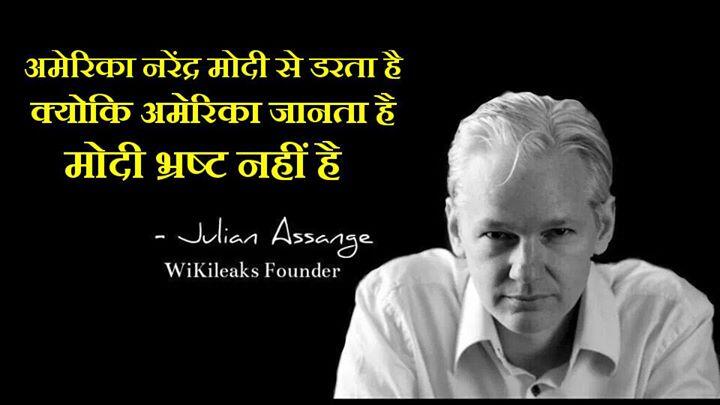
The build-up started while Modi was still campaigning in 2014. In January
that year, a quote about Modi attributed to WikiLeaks founder Julian
Assange went viral on Twitter, WhatsApp, and Facebook, boosted by shares
from members of Modi’s party, the Bharatiya Janata Party (BJP).
View image on Twitter
<https://twitter.com/PreetamV/status/427102983164153857/photo/1>
[image: View image on Twitter]
<https://twitter.com/PreetamV/status/427102983164153857/photo/1>

 Follow <https://twitter.com/MrsGandhi>
Priti Gandhi
✔@MrsGandhi <https://twitter.com/MrsGandhi>

Narendra Modi for Prime Minister!! "@PreetamV <https://twitter.com/PreetamV>
: pic.twitter.com/dZabXcVEbj <http://t.co/dZabXcVEbj>"
10:04 PM - 25 Jan 2014
<https://twitter.com/MrsGandhi/status/427117393400184832>

   -
   <https://twitter.com/intent/tweet?in_reply_to=427117393400184832>
   -
    485485 Retweets
   <https://twitter.com/intent/retweet?tweet_id=427117393400184832>
   -
    164164 likes
   <https://twitter.com/intent/like?tweet_id=427117393400184832>

WikiLeaks denied the quote.

 Follow <https://twitter.com/wikileaks>
WikiLeaks
✔@wikileaks <https://twitter.com/wikileaks>

Narenda Modi's #BJP <https://twitter.com/hashtag/BJP?src=hash> has been
pushing this fake #Modi <https://twitter.com/hashtag/Modi?src=hash>
 endorsement http://fekle.in/wp-content/uploads/2014/01/assange-modi.jpg …
<http://t.co/kyryXQpmht> - but #Assange
<https://twitter.com/hashtag/Assange?src=hash> has never said anything
about #Modi <https://twitter.com/hashtag/Modi?src=hash>
11:43 PM - 16 Mar 2014
<https://twitter.com/wikileaks/status/445261567295512576>

   -
   <https://twitter.com/intent/tweet?in_reply_to=445261567295512576>
   -
    1,8921,892 Retweets
   <https://twitter.com/intent/retweet?tweet_id=445261567295512576>
   -
    568568 likes
   <https://twitter.com/intent/like?tweet_id=445261567295512576>

That didn’t stop the wave of Modi-related forwards on WhatsApp.

In October 2015, a photo of Modi sweeping the floor “during an RSS rally in
1988” — an attempt to highlight the prime minister’s humble roots — blew
up. Later it became clear the image was photoshopped
<http://www.huffingtonpost.in/2016/01/21/remember-that-photo-of-modi-sweeping-the-floor-rti-reply-has-co/>
.

A photo of Modi sweeping the floor “during an RSS rally in 1988” (left) was
found to be photoshopped from the original picture (right) in 2015.

Last year, India’s Press Information Bureau, an agency that manages
government communication with the media, was left red-faced after it
published a photoshopped picture of the prime minister looking out on a
flooded town in the flood-hit state of Tamil Nadu via its official Twitter
handle. A new hashtag, #PhotoshopSarkar
<https://twitter.com/search?q=%23photoshopsarkar&src=typd> — photoshop
government — was born.
<https://twitter.com/SusegadGoan/status/672427037924036608/photo/1>
[image: View image on Twitter]
<https://twitter.com/SusegadGoan/status/672427037924036608/photo/1>[image:
View image on Twitter]
<https://twitter.com/SusegadGoan/status/672427037924036608/photo/1>

 Follow <https://twitter.com/SusegadGoan>
Susegad Goan @SusegadGoan <https://twitter.com/SusegadGoan>

.@PIB_India <https://twitter.com/PIB_India> Has now deleted the tweet with
the photoshopped pic...
8:17 PM - 3 Dec 2015
<https://twitter.com/SusegadGoan/status/672427037924036608>

   -
   <https://twitter.com/intent/tweet?in_reply_to=672427037924036608>
   -
    1212 Retweets
   <https://twitter.com/intent/retweet?tweet_id=672427037924036608>
   -
    33 likes <https://twitter.com/intent/like?tweet_id=672427037924036608>

And in August, Modi himself had to debunk a viral story that claimed *he* had
urged citizens to boycott Chinese-made firecrackers.
View image on Twitter
<https://twitter.com/PMOIndia/status/770930664141185024/photo/1>
[image: View image on Twitter]
<https://twitter.com/PMOIndia/status/770930664141185024/photo/1>

 Follow <https://twitter.com/PMOIndia>
PMO India
✔@PMOIndia <https://twitter.com/PMOIndia>

Few appeals with PM’s ‘signature’ are circulated on social media. Such
documents are not authentic.
3:56 PM - 31 Aug 2016
<https://twitter.com/PMOIndia/status/770930664141185024>

   -
   <https://twitter.com/intent/tweet?in_reply_to=770930664141185024>
   -
    1,6671,667 Retweets
   <https://twitter.com/intent/retweet?tweet_id=770930664141185024>
   -
    2,7582,758 likes
   <https://twitter.com/intent/like?tweet_id=770930664141185024>

More recently, in a thread
<https://twitter.com/samjawed65/status/817624394541498368> that went viral,
Twitter user @samjawed65 <https://twitter.com/samjawed65> deconstructed how
an uncorroborated pro-government report in a mainstream Indian publication
ended up in an aggregation echo chamber with half a dozen other media
outlets re-reporting it, until the *Huffington Post* finally debunked
<http://www.huffingtonpost.in/2017/01/06/reports-of-uae-government-seizing-dawood-property-are-baseless/?ncid=tweetlnkinhpmg00000001>
it
as fake news.

A recently published book details how the BJP deliberately created
<https://www.buzzfeed.com/pranavdixit/bjp-trolled-indians?utm_term=.gmKBJVg5Ed#.jxWp4VqQx7>
abusive
social media campaigns using both WhatsApp and Twitter to troll prominent
Indians and spread lies.

“[It’s clear] how seriously the political Hindu Right in India takes the
online space as an ideological battlefield,” Rohit Chopra, a media studies
professor at Santa Clara University who is working on a book about Hindu
nationalism and new media, told BuzzFeed News. “They have invested money in
it, they have mechanisms for flooding platforms like Twitter with messages
either promoting their view or attacking contrary views, and they seem to
employ a significant number of people in different capacities to manage
this space.”

Krishna Prasad, former editor-in-chief of Indian news weekly *Outlook*,
agreed. Once, Prasad recalled, a social media strategist asked him during a
meeting with BJP politicians, “What have you gotten to trend on Twitter
today?” “There are clearly people in India’s political parties buying
hashtags and trying to influence trending topics,” he said.

“Individuals trying to influence trending topics are considered spammers
and may have their accounts temporarily or permanently suspended,” a
Twitter spokesperson said, and pointed to Twitter’s page
<https://support.twitter.com/articles/101125> that outlines rules for
trending topics.
Dark Social

In November, local newspapers reported that a doctor in the eastern state
of Bihar had died of a cardiac arrest after income tax officials raided his
house and seized illegal currency — except it wasn’t true. The rumors had
first spread on WhatsApp before trickling up to the local media that ran
the story without verification. Eventually, the doctor had to call a press
conference <http://www.bbc.com/news/world-asia-india-37996411> to declare
he was still alive and there had be no raid.

WhatsApp groups are the connective tissue that bind most Indians.

India is the number one market
<http://mashable.com/2016/11/15/whatsapp-160-million-monthly-active-users-india/>
for
WhatsApp in the world. The instant messenger is the most popular messaging
platform, connecting everyone from school friends to India’s bureaucrats
<http://indiatoday.intoday.in/story/prime-minister-narendra-modi-venkaiah-naidu-whatsapp-mps-parliament/1/374827.html>.
WhatsApp groups are the connective tissue that bind most Indians — but they
are also notorious for being hotbeds of spammy forwards and hoaxes.

“Most Indians belong to tight-knit groups on WhatsApp such as a friends
group and a family group,” said Harsh Taneja, an assistant professor at the
Missouri School of Journalism whose research focuses on audience behaviour
and internet use. “But digital networks like WhatsApp are designed to
connect us tightly with groups of acquaintances too, who we may not
otherwise have interacted with frequently.”

These “weak ties”, as Taneja calls them, are the reason why information
spreads rapidly on closed networks like WhatsApp. “Most misinformation that
originates within WhatsApp finds its way through this tight-knit network of
weak ties,” Taneja said. But it’s tough to analyze WhatsApp. The messaging
platform is encrypted end-to-end with no API, algorithms, or trending
topics — which means that it’s virtually impossible to track exactly how
content spreads through it.

A spokesperson at the Hindu Sena, a Hindu nationalist party that celebrated
Donald Trump’s victory
<https://www.buzzfeed.com/andreborges/the-hindu-group-that-supported-trump-through-the-elections-i?utm_term=.csBYvKm1R#.buDEO0kYe>
in
Delhi in December, told BuzzFeed News that he is a part of more than 50
right-wing WhatsApp groups, and sends “thousands of WhatsApp forwards
around the country every day.”

Last year, police in different Indian states arrested
<http://www.medianama.com/2015/10/223-whatsapp-group-admin-arrest/> half a
dozen admins of WhatsApp groups, charging them with the crime of spreading
misleading information, even though an admin has no control over what other
members post in a group they belong to.

“We need to ask tough questions of Facebook, Twitter and Google in an
Indian context.”

Other times, Indian authorities have resorted the using the bluntest weapon
possible: turning off mobile internet entirely. In the first nine months of
2016, the Indian government turned off the internet 22 times
<https://drive.google.com/file/d/0BycAZd9M5_7NOExCRnQ3Q1pqcm8/view> in
various parts of the country — including a four-month stretch in
violence-ridden Kashmir — simply to prevent rumors from spreading over
WhatsApp.

“We need to ask tough questions of Facebook, Twitter, and Google in an
Indian context, just like they are being brought to book in America,” said
Prasad. “In a country like India that is so diverse and culturally
different from the US, these companies cannot get away with saying that we
are just platforms any longer.”

Facebook declined to comment on WhatsApp in the context of fake news. A
Facebook spokesperson instead directed BuzzFeed News to CEO Mark
Zuckerberg’s post <https://www.facebook.com/zuck/posts/10103269806149061> on
the topic. “We’ve made significant progress,” it says. “But there is more
work to be done.”
Pranav Dixit is a tech reporter for BuzzFeed News and is based in Delhi.
Contact Pranav Dixit at [email protected].

--
You received this message because you are subscribed to the Google Groups
"Thatha_Patty" group.
To unsubscribe from this group and stop receiving emails from it, send an email
to [email protected].
For more options, visit https://groups.google.com/d/optout.