*The Dating Game*

Figuring out the age of fossils, or dating them, is key to understanding
them.
Fossils arranged chronologically, for instance, can often suggest
evolutionary relationships among species. And fossils of the same age
demonstrate the distributions of ancient plants and animals around the
world. Fortunately, palaeontologists today have a number of techniques they
can use to answer the question, "How old is it?"

It's All Relative

One way of dating fossils relies on their relative positions in the ground.
When palaeontologists dig deeper in sedimentary rock they are, in effect,
looking back in time. As sediments carried by wind and water accumulate,
they bury older layers—so the bottom layers in a geological sequence are
usually the oldest and the top layers the youngest. Palaeontologists can
thus put fossils in chronological order without knowing the actual age of
each specimen.

Sedimentary Sleuths

When fossils are buried one on top of another, it is easy to arrange them
in chronological order. But the same sedimentary layers can often be traced
over wide areas, so even fossils from sites far apart can be arranged in a
relative chronology.

Clocks In Rocks

Today, scientists use a variety of techniques to date rocks and fossils
precisely. Most often, they measure the amounts of particular radioactive
elements—often radiocarbon or potassium—present to determine when a rock
was formed, or when an animal or plant died. Some techniques work best with
materials millions or even billions of years old. Others only work for much
younger materials. And each method only works for certain materials,
ranging from volcanic rock to charcoal to bone.

Radiocarbon Dating

Living plants and animals absorb carbon from the atmosphere, including
carbon-14—a radioactive form of the element produced when cosmic rays from
the sun interact with nitrogen in the upper atmosphere. But when organisms
die, they no longer take in any carbon, and the carbon-14 in their bodies
begins to decay at a known rate. Scientists use particle accelerators to
measure the amount of carbon-14 in biological materials to determine when
that organism died.

On The Level

The cliff face at the Gran Dolina, a site in the Sierra de Atapuerca in
northern Spain, is over 18 meters (59 feet) tall and encompasses 11
distinct layers formed over more than one million years. Here scientists
are working in layer TD 6, where they found hominid fossils over 800,000
years old—some of the earliest Europeans.

Ash Analysis TABO EARTH QUAKE AT INDONASIA

Gray volcanic tuffs—produced when layers of hot ash are laid down after
volcanic eruptions—are dateable and can help date fossils found in adjacent
layers. As ash layers cool, radioactive potassium-40 contained within
begins to break down into the rare gas argon at a known rate. By comparing
the amounts of stable potassium and argon, paleontologists can estimate how
much time has passed since the volcanic tuff was formed.

*Relative Dating*


The majority of the time fossils are dated using relative dating
techniques. Using relative dating the fossil is compared to something for
which an age is already known.

For example if you have a fossil trilobite
<https://www.fossilera.com/pages/about-trilobites> and it was found in the
Wheeler Formation. The Wheeler Formation has been previously dated to
approximately 507 million year old, so we know the trilobite is also about
507 million years old. But, how can we determine how old a rock formation
is, if it hasn’t previously been dated?

Scientists can use certain types of fossils referred to as index fossils
<http://en.wikipedia.org/wiki/Index_fossil> to assist in relative dating
via correlation. Index fossils are fossils that are known to only occur
within a very specific age range. Typically commonly occurring fossils that
had a widespread geographic distribution such as brachiopods, trilobites,
and ammonites <https://www.fossilera.com/fossils-for-sale/ammonites> work
best as index fossils. If the fossil you are trying to date occurs
alongside one of these index fossils, then the fossil you are dating must
fall into the age range of the index fossil.

Sometimes multiple index fossils can be used. In a hypothetical example, a
rock formation contains fossils of a type of brachiopod known to occur
between 410 and 420 million years. The same rock formation also contains a
type of trilobite that was known to live 415 to 425 million years ago.
Since the rock formation contains both types of fossils the ago of the rock
formation must be in the overlapping date range of 415 to 420 million years.

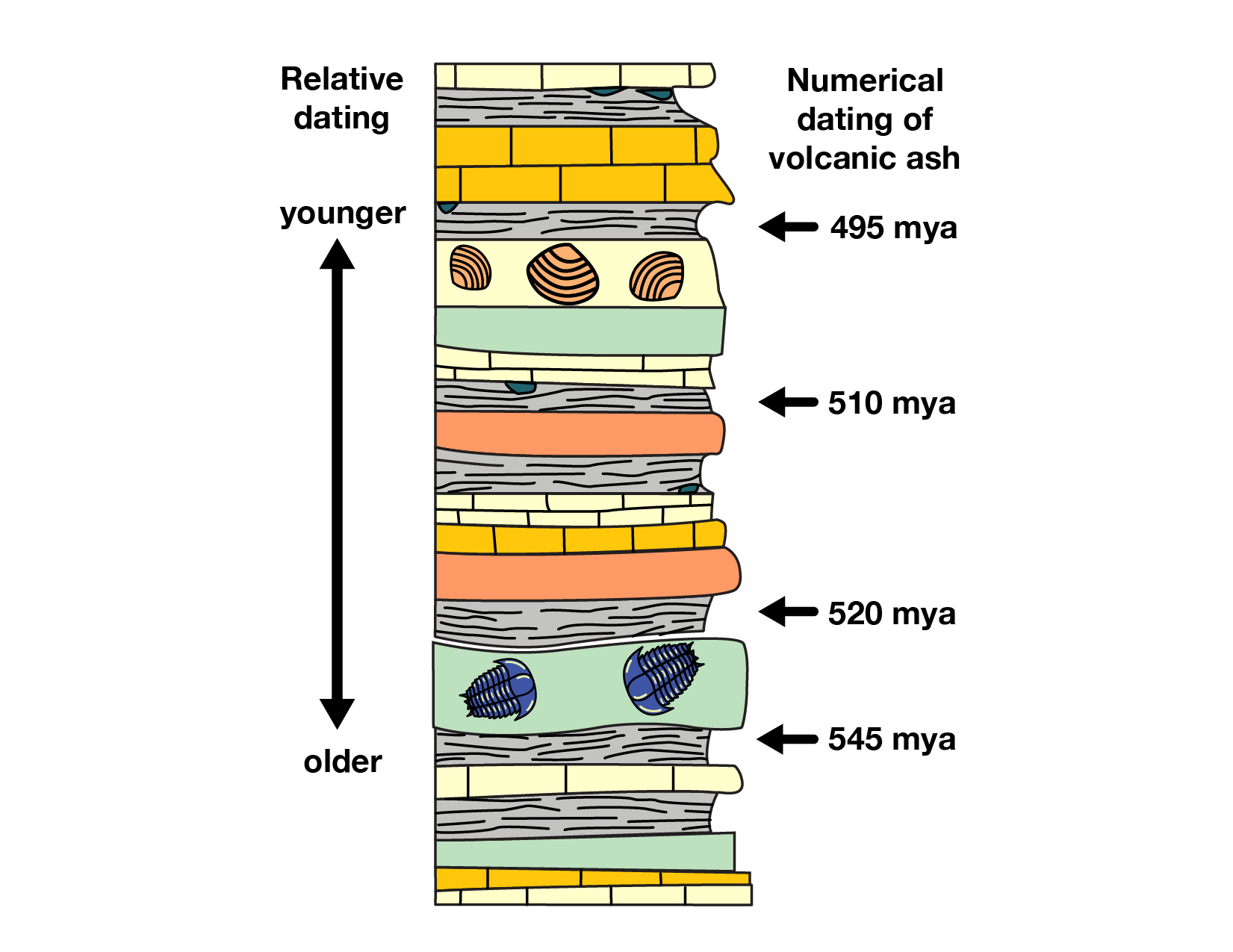
Studying the layers of rock or strata can also be useful. Layers of rock
are deposited sequentially. If a layer of rock containing the fossil is
higher up in the sequence that another layer, you know that layer must be
younger in age. If it is lower in sequence it’s of a younger age. This can
often be complicated by the fact that geological forces can cause faulting
and tilting of rocks.


*Absolute Dating*


Absolute dating is used to determine a precise age of a rock or fossil
through radiometric dating
<http://en.wikipedia.org/wiki/Radiometric_dating> methods.
This uses radioactive minerals that occur in rocks and fossils almost like
a geological clock. It’s often much easier to date volcanic rocks than the
fossils themselves or the sedimentary rocks they are found in. So, often
layers of volcanic rocks above and below the layers containing fossils can
be dated to provide a date range for the fossil containing rocks.

The atoms in some chemical elements have different forms, called isotopes.
These isotopes break down at a constant rate over time through radioactive
decay. By measuring the ratio of the amount of the original (parent)
isotope to the amount of the (daughter) isotopes that it breaks down into
an age can be determined.

We define the rate of this radioactive decay in half-lives. If a
radioactive isotope is said to have a half-life of 5,000 years that means
after 5,000 years exactly half of it will have decayed from the parent
isotope into the daughter isotopes. Then after another 5,000 years half of
the remaining parent isotope will have decayed.

While people are most familiar with carbon dating, carbon dating is rarely
applicable to fossils. Carbon-14, the radioactive isotope of carbon used in
carbon dating has a half-life of 5730 years, so it decays too fast. It can
only be used to date fossils younger than about 75,000 years. Potassium-40
on the other hand has a half like of 1.25 billion years and is common in rocks
and minerals
<https://www.fossilera.com/minerals-for-sale/polished-rocks-minerals>. This
makes it ideal for dating much older rocks and fossils.

“No fossil is buried with its birth certificate,” wrote the renowned
science editor Henry Gee in his 2000 treatise, *In Search of Deep Time*
<https://www.amazon.com/Search-Deep-Time-History-Comstock/dp/0801487137>.
While true, fossils are buried with plenty of clues that allow us to
reconstruct their history. An array of absolute dating techniques has made
it possible to establish the timescale of Earth’s history, including the
age and origin of life, the timing of mass extinctions and the record of
human evolution.

In 2013, in Ethiopia's Afar region, our research team
<https://www.kayereed.com/ledi-geraru-research-project.html> discovered a
rare fossil jawbone belonging to our genus, *Homo*. To solve the mystery of
when this human ancestor lived on Earth, we looked to nearby volcanic ash
layers for answers. Using a geologist’s magnifying glass, we can carefully
scan the ash in search of tiny minerals that are smaller than a single
sprinkle on a sugar cookie and that hold the key to determining the age of
a fossil.

Can we date actual fossils? Sometimes.

Scientists called geochronologists are experts in dating rocks and fossils,
and can often date fossils younger than around 50,000 years old using
radiocarbon dating. This method has been used to provide dates for all
kinds of interesting material like cave rock art
<https://www.smithsonianmag.com/science-nature/worlds-oldest-known-figurative-paintings-discovered-borneo-cave-180970747/>
 and fossilized poop <https://science.sciencemag.org/content/337/6091/223>.
Unfortunately, fossils like our jawbone, as well as the dinosaurs on view
in the new "Fossil Hall—Deep Time"
<http://naturalhistory.si.edu/exhibits/david-h-koch-hall-fossils-deep-time>
exhibition
at the Smithsonian's National Museum of Natural History
<http://naturalhistory.si.edu/>, are just too old for radiocarbon
dating. In these cases, we have to rely on the rocks themselves. We date
the rocks and by inference, we can date the fossils.

The first big challenge is to find the right kind of rocks to collect for
laboratory analysis. We are fortunate that the Afar region has volcanic ash
horizons in the sedimentary rock layers. In fact, just below where the
fossil jawbone was discovered, our team found a new volcanic ash layer that
we named the Gurumaha Tuff. The word *gurumaha* in the local language means
milkshake—a reflection of our mindset in the 90 degree afternoon heat. In a
sense, we can think of volcanic ash layers as buried stopwatches. When the
volcano erupts the timer starts, and we use absolute dating techniques to
tell the elapsed time.

Volcanic rocks typically contain naturally radioactive minerals—our sugar
cookie sprinkles. We can date these minerals using techniques based on the
radioactive decay of isotopes, which occurs at known rates. Measuring
isotopes typically involves lasers and mass spectrometers
<http://bgc.org/facilities/argon_lab.html> and sometimes even nuclear
reactors. We calculate age using the decay rate and isotope measurements,
which gives us the elapsed time on our stopwatch.

We successfully dated the Gurumaha Tuff to 2.82 million years old by dating
the naturally radioactive mineral feldspar. Since the jawbone eroded from
above the Gurumaha Tuff, it must be younger. We calculated
<https://www.smithsonianmag.com/science-nature/oldest-human-fossil-unearthed-ethiopia-180954470/>
the
jawbone is between 2.80 and 2.75 million years old, making it the oldest
known fossil of
<https://science.sciencemag.org/content/347/6228/1355.abstract>our genus
<https://science.sciencemag.org/content/347/6228/1355.abstract>*Homo*
<https://science.sciencemag.org/content/347/6228/1355.abstract>

*.* *Geochronologists have an abundance of tools at their disposal, but
still, some rocks and fossils prove difficult to date. Innovations to
existing dating methods are eliminating these barriers. For
example, revisions to a method
<https://onlinelibrary.wiley.com/doi/abs/10.1002/ajpa.20516> called electron
spin resonance
<https://en.wikipedia.org/wiki/Electron_spin_resonance_dating> allow
scientists to date rare fossils, like hominin teeth, because they can
directly date the fossil without visibly damaging the specimen. In the
Afar, scientists are attempting to date the actual layers from which the
fossils erode, rather than relying on the presence of volcanic ash. This
would more accurately tell us the age of fossil-bearing rocks, and open new
field sites for exploration that lack such layers.*

Fossils span geologic time from hundreds to even billions of years and are
discovered in many rock types and settings. Selecting a suitable dating
technique is a critical step to obtaining a meaningful and accurate age.

Scientists have dated fossils found in South African caves to between
236,000 to 335,000 years old <https://elifesciences.org/articles/24231> using
several different geochronometers, including optically stimulated
luminescence
<https://en.wikipedia.org/wiki/Optically_stimulated_luminescence>, a tool
that allows us to calculate the last time cave sediments were exposed to
light. Another common method, uranium-lead dating, relies on the
radioactive decay of uranium and can be used to date rocks containing the
oldest known fossils on Earth—older than 3.5 billion years old!
<https://science.sciencemag.org/content/260/5108/640/tab-pdf>To put that in
context, the age of the Earth is 4.54 billion years
<https://www.smithsonianmag.com/smart-news/how-do-we-know-earth-46-billion-years-old-180951483/>,
but our species has only been around for approximately 300,000 years
<http://humanorigins.si.edu/evidence/human-fossils/species/homo-sapiens>.
<http://humanorigins.si.edu/evidence/human-fossils/species/homo-sapiens>

The age of the Earth and origin of life is almost unfathomable, but the
Smithsonian’s new Deep Time Hall
<https://naturalhistory.si.edu/exhibits/david-h-koch-hall-fossils-deep-time> is
designed to help us grasp the enormity of Earth’s history in light of our
present-day impacts
<https://www.smithsonianmag.com/smithsonian-institution/how-does-earth-carbon-cycle-work-180972283/>.
The 18th-century geologist James Hutton recognized that geologic processes
require long timescales, a concept central to what we mean by the term deep
time. The purpose of geochronology—dating rocks and fossils—is to weave
together the dates we obtain to tell the extraordinary story of Earth’s
deep time.

Radiometric dating

Geologists use radiometric dating to estimate how long ago rocks formed,
and to infer the ages of fossils contained within those rocks.

*Radioactive elements decay*

The universe is full of naturally occurring radioactive elements.
Radioactive atoms are inherently unstable; over time, radioactive “parent
atoms” decay into stable “daughter atoms.”

When molten rock cools, forming what are called igneous rocks, radioactive
atoms are trapped inside. Afterwards, they decay at a predictable rate. By
measuring the quantity of unstable atoms left in a rock and comparing it to
the quantity of stable daughter atoms in the rock, scientists can estimate
the amount of time that has passed since that rock formed.

<https://evolution.berkeley.edu/wp-content/uploads/2021/05/strat_column_2020.png>*Bracketing
the fossils*

*Fossils are generally found in sedimentary rock — not igneous rock.
Sedimentary rocks can be dated using radioactive carbon, but because carbon
decays relatively quickly, this only works for rocks younger than about 50
thousand years.*

So in order to date most older fossils, scientists look for layers of
igneous rock or volcanic ash above and below the fossil. Scientists date
igneous rock using elements that are slow to decay, such as uranium and
potassium. By dating these surrounding layers, they can figure out the
youngest and oldest that the fossil might be; this is known as “bracketing”
the age of the sedimentary layer in which the fossils occur.

     So dating is an art; called or addressed as science from comparative
preponderances of probability. Ash is not everywhere; what is true to South
Africa may not suit India as a whole theory. But a tentative spectrum is
ascertained. When the human elements were found 250 million years before,
asking the question what was from many diverged into. Facts do keep
changing. There are volumes of books written against science and the Bible
available for reading. But India has uncorrupted records of evolution. 28
chatur-yugas mean in trillion years. If fossils dating is believed , why
not the Astro records also and the verses in the literature, which
definitely cannot be coherently thought about. KR IRS 13 1 23

--
You received this message because you are subscribed to the Google Groups
"Thatha_Patty" group.
To unsubscribe from this group and stop receiving emails from it, send an email
to [email protected].
To view this discussion on the web visit
https://groups.google.com/d/msgid/thatha_patty/CAL5XZopOqduXbAYd5jq1EtwVbzfGg%3DQUm3JANxxME5Ok9Dkmjw%40mail.gmail.com.