TidBITS#851/16-Oct-06
=====================
  Issue link: <http://db.tidbits.com/issue/851>
  Just when you thought Eudora might never be updated, we have
  surprising news: the venerable email client is becoming an
  open-source project built on Mozilla's Thunderbird. Read on for
  details, staff commentary, and a MacNotables podcast with Adam Engst
  and Macworld's Jason Snell. Also in this issue, Apple releases a red
  iPod nano whose sales will contribute to global AIDS relief, Google
  buys YouTube for $1.65 billion, and 3D-XplorMath makes scientific
  fine art. Plus, Glenn Fleishman notes the first set of ExpressCards
  coming to the Mac, and Charles Maurer returns with a review of
  Photomatix.

Articles
    New iPod nano Sees (RED)
    Mathematical Art from a Mac
    ExpressCards Issue Forth
    Google Buys YouTube for $1.65 Billion
    Eudora Goes Open Source with Thunderbird
    Photomatix: A Virtual Magic Wand
    Hot Topics in TidBITS Talk/16-Oct-06


------------ This issue of TidBITS sponsored in part by: --------------

* READERS LIKE YOU! Support TidBITS with a contribution today!
  <http://www.tidbits.com/about/support/contributors.html>
  Special thanks this week to Francesco Faggionato, Tatsuo Iwata,
   Andres Saldana, and Robert Dalsemer for their kind support!

* Make friends and influence people by sponsoring TidBITS!
  Put your company and products in front of tens of thousands of
  savvy, committed Macintosh users who actually buy stuff.
  For more information and rates, email <[EMAIL PROTECTED]>.

* SMALL DOG ELECTRONICS: Exclusive for TidBITS Readers!
  Classic 60 GB Click Wheel iPod Photo, Apple Refurbished,
  one year warranty, on sale for $189!
  Visit: <http://www.smalldog.com/tb>  -- 800-511-MACS

* FETCH SOFTWORKS: With Fetch 5.1, FTP and SFTP are simpler
  than ever. Use it on Mac OS X to upload, download, mirror,
  and manage your Web site, eBay images, and data sets.
  Download your free trial version! <http://fetchsoftworks.com/>

* WebCrossing Neighbors Creates Private Social Networks
  Create a complete social network with your company or group's
  own look. Scalable, extensible and extremely customizable.
  Take a guided tour today <http://www.webcrossing.com/tour>

* Circus Ponies NoteBook: Get organized, in two easy steps!
  De-clutter your Desktop. Organize your Web clippings. Manage
  your projects.  Voice annotate your notes. With NoteBook, it's
  simple. Try it free for 30 days. <http://www.circusponies.com/>

* MARK/SPACE, INC: Get the most from your handheld or smartphone
  with The Missing Sync. Sync Address Book, iCal, iPhoto, iTunes
  and more to Palm OS, Windows Mobile or Sony PSP devices. See
  what you've been missing! <http://www.markspace.com/bits>

* StuffIt Deluxe 11 from Smith Micro introduces the StuffIt Archive
  Manager. It collects related files of any type, searches
  offline archives, and can display previews of archived JPEGs!
  Only $29.99 till 31-Oct-06! <http://www.stuffit.com/tidbits/>

---------- Help support TidBITS by supporting our sponsors ------------


New iPod nano Sees (RED)
------------------------
  by Mark H. Anbinder <[EMAIL PROTECTED]>
  article link: <http://db.tidbits.com/article/8706>

  Apple will donate part of the proceeds from sales of a new, red-hued
  iPod nano model to the global fight against AIDS. The $200  iPod
  nano (PRODUCT) RED offers 4 GB of storage, just like the other
  colored iPod nanos the company announced last month (see "Apple
  Updates iPods, Introduces Movies, Previews iTV," 18-Sep-06). Apple
  will donate $10 from each sale to the Global Fund to fight AIDS in
  Africa.

<http://www.apple.com/ipodnano/red/>
<http://db.tidbits.com/article/8676>

  The iPod nano (PRODUCT) RED Special Edition joins red Motorola cell
  phones, red Armani wristwatches, and red American Express charge
  cards among special products aimed at raising AIDS awareness along
  with funds that will help buy and distribute anti-retroviral
  medicine. The (RED) movement was created by U2 singer Bono and
  political activist Bobby Shriver to engage businesses in the fight
  against AIDS.

<http://www.joinred.com/>

  The (RED) manifesto states, "We believe that when consumers are
  offered this choice, and the products meet their needs, they will
  choose (RED)." Apple says they'll also offer a special edition (RED)
  $25 iTunes gift card beginning next month. The new iPod nano model
  is available worldwide immediately.


**Staff Roundtable** -- Is this activism or is it marketing? The
  TidBITS staff weighs in on the iPod nano (PRODUCT) RED Special
  Edition:

  [Adam Engst] Perhaps I've never noticed anything quite like this
  before, but I'm quite intrigued by the implications of what appears
  to be a tightly integrated marketing campaign that simultaneously
  enables companies to sell multi-branded products and raises money
  for a worthy cause. There have been plenty of time-limited fund
  raisers in which companies donate some of their profits to a
  particular cause (even we did that in the immediate aftermath of
  Hurricane Katrina, donating 10% of the proceeds from Take Control
  ebook sales in September 2005 to the relief effort), but this is
  different. By combining the brand power of a product like the iPod
  with a new brand - (RED) - both Apple and the (RED) project boost
  each other, Apple gaining the prestige of helping to fight a global
  crisis and (RED) becoming associated with an ultimately (at least
  for the moment) hip product. Call it capitalactivism or
  activicapitalism, but it would seem to be a new breed of
  convergence.

  All that said, the capitalization and punctuation of (RED) is
  driving me crazy.

  [Mark H. Anbinder] In this post-silicone-wristband world, activism
  and awareness are all about brand recognition. I love the idea that
  consumers who want to support a cause have the opportunity to
  purchase recognizable products from iconic brands, demonstrating
  their own support while at the same time directing corporate
  philanthropy. The consumer wins, companies like Apple and Motorola
  win, and important charities win.

  [Jeff Carlson] Of course, you need major brands and major influence
  (in this case, Apple and Bono) to accomplish this type of deal at
  such a large level. What next? Just think of the publicity value if
  Microsoft were to donate $10 toward AIDS relief (or some other
  charity) for each copy of Office sold. The company can certainly
  afford it, and can always use the positive publicity. But will this
  approach scale down? Would (RED) be interested in working a
  conglomeration of Macintosh shareware companies? As can happen with
  big charity endeavors like this, the (RED) program will hopefully
  also serve as an example and encourage others to support other
  causes in similar ways.


Mathematical Art from a Mac
---------------------------
  by David Elliott <[EMAIL PROTECTED]>
  article link: <http://db.tidbits.com/article/8707>

  The cover of the journal Science for 22-Sep-06 features a beautiful
  artwork titled "Still Life: Five Glass Surfaces on a Tabletop" by
  graphic artist Luc Benard and mathematician Richard Palais, but the
  image is neither a photograph nor a Photoshop illustration. Instead,
  the five objects pictured are famous mathematical surfaces produced
  by the free Macintosh program 3D-XplorMath. The objects were then
  exported into Bryce, a 3D-rendering program, where Luc Benard gave
  them a glassy texture and placed them on a virtual glass-covered
  wooden tabletop.

<http://www.sciencemag.org/cgi/content/short/313/5794/1729>
<http://rsp.math.brandeis.edu/3D-XplorMath/Surface/a/MathCollection.jpg>
<http://rsp.math.brandeis.edu/3D-XplorMath/>
<http://bryce.daz3d.com/>

  The image is the first-place winner in the illustration category of
  the 2006 Science and Engineering Visualization Challenge, jointly
  sponsored by Science and the National Science Foundation.

<http://www.sciencemag.org/sciext/vis2006/>

  Richard Palais, a well-known professor of mathematics at the
  University of California, Irvine, has worked on the mathematical
  visualization program 3D-XplorMath (previously known as
  3D-Filmstrip) since 1997. Users can view a gallery of interesting
  mathematical objects in it, plus modify various parameters and
  viewing options for further experimentation. 3D-XplorMath runs in
  Mac OS 9 and Mac OS X as a Carbon application and is a free 12.3 MB
  download.

<http://rsp.math.brandeis.edu/3D-XplorMath/TopLevel/download.html>


ExpressCards Issue Forth
------------------------
  by Glenn Fleishman <[EMAIL PROTECTED]>
  article link: <http://db.tidbits.com/article/8708>

  We've been predicting a gusher of ExpressCards, the new slot-loading
  expansion cards for the MacBook Pro and high-end PC laptops, any
  time now. Any time now appears to be today. This week, three
  ExpressCard offerings bring SATA2 storage, gigabit Ethernet, and a
  new kind of dock to laptops.

  Most significant is WiebeTech's TeraCard Express34, which offers 2.5
  gigabit per second (Gbps) support for SATA storage, including both
  SATA1 and SATA2. SATA2 is one of the best methods for directly
  connected high-speed disk access, typically involving real-time
  video editing or recording, or extremely large data sets used for
  heavy computational tasks in life sciences. The two independent
  eSATA (external SATA) ports are nominally rated at 3.0 Gbps, but the
  ExpressCard single-lane bus runs at 2.5 Gbps. The card comes with
  Windows and Mac OS X drivers, and retails for $120.

<http://www.wiebetech.com/products/TeraCard_Express34.php>

  The MacBook Pro has gigabit Ethernet (10/100/1000 Mbps Ethernet)
  onboard, just like all current Macintosh models. However, those who
  need the highest of high-speed networks might prefer having two
  separate gigabit Ethernet ports, as are found on the Mac Pro and
  Xserve, either to use the laptop as a connector between two networks
  or to pump out the maximum amount of data. Small Tree Communications
  has introduced the PEG34m, an $80 ExpressCard for the MacBook Pro;
  Windows drivers are also available. The Ethernet connector folds
  out, enabling the card to lie flat when not in use; like CardBus
  cards, ExpressCards are thin enough that any port would stick out as
  a large bulge.

<http://www.small-tree.com/Laptop_pcie.html>

  Call the $200 Belkin Notebook Expansion Dock a vision of things to
  come for MacBook Pro users. You're probably familiar with the
  concept of a laptop dock, such as the BookEndz docks, or the Duo
  Docks that Apple offered for my late, lamented PowerBook Duo, long
  ago. Laptop docks provide a whole host of jacks that marry with a
  laptop's DVI or VGA port, USB and FireWire ports, audio ports, and
  even the power jack so you don't have to connect and disconnect
  every piece of office equipment whenever you come in or leave with
  your laptop. But instead of attempting to mate numerous jacks with
  their dock equivalents, Belkin's new dock simplifies that marriage
  by routing everything through the ExpressCard slot - but it works
  only with Windows laptops for now.

<http://www.bookendzdocks.com/>
<http://www.belkin.com/pressroom/releases/uploads/10_10_06NotebookExpansionDock.html>

  The Belkin dock uses the ExpressCard slot to carry data back and
  forth to five USB 2.0 ports, a 10/100 Mbps Ethernet port, VGA and
  DVI video connectors, and a 5.1 surround-sound audio input and
  output (analog and optical digital). Its monitor port should allow
  the use of two monitors in addition to the MacBook Pro's built-in
  LCD display - the MacBook Pro natively supports an external monitor
  already, and the dock would thus allow a second external monitor.

  A Belkin representative said that the company was working on Mac
  support, but wouldn't commit to a release timetable. If you think
  you might want this particular product available for your MacBook
  Pro, letting Belkin know might help raise its priority.


Google Buys YouTube for $1.65 Billion
-------------------------------------
  by Adam C. Engst <[EMAIL PROTECTED]>
  article link: <http://db.tidbits.com/article/8709>

  Search engine giant Google announced last week that it is buying the
  popular video sharing site YouTube for $1.65 billion in Google
  stock. Although Google has its own video sharing service, Google
  Video, traffic statistics from Hitwise show YouTube with two and a
  half times more hits than Google Video back in August 2006, and more
  than four times the visits in September 2006. YouTube will keep its
  name and will continue to operate independently from Google, and
  Google claims that YouTube will complement Google Video rather than
  replace it.

<http://www.google.com/press/pressrel/google_youtube.html>
<http://weblogs.hitwise.com/bill-tancer/2006/08/google_youtube_and_myspace_an.html>
<http://weblogs.hitwise.com/leeann-prescott/2006/10/google_youtube_rumor_-_hitwise.html>

  Does the acquisition make sense? From Google's perspective, it gives
  Google the lion's share of the fast-growing video sharing world, and
  another vast source of pages on which to display contextual
  advertising. Google has said it won't run ads before videos, but I
  have to assume that people at Google are thinking hard about new
  ways to turn user-contributed video into a serious revenue stream.

  It's even easier to see why YouTube would want this deal. The
  company has been losing money and hasn't come up with any reasonable
  way to reverse that trend. Bandwidth and server costs and
  maintenance must be insane for YouTube, but those are problems that
  Google has already solved. Plus, YouTube was facing threats of
  lawsuits from the major movie studios, and Google announced deals to
  display music videos from Sony BMG Music Entertainment and Warner
  Music Group. Those deals indicate Google may have the negotiating
  clout to make licensing happen more broadly, and Google certainly
  has the money and legal firepower to fight any lawsuits that do
  ensue.

<http://www.google.com/intl/en/press/pressrel/google_sonybmg.html>
<http://www.google.com/intl/en/press/pressrel/google_wmg.html>

  These music videos will be made available for online viewing for
  free (select music videos from Warner Music Group will also be
  available for purchase as downloads for $2), and the studios will
  gain revenue via Google's normal ad model. That may hurt Apple's
  ability to sell $2 music videos via the iTunes Store (see "iTunes 6
  Gets Video," 17-Oct-05), although it remains to be seen if the audio
  and video quality of free music videos on Google Video/YouTube will
  be comparable to downloads from the iTunes Store.

<http://db.tidbits.com/article/8288>

  Google's press releases also note that the company is working with
  content companies to allow people access to music and video for use
  in their "creative user-generated productions," which presumably is
  meant to cover user-created videos, but makes me wonder about sample
  and mixing of music as well. But the most interesting statement in
  the Warner Music Group press release is: "Once Google's technology
  is implemented, content companies such as Warner Music Group will
  have the opportunity to monetize the use of music in user-generated
  content, or if they choose, have the content removed from the
  platform."

  There's clearly a dance going on here, but it's unclear who's
  leading or where it's headed, and it bears future scrutiny. Google
  may or may not always live up to its motto, "Don't be evil," but
  companies like Sony BMG Entertainment and Warner Music Group have
  definitely thrown their lot in with the devil in the past, as with
  the scandal surrounding Sony BMG's surreptitious distribution of
  spyware on audio CDs as a copy prevention mechanism.

<http://en.wikipedia.org/wiki/2005_Sony_BMG_CD_copy_protection_scandal>


Eudora Goes Open Source with Thunderbird
----------------------------------------
  by Mark H. Anbinder <[EMAIL PROTECTED]>
  article link: <http://db.tidbits.com/article/8710>

  Qualcomm announced last week that future versions of the venerable
  email program Eudora, which the company has sold for many years,
  will become an open-source collaboration with the Mozilla
  Foundation. Steve Dorner, vice president of technology for
  Qualcomm's Eudora group and the software's original developer, says
  he'll lead a group that will "build an open-source mailer with
  Eudora features on top of Thunderbird."

<http://www.eudora.com/faq/>
<http://www.mozilla.com/thunderbird/>

  First created in 1988, Eudora was a popular Macintosh email client
  in the early days of the Internet, and it still enjoys broad use,
  especially at academic institutions and among Mac veterans who
  refuse to give up its power-user capabilities in favor of newer
  software. In 1992, Qualcomm (otherwise known for developing wireless
  phone technologies) acquired the software from the University of
  Illinois and hired Steve Dorner, and has continued to develop Mac OS
  and Windows versions.

  "I was getting really tired of maintaining Eudora's elderly code
  base, as well as working on extremely boring things like HTML
  rendering," Dorner told TidBITS. He looks forward to "using
  Thunderbird as a base," allowing him to focus on "the things that
  make up the core productivity parts of the Eudora experience." The
  company picked the cross-platform Thunderbird product because, he
  says, "it has strengths where Eudora has weaknesses, and will
  complement us quite nicely. Mozilla is also happy to have us
  developing for their platform, and has made it very clear to us that
  they welcome our effort." He hopes "that improvements [will] flow
  freely between the two mailers."

  Qualcomm plans to release the first freeware, open-source version of
  Eudora in the first half of 2007. In the meantime, the company has
  released the final commercial versions (6.2.4 for Mac OS X and 7.1
  for Windows), which will continue to be available, now for $20, with
  support provided for six months. Existing support contracts and site
  licenses will be honored until the end of the current terms, and
  paid and sponsored-mode versions of the current software will
  continue to work "in perpetuity."

  Steve Dorner admits he doesn't know which parts of Eudora are most
  useful to its proponents, and asks users to speak up and offer input
  "on what our priorities should be." Users who wish to weigh in, or
  developers who'd like to pitch in for the open-source effort, should
  visit the Eudora developer page.

<http://eudora.com/developers/>

  The just-released Eudora 6.2.4 is a minor upgrade, offering mostly a
  new importer for the Tiger version of Apple Mail (as much as it
  seems somewhat unlikely that many people would be switching from
  Mail to Eudora until progress is seen on the open source version of
  Eudora), updated SpamWatch definitions to help Eudora keep up with
  spammer tricks (available only in Paid mode), and a variety of minor
  tweaks and bug fixes. Since it costs $20 to keep using Eudora in
  Paid mode, the decision of whether or not to upgrade is mostly a
  matter of whether you've been having trouble with now-fixed bugs.
  It's a 12.3 MB download.

<http://www.eudora.com/download/eudora/mac/6.2.4/ReleaseNotes.txt>
<http://www.eudora.com/download/>


**Staff Roundtable** -- Although not everyone on the staff currently
  uses Eudora, many of us still do, and our long experience with the
  program generated some opinions.

  [Adam Engst]: I've already had numerous people asking me what I
  think of Qualcomm's announcement, often with what seem to be ominous
  undertones or the assumption that this announcement means the end of
  Eudora as we know it. But in fact, I'm happy to hear that Qualcomm
  will be working with the Mozilla Foundation to build the next
  version of Eudora on top of Thunderbird. It's a relief to have a
  strong public statement of direction after watching Eudora exist in
  a kind of corporate limbo for several years, never receiving the
  resources that were necessary to give it a modern code base.
  Although I don't have any particular experience with Thunderbird,
  open source projects generally work well under the hood, so a
  combination of open source underpinnings and Eudora's power-user
  feature set could be great. Plus, although Eudora has been available
  for free in various forms over the years, having the full program
  become freeware will enable it to compete better with bundled
  applications like Mail.

  That said, I do have some reservations. First, will Eudora attract
  developers who will make substantive contributions? I'd guess that
  Eudora has a disproportionate number of developers in its user base,
  and universities that desperately want to avoid Microsoft Outlook
  (and they do) may well be interested in contributing development
  resources. Second, will the Eudora team be able to create something
  compelling in a reasonable time frame? I'm sure it will be plenty of
  work just to get a basic set of Eudora's current features working,
  but email is crying for a complete rethinking.

  What I'd really hope to see is a plug-in capability in the new
  Eudora that enables developers to create innovative plug-ins, much
  as has happened with the open source Firefox Web browser. Firefox
  itself isn't particularly unusual, but the numerous plug-ins extend
  its functionality in a wide variety of ways. Plug-ins for the new
  Eudora would seem likely, since Thunderbird already offers this
  capability.

<https://addons.mozilla.org/thunderbird/>

  I encourage anyone interested in the future of Eudora, whether or
  not you're a developer, to participate in the open source project.
  Goodness knows that open source software could use more user
  interface designers, documentation specialists, and normal users to
  provide real-world feedback.

  Also, Jason Snell of Macworld and I discussed the Eudora
  announcement with Chuck Joiner on a special edition of our
  MacNotables podcast. It's a hoot, so give it a listen!

<http://www.macnotables.com/archives/2006/681.html>

  [Glenn Fleishman]: I have to ask, as a loyal user of Bare Bones
  Software's Mailsmith, what Eudora becoming free and open-source does
  to the cosmos of email clients for Mac OS X. It's pretty clear
  there's a very small market to sell email clients to Mac OS X users
  based on Qualcomm exiting the paid market - and you could use Eudora
  in one of two free modes, anyway - and the paucity of unbundled
  commercial email clients.

<http://www.barebones.com/products/mailsmith/>

  Apple's Mail is part of Mac OS X. Eudora has a free and paid mode.
  Entourage is part of Microsoft Office. AOL's mail is part of the AOL
  client. Thunderbird is free. PowerMail and GyazMail are commercial,
  and although I have no idea of their user bases, neither shows up in
  my email with any frequency. And Mailsmith is commercial software.

<http://www.ctmdev.com/powermail/>
<http://www.gyazsquare.com/gyazmail/>

  Of course, most Eudora users I know used the free Sponsored mode,
  which means that switching to free, open-source (no sponsor) as
  their only method of release isn't as profound a shift as switching
  from a commercial client. This may not, therefore, affect Bare Bones
  or any bundled/free mail clients' market share or mind share.

  What will be interesting is whether the open-source community and
  existing projects merge into a Eudora/Thunderbird code base, or even
  fork from Thunderbird into something completely new. I have long
  said that open-source can't make decent graphical user interfaces,
  and that's still been generally true, with projects under the
  Mozilla Foundation (which is heavily funded by corporations and
  donations) being the biggest exceptions.

  [Mark H. Anbinder] No doubt because of its origins in higher
  education, Eudora enjoys a bigger market share in academia than
  anywhere else. That share has been dropping, though, as Eudora's
  ability to keep up with modern mail habits has fallen behind. At
  Cornell University, for example, Eudora users (especially on the
  Windows platform) have complained about inadequate IMAP support, and
  Steve Dorner would be the first to admit that the software's
  capability to display HTML-encrufted email is stuck in the 1990s.

  Even though many users, looking for a more modern user experience or
  better IMAP handling, have migrated to Thunderbird or Mail over the
  last couple of years, Eudora's power-user contingent is holding on
  as long as it can, unwilling to give up years of perfectly tuned
  filters, fast and powerful searching, and comprehensive support for
  multiple "personalities."

  Filters and personalities are certainly the key reasons I still use
  Eudora; it lets me handle mail to and from a dozen separate
  addresses in a way that no other clients I've tried can offer,
  including both Mail and Thunderbird. Combine that with over a decade
  of mail stored in Eudora, and you can imagine I'm looking forward to
  a new Eudora that will let me migrate effectively, gaining modern
  email features without losing the core capabilities I'm accustomed
  to.


Photomatix: A Virtual Magic Wand
--------------------------------
  by Charles Maurer
  article link: <http://db.tidbits.com/article/8711>

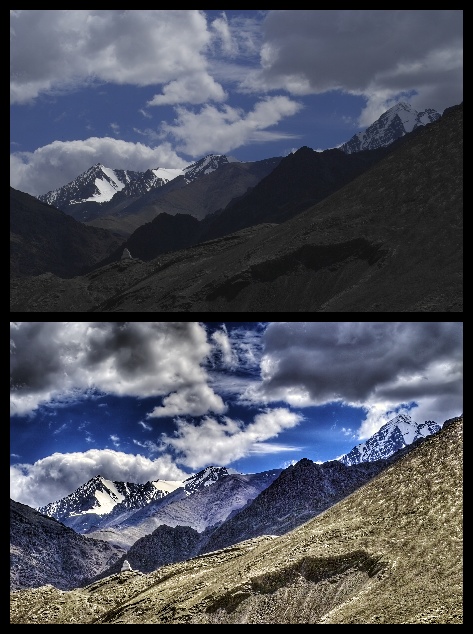
  Imagine you are staring at a magnificent mountain scene - blue sky,
  dramatic clouds, glaciered peaks, rocks of varied hue. You take a
  picture but when it's processed you are disappointed. The sky and
  glaciers show up clearly but everything else is dark or black.

  Every photographer has experienced this kind of disappointment. It
  happens because the range of brightness of objects outdoors is
  usually higher than a camera can capture or a sheet of paper can
  reproduce - typically a thousandfold higher or more - so the
  photographic process must squeeze and truncate the tones to make
  them fit. Digital processing can dodge some of this problem (see
  "Reality and Digital Pictures," 12-Dec-05) and now an application
  can tackle it directly: MultimediaPhoto's Photomatix. As you can see
  from the before-and-after photo of just such a scene, it works like
  magic.

<http://db.tidbits.com/article/8365>
<http://www.hdrsoft.com/>
<http://www.tidbits.com/resources/851/IMG01004demo.jpg>


**Dynamic Range** -- The range of brightness of a scene or an image is
  called its dynamic range. A sunny scene will likely have a dynamic
  range of at least 100,000:1 and its range can exceed 1,000,000:1. In
  contrast, image sensors can record on the order of 1,000:1 (DSLRs)
  or 100:1 (other cameras), and paper can display a range of only
  about 100:1. The range of computer monitors is roughly comparable to
  that of paper.

  Note that these are two different problems: (1) the dynamic range of
  a scene can be greater than a camera can capture and (2) the dynamic
  range of a digital image can be greater than paper or screens can
  reproduce. Both of these are problems of high dynamic range ("HDR"
  in jargon) but the meaning of "high" depends upon the context. There
  are no established conventions for the use of the term and there is
  no standard HDR format.

  In principle, the first of these problems has a simple solution. If
  one exposure records too narrow a range of tones, first take enough
  exposures to record the entire range then tell a computer to combine
  the overlapping exposures. To combine them you can take some form of
  average, or you can take light tones from one file and dark tones
  from another, or you can create an image with sufficient bits to
  describe every tone in both. In practice these solutions may need
  some fiddling because the tones in an image are neither perceived
  nor recorded in neat steps, but in principle they are
  straightforward.

  The second problem is incomparably more difficult. Consider what it
  might mean to compress tones tenfold. It happens that photographs in
  newspapers display a range of reflectance from highlight to shadow
  of about 10:1. Let's say that you photograph a man reading a paper.
  If all of the photo's tones are compressed tenfold, then you are
  likely to see a man reading a sheet of grey.


**Tonal Compression** -- High tonal compression is quite a trick, yet
  Photomatix does it. Photomatix performs its magic like a magician,
  by directing the viewer's attention. The eye cares little about
  subtle gradations and minuscule detail; the eye looks for clear
  contrasts between adjacent tones. "Local contrast" is the jargon.
  Most of the information we take from a scene comes from local
  contrast. Photomatix makes sure that we notice this local contrast
  and slips through the compression on the side. Where it finds clear
  contrasting tones, first it enhances them and then it compresses the
  rest.

  To see how this works, look at this picture of buffalo herders. The
  dark image shows the raw file. It is exposed to retain detail in the
  highlights. To make the picture in the middle I lightened the
  shadows using Photoshop's shadow/highlight control. For the picture
  on the right I used Photomatix. Both versions I finished to make as
  naturalistic as I could. (Note: the herder's beard looks unnatural
  because he dyed it with henna.)

<http://www.tidbits.com/resources/851/IMG05432demo.jpg>

  Although this function is intended for squeezing HDR pictures onto
  paper - well, any magician who can saw a woman in half can also pull
  a rabbit from a hat. Local contrast carries most of the information
  in every picture, not merely in pictures with a high dynamic range
  but also in pictures with a low dynamic range. Enhancing local
  contrast within a dull photo can increase its apparent dynamic
  range.

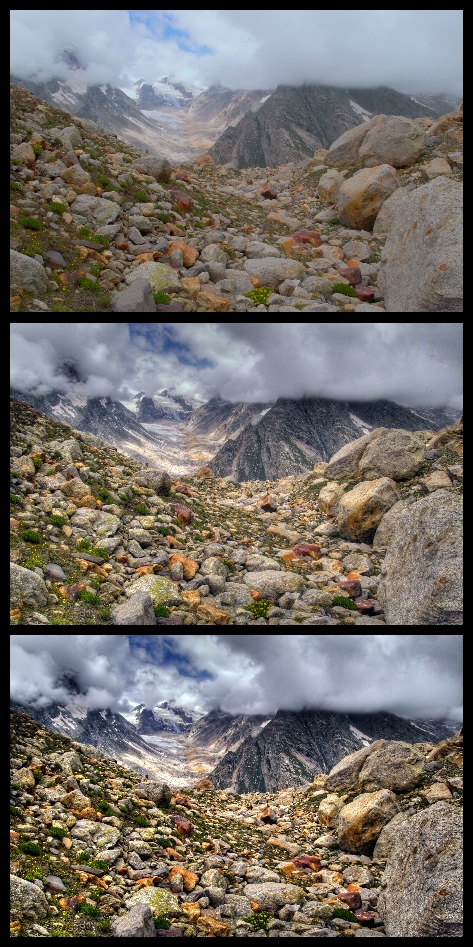
  For an example of this, look at these three pictures. All of these
  carry the same range of tones. The top one shows the raw file. It
  contains the highlights and shadows needed to show
  three-dimensionality, but the lighting is so flat that the
  highlights and shadows are difficult for the eye to see readily or
  for ordinary manipulations to bring out. In the middle picture
  Photomatix has enhanced those contrasts to turn a dull photo into a
  decent one. The new contrasts I was able to enhance further by
  conventional means to make the finished picture at the bottom.

<http://www.tidbits.com/resources/851/IMG06150demo.jpg>


**Combining Exposures** -- Photomatix's developer sells a plug-in
  ($70) that does only tonal compression and a stand-alone package
  ($100) that also provides several ways of combining different
  exposures into a single image. Currently the plug-in works only with
  Photoshop CS2 although it will probably also work with Photoshop
  Elements 5. (It also works with Photoshop CS and Photoshop Elements
  4 for Windows.)

  I usually use the plug-in, because I work with Photoshop CS2 and
  rarely combine exposures. I have combined some photos to stunning
  effect but the Foveon sensor in my DSLR has a sufficiently broad
  dynamic range that I seldom want to do this and when I do, usually I
  cannot because the camera is not on a tripod or the subject is not
  dead still.

  Images from cameras with a smaller sensor would benefit from this
  treatment more often, as might scans of film, but I would not expect
  it to be an artistic panacea, not even when the camera is on a
  tripod and the subject is stationary. That's because if a scene
  shows extremes of contrast, it will likely look unnatural if the
  photo replaces the extremes with moderation.

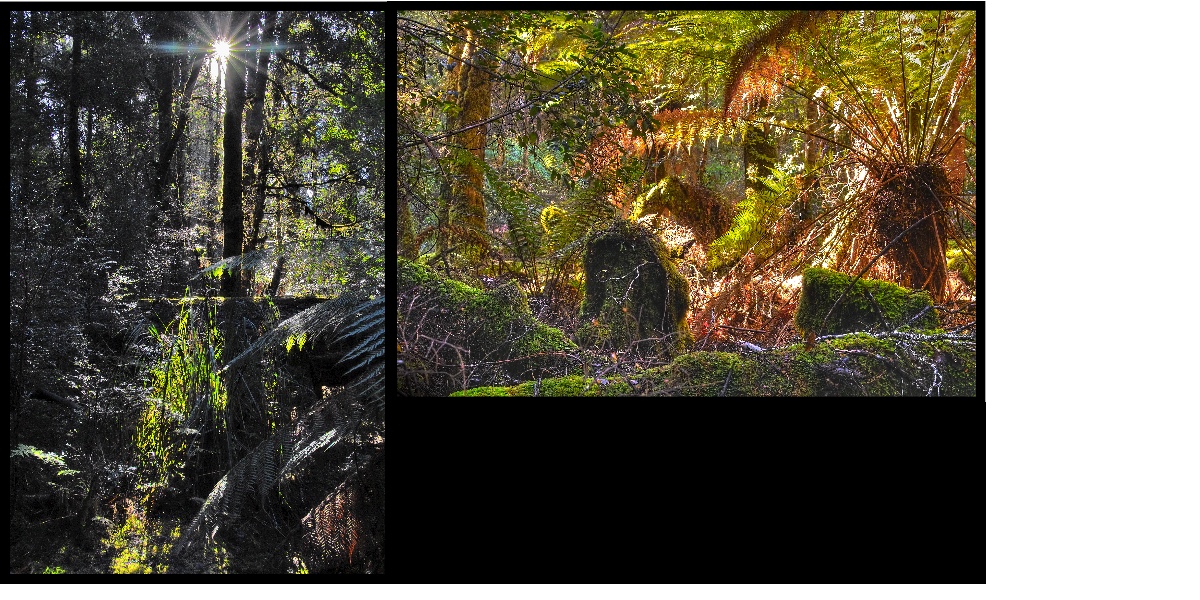
  You can see an example in these photos of a rain forest. On the
  left, a single exposure captures the extreme contrast of the forest
  but loses the range of colour in the shade. It shows the forest but
  not the trees. On the right, a combination of two exposures shows
  the trees but not the forest.

<http://www.tidbits.com/resources/851/ForestDemo.jpg>

  Since I seldom combine images, I cannot compare Photomatix's
  combining functions with the equivalent features of Photoshop or
  other products. I can say, however, that Photomatix's tone-mapping
  strikes me as more sophisticated than the equivalent functions in
  Photoshop or in any other plug-in I know of. Sometimes the
  tone-mapping from Photomatix seems too dramatic, but I have found
  Photomatix to be so helpful so often that I have learned to try it
  on almost every picture I take, to see what it will do.


**The First Step** -- An image re-mapped with Photomatix is a starting
  point, not a finished product. After re-mapping an image - which
  must be done before anything else - I still need to adjust it in all
  the usual ways, just as I need to after adjusting it with
  Photoshop's shadow/highlight control (see "Editing Photographs for
  the Perfectionist," 27-Sep-04). Also, enhancing detail in shadows
  and highlights enhances noise as well, so the image ends up needing
  an unusually thorough cleaning. A specialized noise-reduction
  package like Noise Ninja I find to be essential.

<http://db.tidbits.com/article/7832>

  Although Photomatix is an excellent product, it is still a young
  one. The developer is still tinkering with the algorithms and the
  user interface. On my computer the plug-in and application have both
  been stable, but occasionally they have not behaved quite as
  expected and the processed image does not always look quite like the
  preview. However, the developer is a single person who handles sales
  and support as well as programming, so she does not sweep problems
  under a corporate rug; she deals with them. The latest releases (1.1
  for the plug-in and 2.3 for the application) appear to be
  significantly cleaner than the last ones. Demo versions are free for
  the downloading.

<http://www.hdrsoft.com/download.html>

    PayBITS: If Charles's recommendations for improving photos
    helped, he asks that you make a donation to Doctors Without
    Borders: <http://www.doctorswithoutborders-usa.org/donate/>
    Read more about PayBITS: <http://www.tidbits.com/paybits/>


Hot Topics in TidBITS Talk/16-Oct-06
------------------------------------
  by TidBITS Staff <[EMAIL PROTECTED]>
  article link: <http://db.tidbits.com/article/8712>

**cross-platform: Visual Basic** -- With Visual Basic disappearing on
  the Mac, what options exist for cross-platform scripting? (18
  messages)

<http://emperor.tidbits.com/TidBITS/Talk/973/>


**Mac OS X 10.4.8: anyone tried it?** Readers share their experiences
  with the latest Mac OS X update. (12 messages)

<http://emperor.tidbits.com/TidBITS/Talk/974/>


**Get a Piece of the Thinking Rock** -- Matt Neuburg's review of the
  Getting Things Done utility prompts a look at Midnight Inbox. Plus,
  did traffic from our article crash the Thinking Rock servers? (11
  messages)

<http://emperor.tidbits.com/TidBITS/Talk/975/>


**Power button** -- Last week's tip for re-mapping the function of a
  laptop's power button brings up other ways to put a Mac to sleep.
  (16 messages)

<http://emperor.tidbits.com/TidBITS/Talk/976/>


**Editing/Healing a Corrupt Eudora Mailbox** -- Where does Eudora keep
  the index information about a mailbox? It can depend on several
  factors. (6 messages)

<http://emperor.tidbits.com/TidBITS/Talk/977/>


**Eudora goes open source** -- Speaking of Eudora, readers react to
  last week's news that the email software's next incarnation is going
  to be an open-source project built upon Mozilla's Thunderbird. (16
  messages)

<http://emperor.tidbits.com/TidBITS/Talk/978/>


**UK Mac accounting software** -- A reader in the United Kingdom is
  looking for opinions and alternatives to accounting software such as
  QuickBooks for the Mac. (7 messages)

<http://emperor.tidbits.com/TidBITS/Talk/980/>


$$

This is TidBITS, a free weekly technology newsletter providing timely
news, insightful analysis, and in-depth reviews to the Macintosh and
Internet communities. Feel free to forward to friends; better still,
please ask them to subscribe!

Non-profit, non-commercial publications and Web sites may reprint or
link to articles if full credit is given. Others please contact us. We
do not guarantee accuracy of articles. Caveat lector. Publication,
product, and company names may be registered trademarks of their
companies. TidBITS ISSN 1090-7017.

Copyright 2006 TidBITS: Reuse governed by Creative Commons license.

Contact us at:    <[EMAIL PROTECTED]>
TidBITS Web site: <http://www.tidbits.com/>
License terms:    <http://www.tidbits.com/terms/>
Full text search: <http://www.tidbits.com/search/>
Subscriptions:    <http://www.tidbits.com/about/list.html>
Account help:     <http://www.tidbits.com/about/account-help.html>


--
If you want to unsubscribe or change your address, use this link
http://emperor.tidbits.com/webx?unsub@@.3c557dc4!u=306a67f9