> Daer Tom,
>
> Thanks very much for your reply. I not only see very good answer,
> by reading your mails(and other replies from )I also got some
> idea of how you reasoning the answer. Thats most valuable for me.
>
> Another thing, I remembered you said once that all stabilities are
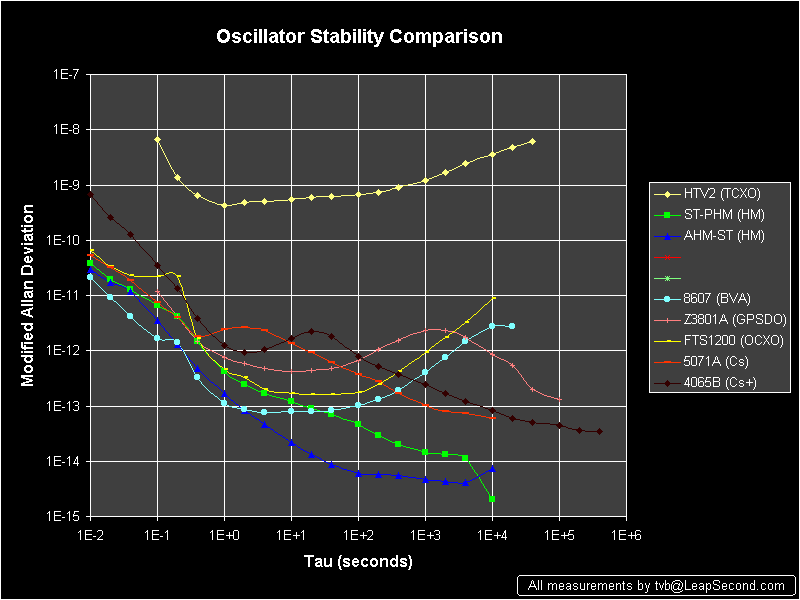
> relative. When I saw your chart of ADEV for some of your best
> frequency source at: http://www.leapsecond.com/museum/manyadev.gif
> what is your reference? especially when you measure the two
> H-Masers in long time interval?
>
> Cheers,
>
> Lymex, BG2VO
Those plots were made from raw data so strictly
speaking they are all relative. But the frequency
reference in most cases was a maser so I didn't
"subtract the background".

The plots of maser vs. maser were also relative
so theoretically the performance of each maser
might be a little better at certain tau than either
of the two plots show. For example if two masers
have a stability of 9e-14 for some tau you might
be able to assume the actual stability of each
one at that tau is 6e-14 (since 9 / sqrt(2) = 6).

The right way to do it is with a "3 cornered hat".
If you have three clean pair-wise runs of three
similar frequency standards then you can use
a 3 cornered hat to isolate the stability of each
of the three standards. The three lines of code
that do this are at the end of:

http://www.leapsecond.com/tools/3hat.c

/tvb


_______________________________________________
time-nuts mailing list
[email protected]
https://www.febo.com/cgi-bin/mailman/listinfo/time-nuts