Lymex,

OK, here's the second part of your answer.
> I tried this method several time before by feeding the A
> and B input the same 10MHz source, and the result is not
> as good as promised. It always jump more than 25ps and
> sometimes more than 50ps. When I look at the Jitter:Allan
> (for every second), it something like 20ps. Until today

I suspect this jumping will occur when the two
channels are highly synchronous; in this case
some of the advantage of white noise averaging
is not present. What you're seeing looks like
LSB quantization effects to me. I would further
guess the results would be different for slightly
different lengths of cable between A and B.

The 53132A also has effects like this; there's
a small footnote in the manual that mentions
that resolution is reduced for certain bands
of input frequencies. The normal 12 d/s drops
down to 11 d/s.

Some of HP's old counters would deliberately
dither the clock to avoid this (can someone
provide a list; maybe 5328A & 5345A?).
Clock dithering is a bad idea for single time
interval measurements but a useful idea for
repetitive measurements such as TI or CW
frequency averaging.

> I found a way to modify it by:
> 1) Tee the input again and use this 3rd 10MHz as the
> external reference for SR620 (I use SR625 as reference
> before, which is wrong)
> 2) Make the input A  none 50 Ohm input.
> When I look at the Jitter:Allan again it says <9ps!
> And the mean reading is very much stable to <2ps!

Can you clarify which three 10 MHz sources go
to which inputs in this test case; do you have
one 10 MHz reference split to 3 cables: one to
input A, one to input B, and one to ext ref?

If so, I worry you are seeing synchronous effects
between the reference clock, input gate circuits,
and the channel counter circuits; and not fully
exercising the analog TA converters (since all
the relative phases are fixed). But I don't have
hard data to support this hunch.

Lastly, you might want to run the SR620 autocal.
It may have no effect on your artificial test above
but it should improve the stddev of the actual
oscillator comparison tests.

> I'm confident (sigma=2) that the consecutive pair will not
> change more than 1ps because about 95% of the reading
> will be changed not more than 1ps. Here is the short video
> to demonstrate this (6.0MB):
> http://www.dl-car.com/~2038/time/DSCN5103.MOV

Cute. Do you have RS-232 or GPIB capability on
your PC?

> Therefore, if we replace input B with another 10MHz, we
> can observe the drift of a few parts in 10^12 in 1 sec.
>
> If we can record 100 readings (in 100 seconds) and make
> some calculation (in Excel, say), we will get the Allan
> deviation down to perhaps 1E-12.

Yes, the main thing is that you are letting
the counter make the phase measurements
and using external software do the analysis.
This is how most of us do it. It's nice that the
SR620 has a built-in ADEV function, but it
only works for one selected tau; in reality, as
you now see, you can do so much more with
external software once you have logged the
raw data.

Let us know the new results if you re-run the
tests of your 6 frequency standards using this
higher resolution frequency averaging mode.

> Here is the example of my calculation:
> Video (9.6MB): http://www.dl-car.com/~2038/time/DSCN5104.MOV
> Calculation: http://www.dl-car.com/~2038/time/ADEV.XLS
> Input A: HP58540A, holdover
> Input B: Trimble Thunderbolt locked to GPS
>
> Any comments of corrections?

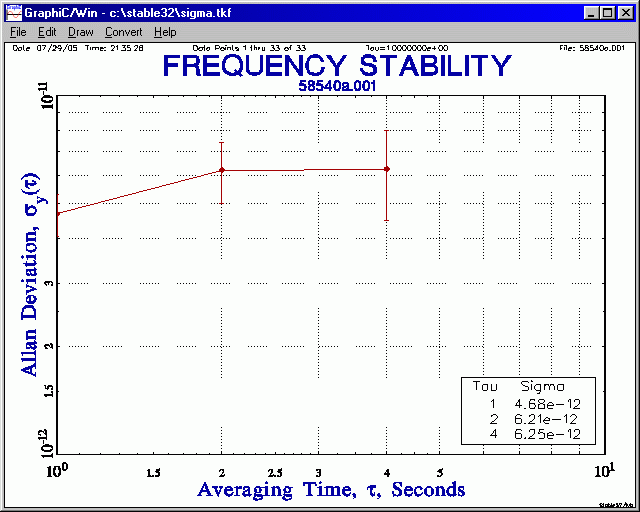
In the Excel page, I didn't understand method 1;
it looked like first differences to me not second
differences. Method 2 is correct. I verified your
4.68e-12 ADEV result using Stable32. See
http://www.leapsecond.com/temp/2005-07-29-Lymex/clip6.gif

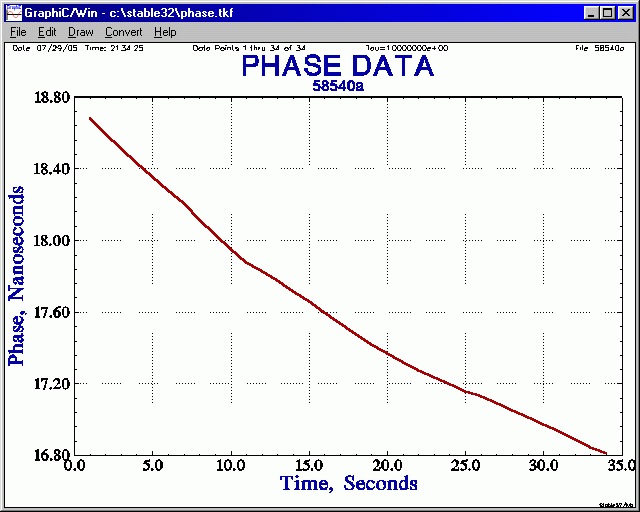
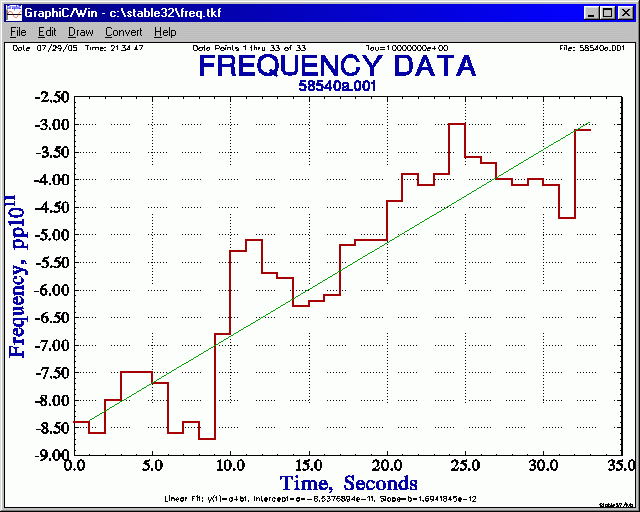
One more thing; your phase data shows extremely
high frequency drift, a rate of 1.4e-7 / day. This is
odd. See phase and frequency plots:
http://www.leapsecond.com/temp/2005-07-29-Lymex/clip2.gif
http://www.leapsecond.com/temp/2005-07-29-Lymex/clip4.gif

/tvb


_______________________________________________
time-nuts mailing list
[email protected]
https://www.febo.com/cgi-bin/mailman/listinfo/time-nuts