> Loran can do great frequency measurement -- almost as good as GPS.  But
> for timing, it's not so hot.  The problem with current Loran is that it
> doesn't carry a timecode, or mark the second epoch.  It's possible to
> recover 1pps from Loran with a bit of work (the Austron 2100T receiver
> can do this) but it's not a trivial task, and in any event you need
> something else to disambiguate the seconds.
>
> John
I agree with you that Loran-C makes a very good
frequency reference.

I also suspect there are applications where Loran-C is
superior to GPS (antenna placement, reliability, noise
immunity, etc.), or can at least augment GPS or local
cesium clocks for increased timing redundancy.

I've had various flavors of Austron and Stanford Research
FS700 Loran-C receiver running for years here and now
regret not logging them continuously so I could give you
all a nice Loran-C ADEV plot out to a year...

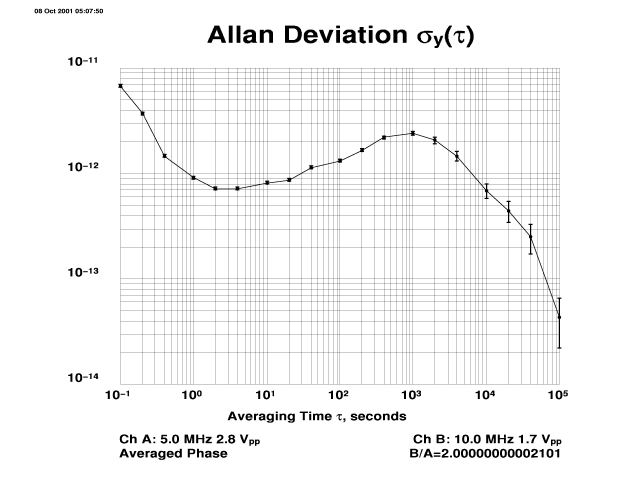
But for those of you interested, here is a quick graph
showing the output of a FS700 for shorter tau.

http://www.leapsecond.com/museum/fs700/

The peak near 2000 seconds is just like what you see
with a GPSDO (and for the same reason). Compare
the plot above to this typical GPSDO:

http://www.leapsecond.com/museum/58503b/log2774v.gif

It will be interesting to see what happens at longer tau
but so far it looks like this Loran-C receiver is within
one decade of the 50503B.

/tvb


_______________________________________________
time-nuts mailing list
[email protected]
https://www.febo.com/cgi-bin/mailman/listinfo/time-nuts