"Tom Van Baak" <[EMAIL PROTECTED]> wrote:

  >Hi Mike,
  Hi Tom,

  I want  to thank you for the very nice reply you gave to my  email a
  while ago.  Unfortunately,  I   am  still  learning  about precision
  frequency references, and I don't have enough knowledge yet  to give
  you an  intelligent  reply, or even ask a sensible  question.  But I
  will as soon as possible.

  In the  meantime,  your site is invaluable  for  newcomers  like me.
  Thank you very much for taking the time to organize it so well.

  > Rick's CNSC02-O1  implementation has been discussed here  a number
  > of times  over  the  years   (google   the  archives).  It  uses a
  > programmable digital  delay  line to compensate  for  the receiver
  > reported quantization error on each pending 1 pps.

  The single-shot is supposed to eliminate the 1PPS jitter? So it must
  be triggered on the 1PPS, and the variable delay gives an average of
  half the clock period?

  Thanks for the tip. I'll research the archives and see if I can some
  up with some better understanding of how it works.

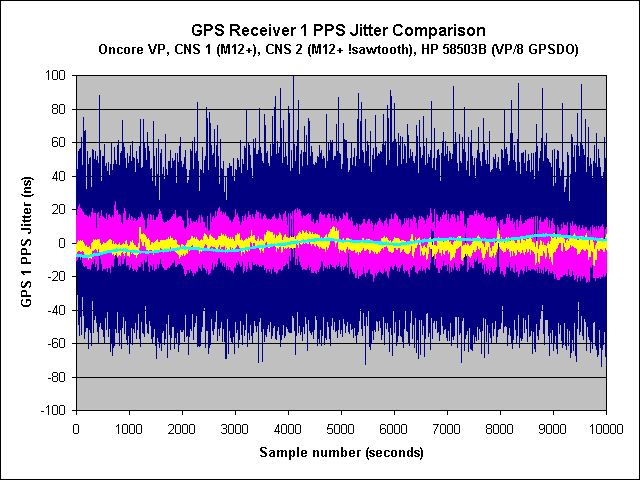
  > Here's a  quick plot of an M12+ receiver without  (pink)  and with
  > (yellow) sawtooth correction:

  >http://www.leapsecond.com/pages/gps4/cns-1pps.gif

  Thanks. I had not found that page yet. Just judging by  eyeball, the
  pink and yellow traces don't seem to track very well. Any reason?

  And what's the blue trace for? I can't seem to find the parent page,
  so I don't know if you have already explained it.

  > No, the correction doesn't handle for the case of  prolonged "zero
  > beat" errors.

  > As you continue your reading about sawtooth errors see also:

  >http://www.leapsecond.com/pages/m12/sawtooth.htm

  Yes, I had found that page. The top graphs make me believe my method
  will work fine.

  The bottom graphs say it won't:)

  >http://www.leapsecond.com/pages/vp/heater.htm

  Yes, that page is also very encouraging. All I have to do  is figure
  out how to close the loop on a long delay in the feedback. I believe
  the PRS10 can average up to 8 hours, so it should be possible.

  >http://www.leapsecond.com/pages/vp/sawtooth.htm

  Yes, Yes,  Yes.  I had found that page. It  is  very  important. The
  uniform distribution in the top graph says my method will work.

  The bottom  graph  looks very similar to ones I  got  from measuring
  jitter on  hard disk drives back in the 80's. The  graph  contains a
  great deal  of  information on what is happening  in  the read/write
  channel, head/media  magnetics,  servo  system,  and  external noise
  sources. As  soon  as I saw that, I wondered if  a  similar analysis
  method might work in this case.

  >http://www.leapsecond.com/pages/58503-cns2/

  Thank you very much. That page has a lot of very good information. I
  like the way you take data and present it. The data is  exactly what
  is needed  to illustrate an issue, and the presentation  is  so very
  clear that anyone should understand it.

  Overall, I was a little disappointed to find the sawtooth correction
  only gives about a factor of 3 or so improvement. The results I have
  obtained with  my  method have given over  two  orders  of magnitude
  improvement in noise reduction. That's with no optimization.

  But this  is a new area, and there is a lot to learn  about  what is
  going on. So I am very anxious to get my hands on some equipment and
  start developing  the  necessary   circuits.  They  are  really very
  simple. Anyone should be able to do it with no problem.

  I just got from eBay an HP 8566A, an HP 53310A including  the 53305A
  Phase Analysis  software,  an  HP 3456A, two  TEK  2467's,  and some
  National Instuments AT-GPIB / TNT cards with cables and drivers. The
  Win98 drivers for the NI were courtesy of a poster on  the TekScopes
  forum, and  I  uploaded them to Didier's site  for  anyone  else who
  might be interested.

  My big  problem right now is none of my working  computers  have any
  ISA slots for the GPIB. I have some old motherboards with ISA slots,
  but no software drivers to get the motherboard working.

  And, of  course,  I have to get a TBolt and  a  rubidium oscillator.
  Hopefully that's the next step.

  >/tvb

  Thanks,

  Mike Monett

_______________________________________________
time-nuts mailing list -- [email protected]
To unsubscribe, go to https://www.febo.com/cgi-bin/mailman/listinfo/time-nuts
and follow the instructions there.