Hi, Scott,

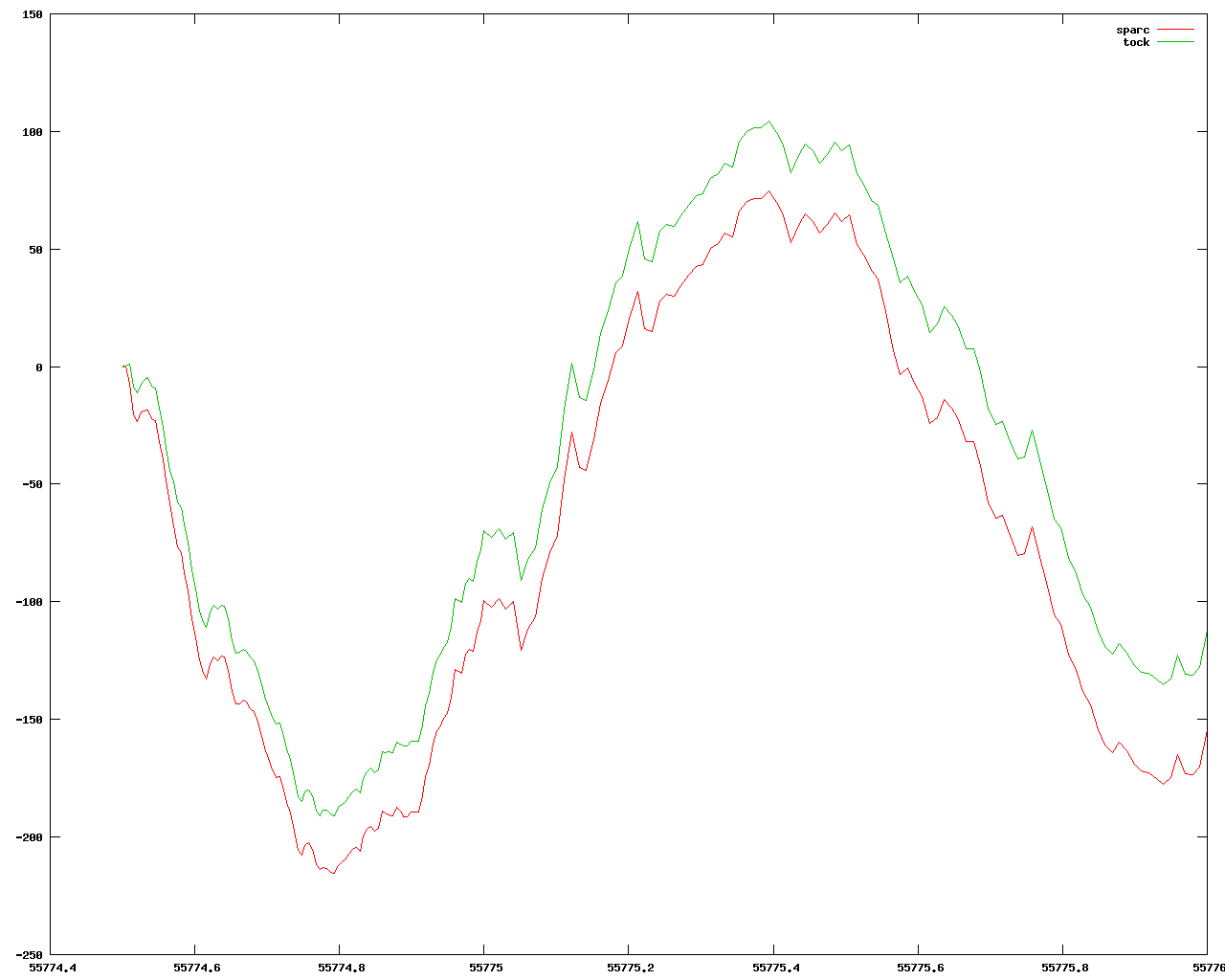
     They track because most of Arkansas is part of the Eastern Interconnection
and the transmission systems are tied together through that.  The general shape
follows the loading of the system; that is, as the load increases throughout
the day the alternators slip behind; as it decreases they advance.  They try to
keep the system frequency accurate to +/- 0.02 Hz. but that integrates out to a
worst case of 72 cycles slip or advance/hour.  PNNL has developed the Grid
Friendly Grid Monitor software and you can use that to watch the frequency and
accumulated phase error of the Western Interconnection.
     Here in New Orleans a friend in the power company who was interested in
its history told me a story.  In the very early days, frequency control was
pretty poor and it was hard to keep up with the changing load. So by 5 PM every
day, every electric clock in the city was 10 or 15 minutes slow.  So overnight
they'd speed up the system and so by 8 AM the next morning every electric clock
would be 10 or 15 minutes fast because the total slip during the day was 20 or
30 minutes.  Today we'd consider that absolutely unacceptable (even for
non-Time Nuts), but back then it just was.

     Still, elimination of TEC is idiotic.  I had occasion recently to talk to
a couple of very high-level power systems people and they thought it was crazy
as well.  Like elimination of leap seconds, we'll just have to see.

          Francis


>Message: 7
>Date: Tue, 02 Aug 2011 21:18:17 -0500
>From: Scott Newell <[email protected]>
>To: [email protected]
>Subject: [time-nuts] Weird TEC data
>Message-ID: <[email protected]>
>Content-Type: text/plain; charset="us-ascii"; format=flowed
>
>Here's the latest plot from my TEC test rigs.  Y-axis is phase error
>(in 60 Hz cycles), X-axis is time in MJD.  The plot starts at 7AM local time.
>
>http://n5tnl.com/tec/tec_test_01.png
>
>Same serial connected embedded hardware, timestamped on the receipt
>of first character.  One machine (red line) is a Sun running debian,
>the other (green line) is a Dell PC, also running debian.  Both
>running ntp, of course.  One is located in a fairly large city (by
>Arkansas standards!), the other is out in a small country
>town.  Different utility providers.
>
>The general shape and bumps in the plots track nicely, but I'm
>wondering why there's so many cycles difference after 36 hours.
>
>Comments?

_______________________________________________
time-nuts mailing list -- [email protected]
To unsubscribe, go to https://www.febo.com/cgi-bin/mailman/listinfo/time-nuts
and follow the instructions there.