On Sun, Apr 07, 2013 at 11:27:23AM +0100, Alexander Wright wrote:
> On 07/04/13 05:01, WB6BNQ wrote:
>> Hi Alec,
>> You may be in luck.  However, I would need some additional pictures,
>> particularly
>> of the connector on the bottom, also some of the inside.


> Bill,

> Thanks for your reply! Here are some photos of the inside:
> http://m0tei.co.uk/fe5650pics/

> You'll see that it comes with a custom machined plate screwed
> onto the front - this was how it was mounted in the thing i
> pulled it out of. It can be removed but i found it easier to
> take the thing apart with it on. A thermostatic switch used to
> bolt onto it to (presumably) act as a thermal cutout.

The baseplate (2xLM2941, LP2952) basically is the power
supply/regulation, so nothing interesting there.

> You'll also notice that the boards we're probably interested
> in are potted it some sort of white compound - it's hard but
> crumbly - feels like some sort of polymer foam. I've started
> to pick it off a bit but could you just confirm that this is
> actually a sensible thing to do before I go all out scraping
> it off?

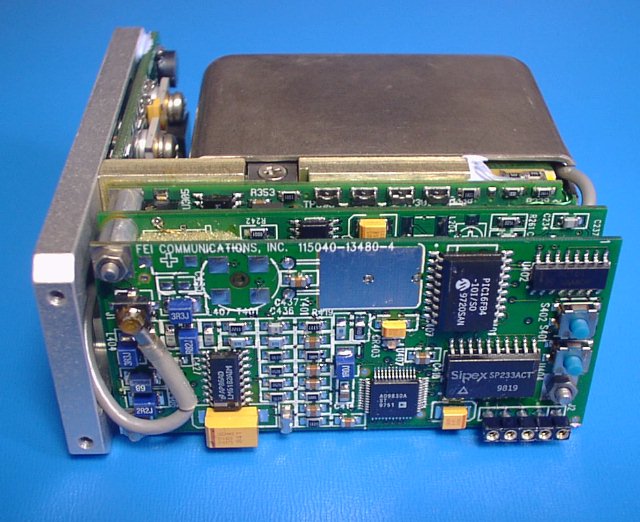
The purpose of the polymer foam is isolation to keep a
stable temperature throughout the boards.

http://www.qsl.net/z/zl1bpu/PROJ/FE5650-2.jpg

The top layer in this image is the DDS board, and it is
basically identical to the FE5680A, which means it can
be adjusted in a wide range, but only does digital synthesis
based on the reference frequency.

But let's see what Bill says to the pictures ... :)

best,
Herbert

> Thanks!

>> The primary physics package is a stand alone analog Rubidium frequency
>> standard

>> that outputs 50.255* MHz frequency.  That signal is used to drive various
>> output
>> board configurations, included inside the unit, to provide a customer
>> required
>> output frequency.  The more recent revised units (they look the same) use
>> a new
>> digital scheme that is much more of a hassle.


> This unit is probably from late 1996/1997 if that helps?

>> The one that I and a number of people are familiar with is the
>> 5650-option-58
>> model whose output was a 1pps.  To get the 1pps the 50.255+ MHz signal was
>> used
>> to drive a Direct Digital Synthesizer (DDS) that produced 8.3+ MHz signal
>> that
>> was then divided down via normal TTL dividers to produce the 1pps.  The
>> DDS is
>> capable of being changed to other frequencies up to about 20 MHz, however,
>> the
>> filter following the DDS needs to be changed or bypassed to properly
>> filter the
>> new frequency.  Bypassing is the easiest method but would require using an
>> external filter to get rid of aliasing and spurs.

>> I put together a zip file of various information on FEI-5650-option 58
>> that will
>> help you get familiar with the family line.  If you have problems with the
>> link
>> let me know.  Also, after you get a successful download let me know so I
>> can
>> reduce the FTP storage level, thank you.

>> http://pages.suddenlink.net/stevewingate/cryptic1/for alec on
>> 5650-option-58.zip

>> Bill....WB6BNQ


> Awesome, looks like there's some great info there! Unfortunately i'm not
> sure hoe relevant it is to mine since my option doesn't seem to do RS232....


> On 07/04/13 04:17, Herbert Poetzl wrote:

>> Open it up, take some nice pictures of the circuit boards
>> and components and I can probably tell you what might be
>> possible (after looking at them :).


> Thanks Herbert! Pictures above^

>>> As far as i'm aware this model doesn't have serial control.

>> best,
>> Herbert


> Best regards,
> Alec


> _______________________________________________
> time-nuts mailing list -- [email protected]
> To unsubscribe, go to
> https://www.febo.com/cgi-bin/mailman/listinfo/time-nuts
> and follow the instructions there.
_______________________________________________
time-nuts mailing list -- [email protected]
To unsubscribe, go to https://www.febo.com/cgi-bin/mailman/listinfo/time-nuts
and follow the instructions there.