hi tom,
thank you very much! that is quite interesting. i am happy to learn that
there is nothing wrong with *my* counter! converting the non-linearity
effect into a correction table is beyond my abilities, but simply
knowing that this effect is inherent to the 53132a counter helps a lot.
indeed, my plots look similar to yours. after only three hours of
warming up i measured the TI of an HP 10811 against the 1 pps output of
my fury. the 10 mhz output of the fury was used as the external timebase
of the counter.
the raw data of one hour measuring. average period of cycle wraps is 93.3 s:
https://farm8.staticflickr.com/7314/14076566541_79094d6850_o.png

steps and drift removed (detail):
https://farm8.staticflickr.com/7348/14079753105_f8ac97766d_o.png

autocorrelated. the average distance between two peaks is 94.6 s:
https://farm6.staticflickr.com/5518/14056659576_703b446cc2_o.png
as expected, the pattern is also visible in the ADEV plot (overlapping,
all tau):
https://farm8.staticflickr.com/7382/14079754735_62d70d1480_o.png

and even better a few hours later (shorter period of cycle wraps):
https://farm8.staticflickr.com/7042/14079754345_b4b6f9afb8_o.png

but almost invisible in the "standard" ADEV plot:
https://farm6.staticflickr.com/5474/13893141107_5aa39eb199_o.png

hans


Hi Hans,

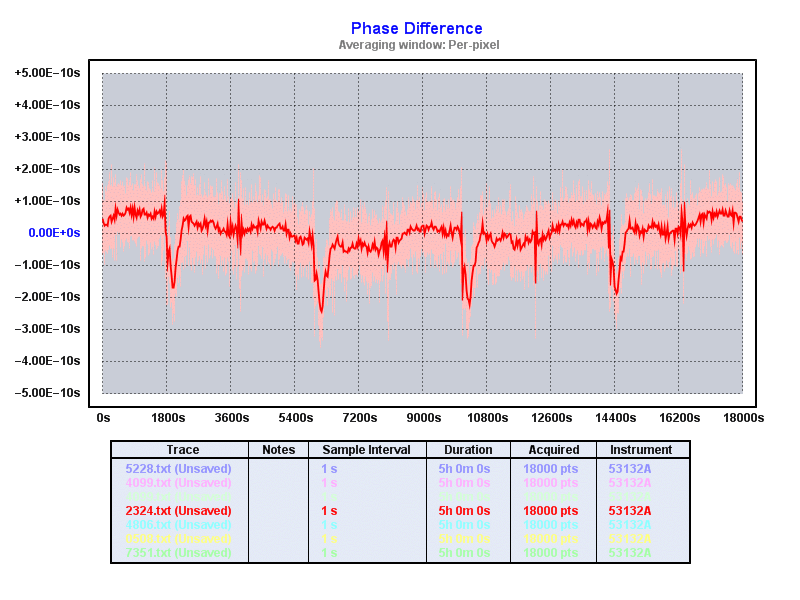
See if your plots look like approximately like these:
http://leapsecond.com/pages/53132/2324.gif
http://leapsecond.com/pages/53132/4099.gif

I did this as part of a week-long 51132A TIC resolution and linearity test.
I believe this is evidence of interpolator non-linearity within the
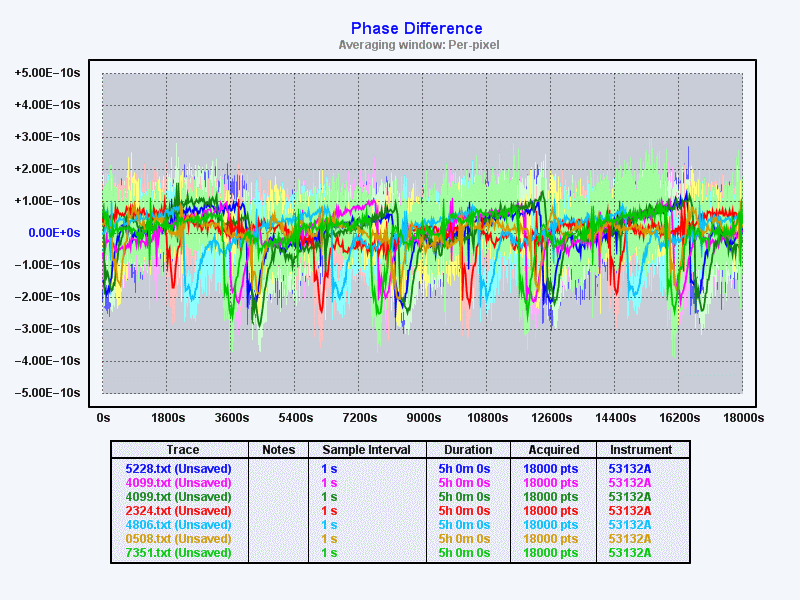
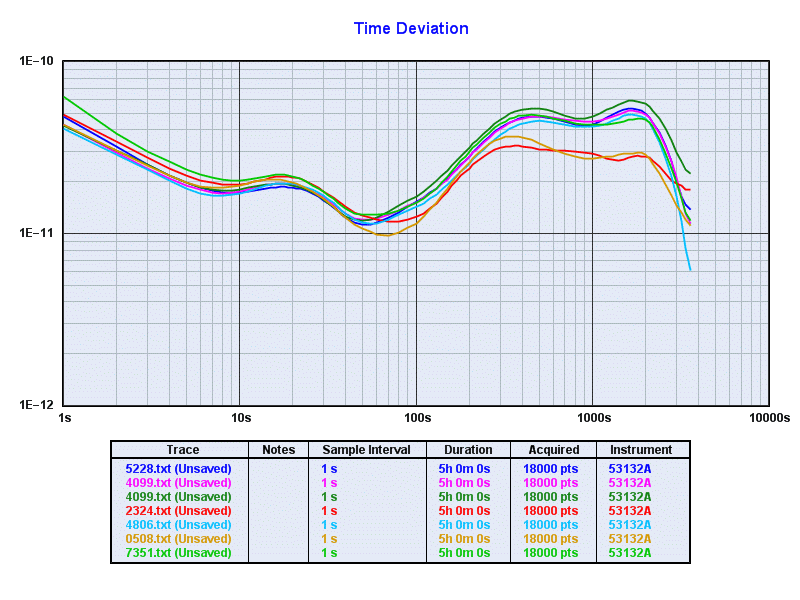
53132 counter. It happens on each 53132 counter I tested although each
has its own unique pattern. See, for example:
http://leapsecond.com/pages/53132/all7-phase.gif
http://leapsecond.com/pages/53132/all7-tdev.gif
There may be input signal conditioning, cross-talk, and DUT pulling
effects too. I haven't sorted it all out yet.
Note the counters all meet spec. But under the spec is this very
interesting world of interpolator non-linearity. It is exposed any time
you very slowly ramp through the interpolator range, or if you apply
pure noise and look at the distribution of all the bin's (histogram). So
these subtle, periodic effects are expected in any interpolator design,
but it is cool to actually see and measure it.
If they are consistent for a particular counter you can convert these
"calibration" measurements into a correction table and thus improve the
resolution of all subsequent time interval readings. The SR620 does this
with an EEPROM table.
In my test I compared two 5 MHz oscillators that were about 5e-11 apart
in frequency. That way it took about 4000 seconds to complete one 200 ns
cycle wrap. Collect data for a day and you have a nice series of
waveforms. I see both 100 ns periods (due to the 10 MHz 53132 clock) and
200 ns periods (due to the 5 MHz DUT).
Avoiding cycle wraps with dividers doesn't really solve the problem.
Also, it's not always practical to continuously sit in a small fraction
of the full interpolator cycle. One solution is applying interpolator
calibration, as mentioned above. But the solution I use is exactly
opposite of your intuition -- for best resolution I welcome as many
cycle wraps as possible. This is especially effective if you compute
phase slope (frequency offset) with a least squares fit, instead of
point-to-point.
/tvb
_______________________________________________
time-nuts mailing list -- [email protected]
To unsubscribe, go to https://www.febo.com/cgi-bin/mailman/listinfo/time-nuts
and follow the instructions there.