Dear Bob,

The capacitors are 47n NP0/C0G types (Kemet C0805C473K3GAC7800), picked for
low tempco (and low DF and other non-ideal behavior). I've not spotted any
hysteresis artefacts in these in previous designs, but I haven't measured
their performance in this circuit.
Forgot to mention in the previous message: the baluns are transformers
(M/A-COM MABAES0060), so the only DC the ADC should see is its own input
offset (plus offset current across the 25R input filter resistors). Full
schematic is here ( http://www.lartmaker.nl/time-nuts/DMTD_rev0.99.pdf ;
needs cleanup, but all connections are there).

JDB.

On Sun, Feb 23, 2020 at 10:13 PM Bob kb8tq <[email protected]> wrote:

> Hi
>
> What does the temperature coefficient of your “hardware HPF” filter caps
> look like?
> Are they a type that has significant hysteresis?
>
> Bob
>
> > On Feb 23, 2020, at 3:05 PM, Jan-Derk Bakker via time-nuts <
> [email protected]> wrote:
> >
> > Dear Attila,
> >
> > Thanks for the heads up.
> >
> > I am currently using a HPF both in hardware (capacitive coupling into the
> > balun driving the ADC inputs) and in software before the ZCD. This should
> > counteract the first-order effects of this offset, although second-order
> > effects (converter nonlinearity et al) will of course still be an issue.
> > The plots you've quoted include (different kinds of) DC offset correction
> > for all but the "unfiltered" data; getting an efficient DC offset
> > correction working in real time on this 8-bit platform was indeed one of
> > the main challenges of the software-only approach.
> >
> > The FPGA daughterboard is currently in production at Eurocircuits; I hope
> > to have time to work on those the coming month. I'll also try to book
> some
> > time in our climate chamber. (I've had one of our GPSDO-designs running
> in
> > our general labs since before Christmas; surrounding it with bottles of
> > water works well enough to low pass filter temperature swings, but I
> still
> > see 6 degrees C swings overnight as out HVAC only runs during business
> > hours.)
> >
> > To be continued,
> >
> > JDB.
> >
> > On Sun, Feb 23, 2020 at 8:11 PM Attila Kinali via time-nuts <
> > [email protected]> wrote:
> >
> >> Good evening!
> >>
> >> I'm going through some old stuff...
> >>
> >>
> >> On Wed, 27 Nov 2019 00:29:19 +0100
> >> Jan-Derk Bakker <[email protected]> wrote:
> >>
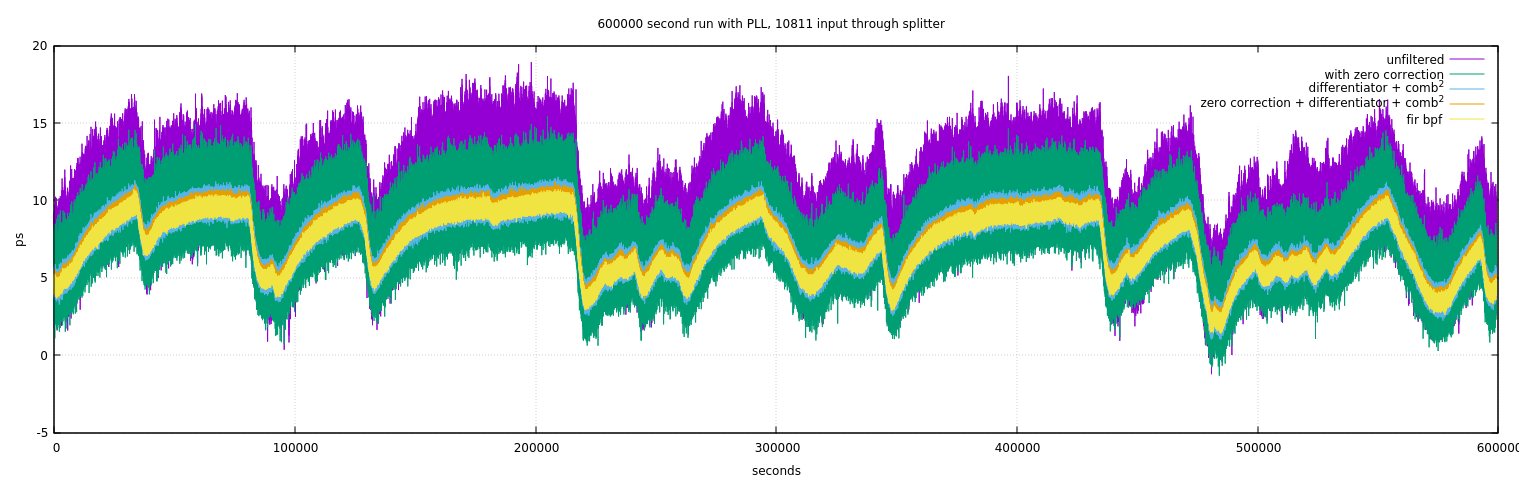
> >>> This has yielded a combined "simple" signal
> >>> processing path of a differentiator, a double comb filter and the
> offset
> >>> estimator, which is getting very close in performance to the "ideal"
> band
> >>> pass filter (OADEV of 3.77e-13@tau=1s versus 3.25e-13@tau=1s for the
> >> BPF;
> >>> full plot:
> >>>
> >>
> http://www.lartmaker.nl/time-nuts/DMTD%20self-noise%20OADEV%20with%20PLL%20and%20various%20filters.pdf
> >>> for this 600000-second recording:
> >>>
> >>
> http://www.lartmaker.nl/time-nuts/600ksec%20run%20with%20PLL,%2010811%20through%20splitter.png
> >>> . OADEV past ~1000sec is severely compromised by the fact that the
> >>> measurement setup is in my home lab which sees temperature swings of up
> >> to
> >>> 20 degrees C and which does get bumped from time to time. Longer runs
> in
> >> a
> >>> more controlled setting forthcoming).
> >>
> >>
> >> I can offer an explanation for the large effect of the zero correction
> seen
> >> here. The LTC2140 is specified to have a +/-10µV/°C drift (at 1Vpp
> >> setting).
> >> Converted into phase error due to zero crossing shift, this turns into
> >> a phase shift of +/-1ps/°C @ 10MHz. Note, the shift is given as +/- and
> >> per channel, which means, it could very well be that the channels are
> >> not matched in their temperature characteristics and thus the total
> phase
> >> shift could be +/-2ps/°C ... though total shift being closer to
> 0.5ps/°C is
> >> more likely.
> >>
> >> Summa sumarum: DC offset correction is important if a zero crossing
> >> detector is used.
> >>
> >>                                Attila Kinali
> >>
> >> --
> >> <JaberWorky>    The bad part of Zurich is where the degenerates
> >>                throw DARK chocolate at you.
> >>
> >> _______________________________________________
> >> time-nuts mailing list -- [email protected]
> >> To unsubscribe, go to
> >> http://lists.febo.com/mailman/listinfo/time-nuts_lists.febo.com
> >> and follow the instructions there.
> >>
> > _______________________________________________
> > time-nuts mailing list -- [email protected]
> > To unsubscribe, go to
> http://lists.febo.com/mailman/listinfo/time-nuts_lists.febo.com
> > and follow the instructions there.
>
>
_______________________________________________
time-nuts mailing list -- [email protected]
To unsubscribe, go to
http://lists.febo.com/mailman/listinfo/time-nuts_lists.febo.com
and follow the instructions there.