Hi
> On Mar 19, 2020, at 3:32 PM, Tobias Pluess <[email protected]> wrote:
>
> Dear colleagues,
> as you may remember I am still working on my own GPSDO project.
> So far I have populated all the components on the PCBs I made, and I have
> written some very basic software to test everything. Currently, I am
> running following simple test:
> I set my DAC to a constant value (5 Volts at the EFC input of the OCXO),
> and then I send the phase measurement to the PC via RS-232 where I can log
> it. More on that later.
> Here is my schematic (not much has changed since last time):
>
> https://hb9fsx.ch/files/gpsdo/gpsdo_schematic.pdf
>
> The GPS phase detection happens on page 3. I use the TDC7200 as
> interpolator.
> Inside the STM32 microcontroller, I let a timer run with the 10MHz clock.
> The timer overflows to 0 when it reaches the value 9999999.
> Further, the 1PPS pulse from my GPS module triggers the interpolator, and
> is delayed by max. 2 clock cycles. The delayed signal stops the
> interpolator and is used as a capture event of the timer.
> So, when the OCXO has the right frequency, the captured value would always
> be the same. To determine the phase, I use the following code:
>
> if(captured value >= 5000000)
>    phase = 10000000 - captured value;
> else
>    phase = -captured value;
>
> with the aid of this bit of code, my phase value is always perfectly in the
> interval -5000000 to +5000000. My test today was to let the OCXO run with a
> fixed voltage at its EFC input, while I recorded the resulting phase data.
> My recorded data is here:
>
> https://hb9fsx.ch/files/gpsdo/phase.txt
>
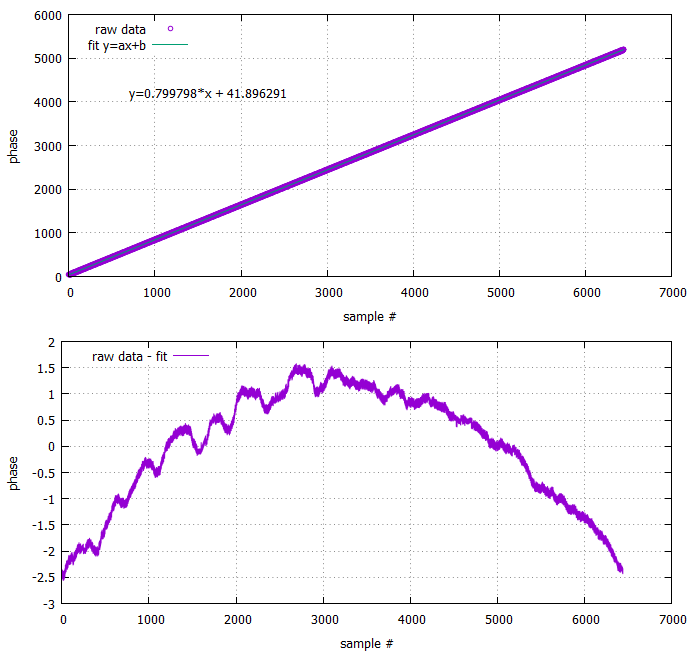
> Now I made two plots (here: https://hb9fsx.ch/files/gpsdo/phase.png). The
> upper is the raw phase data, and I also fitted a linear function to it
> (i.e. if the OCXO has a constant frequency but has some offset from 10 MHz,
> the phase would drift linear into one direction - at least I expect it to
> do so).
> The lower plot is what results when I subtract my linear fitted function
> from the measured phase. I am wondering whether this makes some sense? One
> can see some wiggles and ripple, especially between sampel 0 and 3000. Is
> this the GPS jitter I see there?
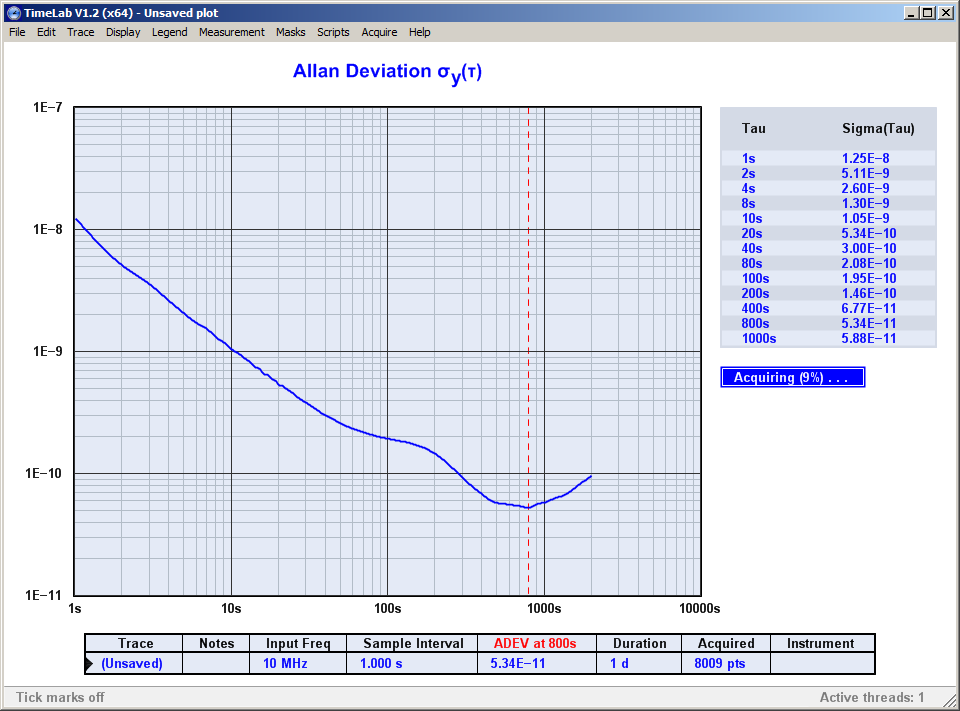
> Further, I also imported this phase data into Timelab and determined the
> ADEV. Here is my plot:
>
> https://hb9fsx.ch/files/gpsdo/timelab.png
>
> This trace is kind of what I expect, but since I use a OSA/UCT 8663 double
> oven OCXO, I would have expected it to be much lower. Something in the
> 1e-12 regime perhaps? is that realistic? As one can see at tau=800s, the
> ADEV is around 5e-11, so is this really all I can expect from this very
> sophisticated OCXO? (However I should maybe add that the OCXO is brand-new
> and has never been used before, so maybe it has some initial aging?).
> I have no plots about the temperature, but this is quite constant.
> For the GPS module, I used an active outdoor antenna at the window ledge.
> Not optimal, but better than an indoor desktop antenna, I guess.

That all looks like the raw / uncorrected for sawtooth output of a GPS module.

Bob


>
> Is this some plausible data I have here, or do I measure complete crap?
>
> It would also be great if someone would look at my code. Maybe I am doing
> something wrong when I read out the TDC7200?
> The code is here https://hb9fsx.ch/files/gpsdo/code/  and the most
> important function is perhaps get_tic().
>
> I am looking forward to any good hints on this! :-)
> best
> Tobias
> HB9FSX
> _______________________________________________
> time-nuts mailing list -- [email protected]
> To unsubscribe, go to
> http://lists.febo.com/mailman/listinfo/time-nuts_lists.febo.com
> and follow the instructions there.


_______________________________________________
time-nuts mailing list -- [email protected]
To unsubscribe, go to
http://lists.febo.com/mailman/listinfo/time-nuts_lists.febo.com
and follow the instructions there.